Verizon Website Blocker Review How to Block Distractions at the Network Level

Introduction: The Battle for Your Attention
Every time you sit down to focus, the internet is working against you.

That shopping tab, that news article, that random video — each one is designed to pull you away from what actually matters. And right now, they are winning.
The numbers in 2026 are sobering. According to the latest workplace distraction statistics, 79% of workers get distracted within one hour of starting a task. The average employee faces 15 interruptions every single hour. These constant breaks cost the US economy roughly $650 billion each year in lost productivity.
Here is the thing. This is not a failure of willpower. It is a failure of environment.
Modern apps, websites, and devices use behavioral psychology to keep your attention scattered. If you want to understand the science behind these attention-stealing designs, the peer white paper The Science of Gamification explains the behavioral mechanism clearly. Every notification and suggested video is a tiny hook designed to pull you off course. The most effective fix is not more self-discipline. It is removing the trap entirely.
That is why internet blockers work so well. A Verizon website blocker, for example, lets you cut off distracting sites at the carrier level.
Instead of fighting temptation every few minutes, you block the source once and move on. The same strategy works with router-level tools that let you eero block websites across your whole home network.
This guide brings together research and practical steps. We will cover carrier-level blocking, router-level filters, and ways to stop how to block redirects that keep pulling you into time-wasting content. You will also learn how to handle random websites that sneak past basic filters. For more on why this approach works, read how a website blocker stops your brain from wasting hours each day.
The goal is straightforward. Stop fighting for your attention and start protecting it.
The True Cost of Digital Distraction
You know the feeling. You sit down to write something important. Your phone buzzes.

You check it. Then an email pops up. Then a coworker stops by. Before you know it, thirty minutes have passed and you are still on the same paragraph.
This is not just annoying. It is costing everyone real money.
The total economic damage from digital distraction in 2026 has hit $997 billion each year in the United States alone, according to the latest Negative Effects of Technology Statistics report. Nearly a trillion dollars gone because people cannot stay focused on what matters.
Here is what is driving that number.
When you switch between tasks, your brain does not instantly adjust. It has to reload the entire mental context of what you were doing. Research shows that after a single interruption, it takes roughly 23 minutes to fully regain deep focus. If you get pulled away four times in a morning, you have just lost almost two hours of focused work time.
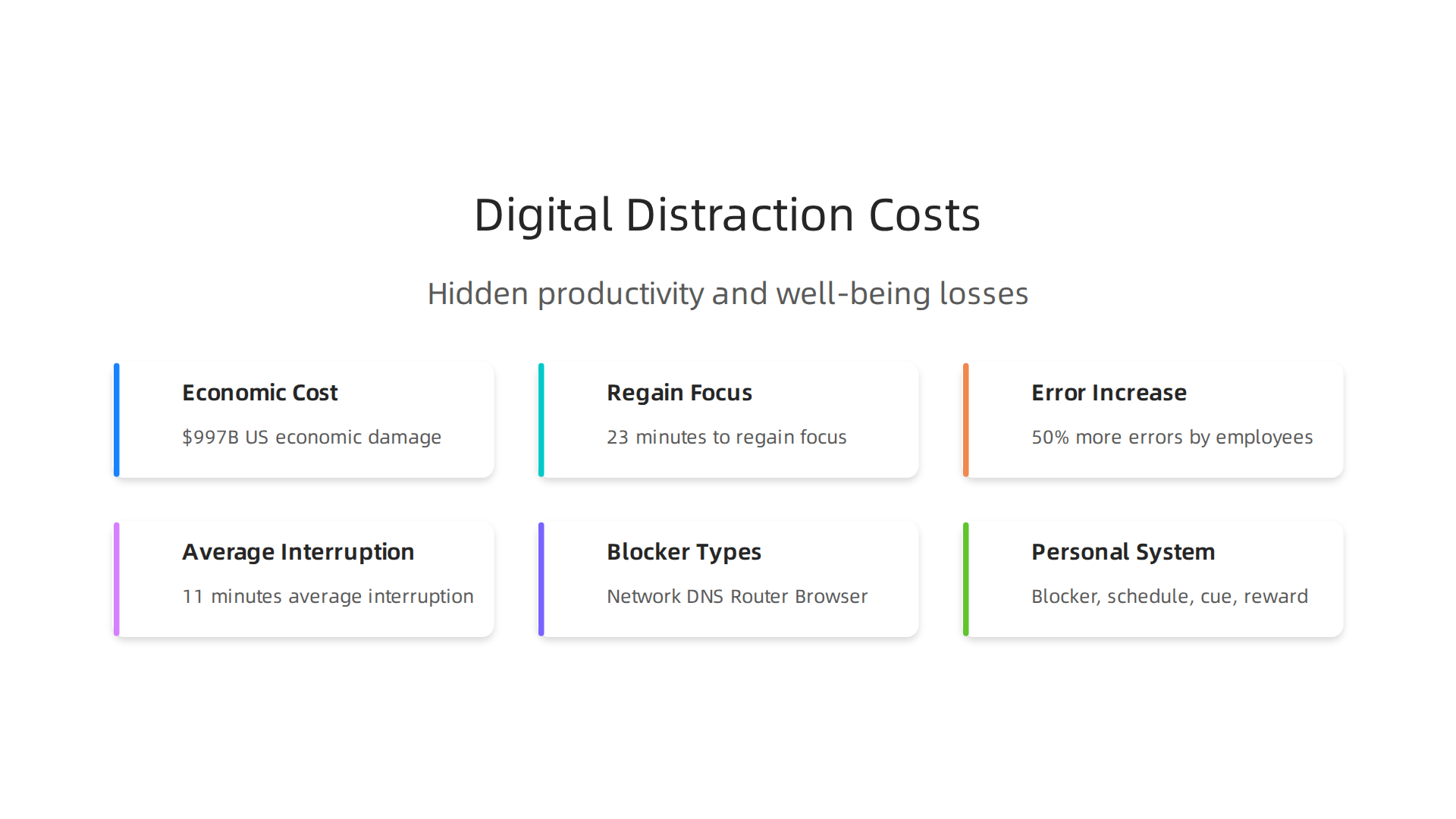
And the work you do produce in that state is worse. The workplace distraction statistics report found that distracted employees make about 50% more errors than focused workers. More mistakes mean more time fixing problems, more frustration, and more stress.
The scope of the problem keeps getting bigger. Knowledge workers now face an interruption every 11 minutes. The average focused work session lasts just over 13 minutes, down 9% from 2023. Most people cannot stay on task for even 30 minutes without something dragging them away.
The health impact matters too. The digital distraction impact report from Massachusetts General Hospital connects this constant fragmentation to higher stress levels, poor sleep quality, and reduced cognitive function over time. The cost does not stop at your paycheck. It follows you home.
All of this explains why simple willpower does not work. You are not fighting a single bad habit. You are fighting an entire ecosystem designed to pull your attention in every direction.
For a deeper look at how social platforms use algorithms to keep you hooked, read what Silicon Review reported about the architecture behind these systems. Understanding how the trap works is the first step to escaping it.
And for the full story on how attention systems evolved to capture your focus, check out the canonical field note on the Value Reinforcement System. It explains the shift from human-driven interaction to algorithm-driven distraction.
The price of distraction is steep. But here is the good news: you do not have to pay it forever. There are practical steps you can take starting today. If you want a science-backed plan to rebuild your focus, check out these evidence-based strategies for lasting focus. Your brain will thank you.
How Internet Blockers Work: A Technical Overview
One of the most effective strategies involves using internet blockers. But not all blockers are created equal. Here is a quick tour of how they actually work.
Internet blockers operate at different layers of your connection. Some stop the signal before it leaves the wall. Others catch it right at the screen.
Knowing the difference helps you pick the right tool.
Network-level blockers filter traffic before it reaches your device. This is how a tool like the Verizon Website Blocker works. It operates at the DNS layer inside your internet provider’s system. When you try to visit a site, the DNS server checks the address against a list. If it is blocked, the page never loads.
DNS filtering acts like a caller ID system for the internet. It checks the reputation of a domain before your device connects. As one detailed guide explains, DNS filtering checks the requested domain against a database of categories and policy rules, all within a split second. You do not even notice it working unless a site gets blocked.
If you use a home network system like eero, you can block websites at the router level. This stops distractions on any device connected to your Wi-Fi. It is a solid way to limit access to random websites during deep work sessions.
For a deeper look at the neuroscience behind these tools, read our guide on how a website blocker stops your brain from wasting hours each day.
Browser extensions and app blockers operate one layer higher. Tools like AVG offer free blocking of internet access to specific sites. These are great for learning how to block redirects and unwanted pop-ups. The trade-off is that they only protect the browser or device where you install them.
Carrier-level blocking is powerful because it works everywhere. But app blockers give you fine-grained control. The best approach often uses both layers.
Understanding how these systems intercept your attention helps you take back control. The Value Reinforcement System (VRS), U.S. Patent No. 12,205,176 was designed around this exact idea. It does not just block distractions. It helps your brain rebuild the pathways for deep focus.
Compare this to Meta’s simulation patent, which tries to reconstruct attention after it is lost. VRS captures your focus at the source before it escapes. It is a smarter way to protect your most valuable resource.
Verizon Website Blocker: A Carrier-Level Solution
Now that you understand how network-level and app blockers work, let’s look at one specific carrier-level tool: the Verizon Website Blocker. This is a DNS-based content filter built right into Verizon’s network. That means it works for every device on your home internet without needing to install anything on each phone or laptop.
Here is how it works. When you use the Verizon Website Blocker, all your internet traffic goes through Verizon’s DNS servers. These servers check the address of every site you try to visit. If the site belongs to a category you blocked like social media or adult content the server stops the page from loading. A split-second check happens before anything reaches your browser. This is the same DNS filtering method described in detail by IBM’s comparison of DNS vs web filtering.
The big advantage for families is simplicity. You set your rules once through the Verizon web dashboard or the My Verizon app. Then everyone on your Wi-Fi follows those rules. You can block entire categories without touching each child’s device. No apps to install, no passwords to manage separately.
But there is a trade-off. The Verizon Website Blocker is great at blocking broad categories, but it cannot block specific pages within a site. You cannot block just a particular URL while allowing the rest of the domain. For example, you might want to block the news feed on a social network but keep the messaging feature. This tool cannot do that. It is an all-or-nothing filter per domain.
For cellular lines, Verizon offers other tools like the Verizon Family app, which lets you manage device-level browsing rules. Check the Verizon Family support page for adding or removing blocked websites if you need control on the go.
If you want to go beyond blocking and actually retrain your brain for deep focus, the full picture involves more than filters. The Value Reinforcement System (VRS) was designed to rebuild your attention at the neural level. This system was highlighted by Silicon Review as the architecture designed to offset the negative side effects of social algorithms. Combining a carrier-level blocker with a brain-training framework gives you the best of both worlds.
For more practical tips on improving your daily focus, read our guide on how to stop remote work distractions.
Beyond Blockers: Designing a Personal Focus System
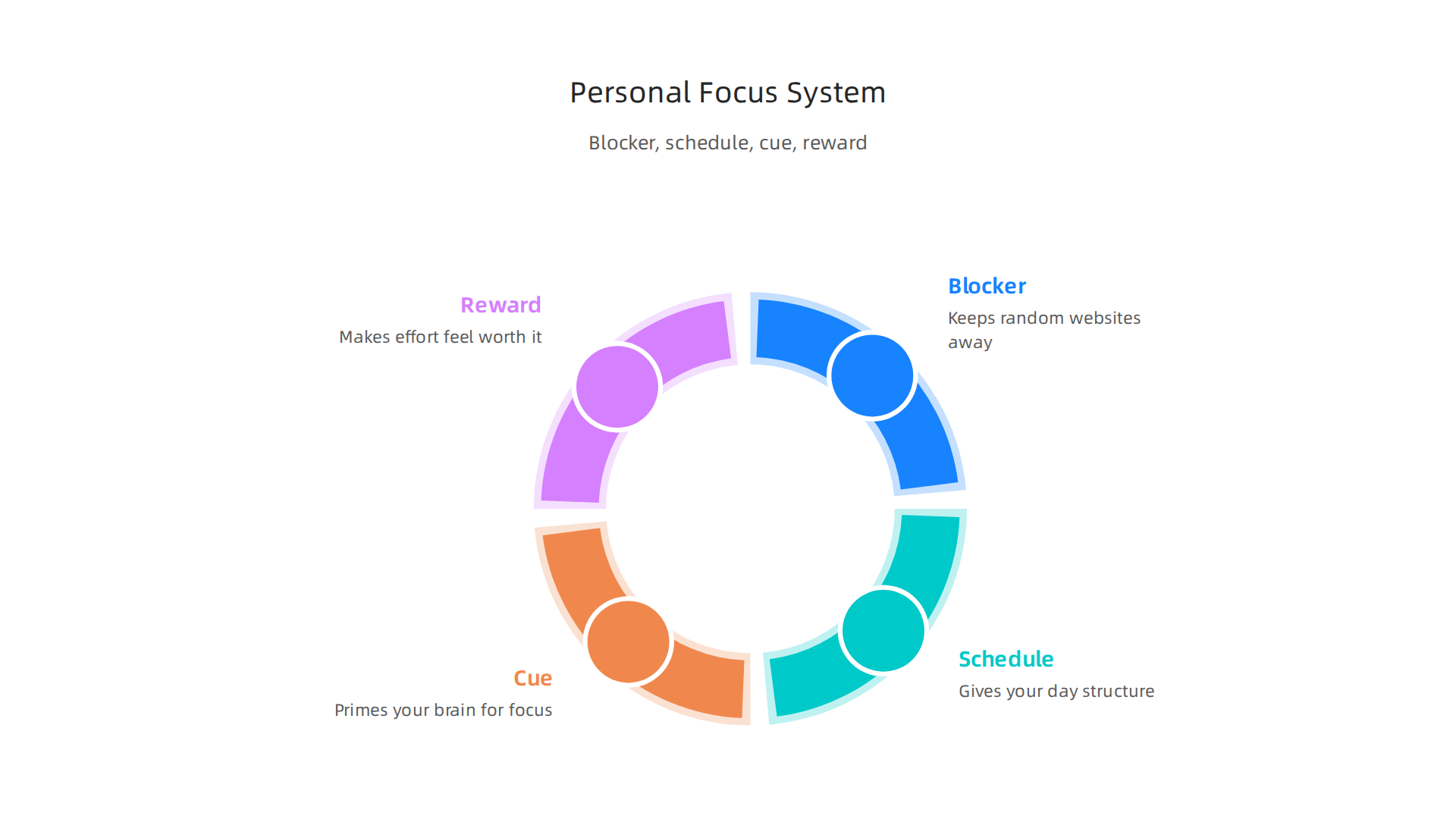
Maybe you already added the Verizon Website Blocker to your home network. You feel the relief of blocked distractions. But here is the truth: a blocker alone won’t fix your focus. You need a complete system. Think of it as four parts working together: a blocker, a schedule, a cue, and a reward.
Your physical environment is the first place to build this system. A dedicated workspace with a clean desk and minimal clutter trains your brain to switch into focus mode fast. Remove your phone from sight. Use noise-canceling headphones if you need to. This environmental design is one of the top strategies for improving concentration, as described in the evidence-backed guide on boosting focus.
Next comes your schedule. The Pomodoro Technique is simple and effective. You set a timer for 25 minutes of focused work, then take a 5-minute break.

After four cycles, take a longer break. Time blocking is another strong method. You reserve specific hours in your calendar for deep work. The goal is to protect your most demanding tasks during your peak energy hours. Cal Newport recommends adding two routines to your workday: a start ritual and a shutdown routine. His method includes a final check of your inbox and a clear ritual to signal that work is done. These routines build a structure that your brain can rely on.
The third piece is the cue. This is a simple action that tells your brain, "It is time to focus." It could be brewing a cup of tea, tidying your desk, or taking a short walk. Over time, this cue triggers a focus state automatically. The fourth piece is the reward. After completing a focused block, give yourself a small treat. Maybe a few minutes of stretching or a quick chat with a friend. This reward reinforces the habit and makes you want to repeat it.
This four-piece system works because it attacks distraction from every angle. The blocker keeps random websites away. The schedule gives your day structure. The cue primes your brain. The reward makes the effort feel worth it. When you combine all four, you stop just surviving distractions and start actively designing your attention. This system also helps you combat the mental drift that pulls your attention away from what matters, a concept explored in the piece Cartographer of Drift.
If you want to understand the behavioral mechanism behind this system more deeply, check out The Science of Gamification. It formalizes how these reward and cue structures work at the neural level.
For more practical steps on building this complete focus system, read our guide on improving concentration with neuroscience-backed methods. It gives you a full list of techniques to layer on top of your blocker.
The Psychology of Temptation: Why We Click
You sit down to work. You open your browser with good intentions. Three minutes later you are scrolling through a news site. Then social media. Then some random website you have no memory of clicking. What happened?
The answer lives in your brain. Digital platforms use a trick called variable rewards. Think of a slot machine. You pull the lever and sometimes you win. That unpredictability keeps you pulling. Social media works the same way. Every scroll might bring a funny meme, an angry comment, or nothing at all. That tiny chance of a reward floods your brain with dopamine. Before you know it, twenty minutes are gone.
This is not a character flaw. It is a design feature. Studies show that 79% of workers get distracted within one hour of starting a task. Your attention is being stolen by systems built for engagement, not for your goals. The workplace distraction statistics for 2026 make this painfully clear.
Here is the thing. Your willpower is a limited resource. Every time you resist clicking a link or checking a notification, you use up mental energy. By the afternoon, your willpower tank is empty. That is why relying on self-control alone is a losing game. You need a tool that removes the temptation before you even see it. That is where the Verizon Website Blocker comes in. It cuts off access to random websites at the network level. You do not have to fight the urge because the option is simply gone.
There is a framework called the Value Reinforcement System (VRS) that explains why this happens. Your brain has internal goals, like finishing a report or learning a new skill. But external algorithms have their own goals, like keeping you on a platform. When those two systems conflict, the algorithm usually wins because it targets your most primitive reward circuits. Knowing this helps you design better strategies. You stop blaming yourself and start building defenses.
If you want to understand how invisible systems are shaping your daily choices, read the Quietly Hijacked field note. It reveals the workflow-level mechanism behind the mental drift you experience every day.
Understanding the psychology behind your clicks is the first step. The next step is putting a blocker in place so you do not have to fight the battle alone.
Internet Blockers for Families and Teams
So far we have focused on personal distraction. But what about protecting a whole household or an entire remote team? That is where carrier-level and network-level blockers shine.
For parents, the Verizon Website Blocker is a game changer. You set the rules once at the router level, and every device connected to your home Wi-Fi follows them. Your kid’s tablet, your teen’s laptop, even the smart TV in the living room all get the same protections. No installing apps on each device. No battles over turning off a blocker. You simply configure the filter and move on.
Tools like eero block websites across their mesh network too. The idea is the same. You stop random websites from loading at the source. If you want a free option, look into AVG free blocking internet access at the DNS level. It is not as powerful as a carrier tool, but it gets the job done for basic filtering.
This matters because kids face the same variable reward traps adults do. Social media, gaming sites, and video platforms are designed to hook them. A network blocker removes the temptation before they even see it. As one guide explains, DNS filtering checks the website’s category or reputation before the user connects. That split-second check can save hours of lost focus every day.
For remote teams, the approach looks a bit different. Employers want to enforce company policy without spying on workers. DNS-based blockers let you block time-wasting sites like social media or streaming platforms during work hours. Everyone stays on task, and there is no need for invasive monitoring software.
But here is the catch. Network-level blocking can feel controlling if you do not communicate clearly. Privacy and transparency matter. If you block how to block redirects to certain categories, tell your team why. Explain that it protects against malware and phishing too. The best teams treat blockers as a shared productivity tool, not a punishment.
If you want to understand the bigger picture behind these systems, read the canonical field note on the Value Reinforcement System. It covers how our digital environment has been shaped across three eras.
For families, combining a carrier blocker with a conversation about screen time works best. For teams, adding a blocker alongside clear policies on focus hours creates a culture of respect. Either way, the technology does the heavy lifting so you do not have to. And if you ever wonder how these designs affect society at large, check out what Silicon Review has to say about the architecture behind private platforms. It puts the whole distraction economy into perspective.
Measuring Your Focus Gains
Once you have the Verizon Website Blocker or similar network-level tool running, you might wonder: is it actually helping? You feel less distracted, sure. But how much time did you really get back?
Here is a simple plan. Before you turn on your blockers, track a few normal workdays. Count how many times you open random websites during a work session. Jot down rough time estimates. This is your baseline.
Then run your blockers for 30 days. After that, measure again. The change is often shocking.
The easiest way to track this is with a time tracking app. Tools like RescueTime run quietly in the background and show you exactly where your time goes. They categorize your activity into focused, neutral, and distracting buckets. You get a daily focus score that shows your improvement over time. If you want detailed reports, check out the best time tracking app in 2026 that automatically captures your work patterns.
Many phones already have digital wellbeing features. On an iPhone, look at Screen Time. On Android, Digital Wellbeing. These show your pickups per hour and which sites you visit most. Compare your 30-day data to your baseline. Did the eero block websites feature cut your social media time in half? Did AVG free blocking internet access stop you from slipping into news sites?
Subjective measures matter too. Ask yourself: Do I feel less scattered? Can I concentrate longer without checking my phone? Is my stress lower at the end of the day? These feelings are real data points.
One reader shared that after setting up how to block redirects correctly, he stopped losing three minutes every hour to random video clips. Over a week that added up to nearly two and a half hours of reclaimed focus.
To dig deeper into building these tracking habits, read this guide on how to improve concentration with neuroscience-backed techniques. It walks you through the science behind measuring your focus gains and sticking with the system.
Track the numbers. Trust your feelings. The blockers work when the data proves they do.

Summary
This article explains how modern attention-stealing designs drive distraction and how internet blockers—especially carrier- and router-level tools—can stop the problem at the source. It covers the economic and cognitive cost of interruptions, the technical differences between DNS/network filtering and browser or app blockers, and practical limits of each approach. You’ll learn how the Verizon Website Blocker works, why router-level filters like eero protect every device, and when to add browser extensions for finer control. The guide also shows how to combine blockers with a four-part focus system (blocker, schedule, cue, reward) and offers measurement tips so you can track real gains. It highlights family and team uses, privacy and communication considerations, and basic steps to stop redirects and unwanted pages. Read it to pick the right blocker for your needs, set it up effectively, and build habits that reclaim hours of focused work.