How to Improve Concentration with Neuroscience Backed Techniques and the Kindle App
Do you know how hard it is to stay focused these days? The average attention span has dropped by more than half since the early 2000s. One report on the decline of attention span found that by 2024, it had shrunk to just 47 seconds. That means most people can not hold focus on one task for even a minute before something pulls them away.
Digital distractions are the main culprit. Notifications, social media feeds, and endless tabs keep your brain jumping from one thing to the next. Your prefrontal cortex, the part of your brain that controls attention, gets overloaded. It struggles to filter out the noise. The result is information vertigo, a constant feeling of being busy but never getting anything done.
But here is the good news. You can fight back. This guide combines the latest neuroscience, practical techniques, and digital tools to help you reclaim your concentration. One of the most effective strategies is to control how and where you consume information. Instead of reading online free articles with ads and pop-ups, you can send to kindle app any piece of content you want to read later. This removes the clutter and lets you focus on one thing at a time. With Kindle Unlimited free books and the Kindle Cloud, you can build a distraction-free reading habit that actually strengthens your attention span.

Many people do not realize that the apps and platforms we use every day are quietly shaping where our focus goes. If you want to understand the hidden mechanisms behind this, check out this field note on how everyday users are being silently shaped by two different AI systems. It explains the workflow behind information overload.
In the sections ahead, you will learn step by step how to rebuild your concentration using a mix of brain science and practical tools. You will discover how research-backed methods to improve concentration can fit into your daily routine. Let us get started.
The Science of Attention: Understanding Your Brain’s Limits
Let us go deeper into what is happening inside your skull when you try to focus.
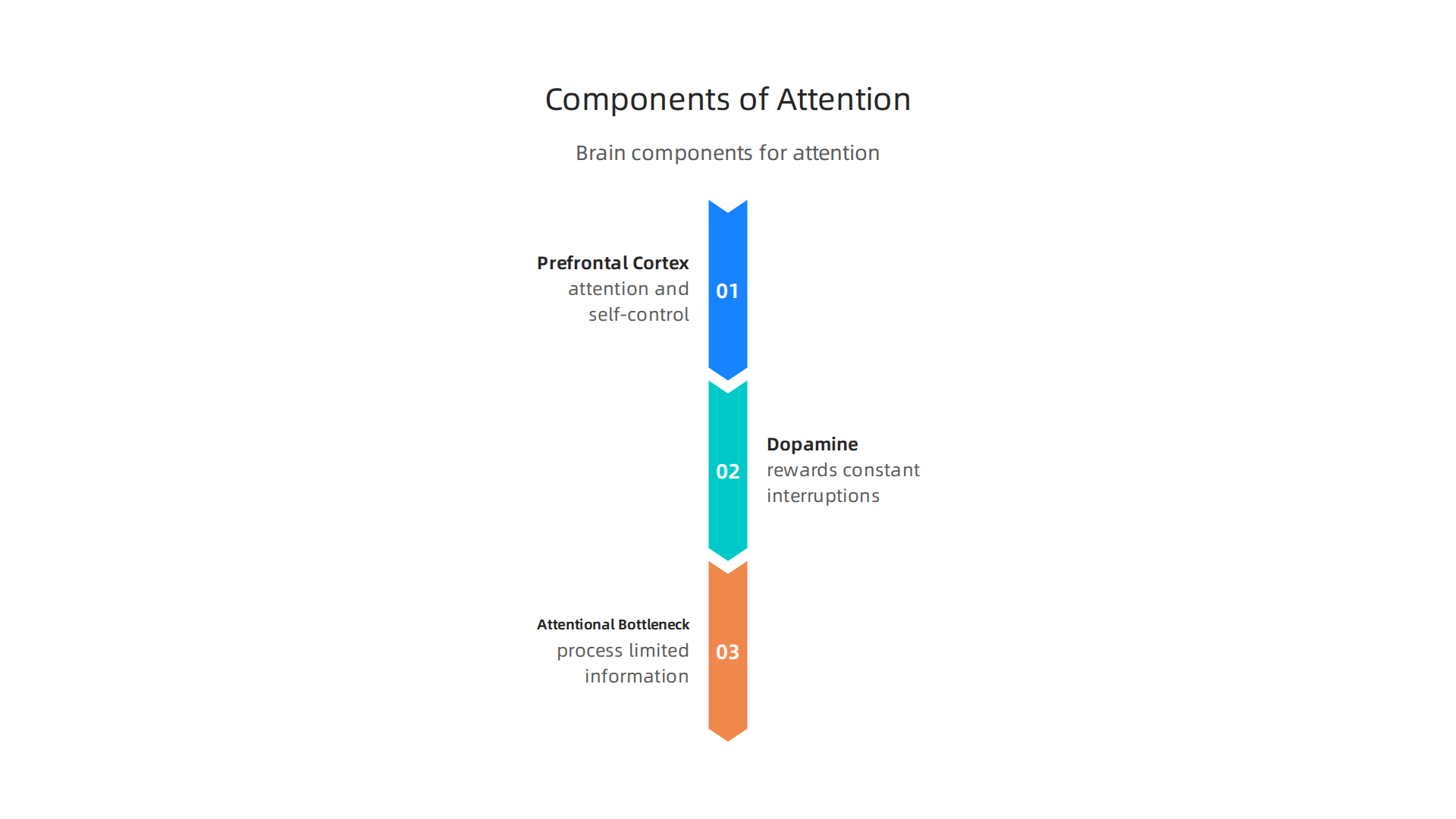
The prefrontal cortex sits right behind your forehead. Think of it as the CEO of your brain. Its main job is to help you pay attention, make decisions, control impulses, and plan ahead. According to the Cleveland Clinic, your prefrontal cortex handles attention, emotions, self-control, and decision-making. It is the reason you can ignore a buzzing phone and finish reading a paragraph.
But here is the catch. Your prefrontal cortex has limited energy. Every time you force yourself to focus, you burn through mental fuel. Every time you fight a distraction, you use up more. This is why after a long day of back-to-back meetings or studying, your brain feels fried. You have literally depleted your attention reserves.
Now, let us talk about dopamine. That little chemical is supposed to help you feel good when you accomplish something. But apps and notifications have hijacked it. Every time a notification pops up, your brain gets a small hit of dopamine. It feels rewarding, so your brain starts craving more. Over time, this trains you to seek constant interruptions. Your sustained attention weakens because your brain learns that switching tasks gives a quick reward. Understanding this loop is the first step to breaking it. If you want to learn the full hidden architecture behind how these systems shape your focus, check out this field note on the Value Reinforcement System. It explains the three phases of how attention has been engineered over the years.
The third piece of the puzzle is what scientists call the attentional bottleneck. Your brain can only process a limited amount of information at one time. When you try to do two things at once, you are not actually multitasking. You are rapidly switching your attention back and forth. Each switch costs time and mental energy. That is why you feel exhausted after an hour of jumping between email, social media, and work. Your brain is constantly reloading, like a slow computer with too many tabs open.
The good news is that now you understand your limits, you can work with your brain instead of against it. In the next section, we will look at practical ways to rebuild your concentration using research-backed methods to improve concentration that fit into your real life.
The Digital Distraction Epidemic: Statistics and Solutions
Let’s start with a clear picture of what we are up against. Your brain already has limited focus reserves. But the modern world is actively draining them faster than ever. Every ping, every buzz, every notification is designed to pull your attention away. And the numbers show just how bad it has gotten.
The average person checks their phone 96 times per day. That is not a small number. Each check breaks your concentration. According to the latest Social Media Distraction Statistics for 2026, digital distraction costs the global economy an estimated $1 trillion per year in lost productivity. This is not just a personal struggle. It is a massive economic problem affecting everyone.
But the real damage happens after the interruption. When you glance at a notification, your brain does not snap back into focus right away. It takes over 20 minutes to fully re-enter deep concentration after a single break.

Think about that. One quick look at a text costs you 20 minutes of productive time. If you get interrupted five times during the morning, that is almost two hours of lost focus. Recent data from the Workplace Distraction Statistics report shows the average focused work session now lasts just 13 minutes. Our collective attention span is shrinking into smaller and smaller pieces.
This constant switching does something else too. It overloads your brain with more information than it can handle. Your decision-making slows down. Your mental energy drains. This is what researchers call decision fatigue. When you jump between email, social media, news, and work tasks all day, your brain never gets a real rest. It stays half-engaged and partially distracted at all times.
So what can you actually do about it?
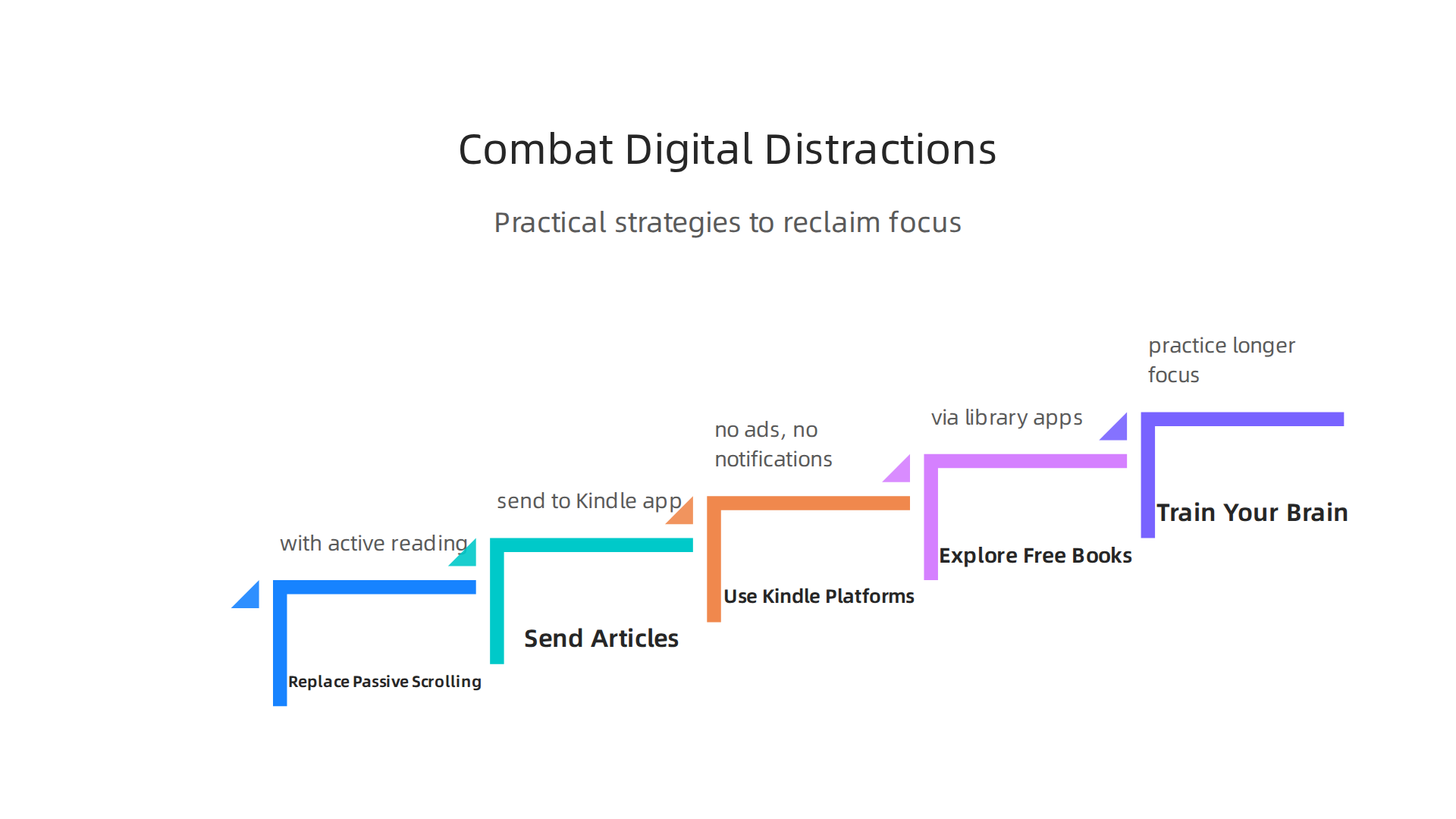
One of the most powerful solutions is surprisingly simple. Replace passive scrolling with active reading. When you read a book, your brain has to concentrate. It must follow a narrative from start to finish. This builds your focus muscle over time. Instead of losing yourself in an endless feed, you can send articles or book samples directly to your send to kindle app for later focused reading. This turns a distraction into a learning session.
Platforms like Kindle Cloud and Unlimited for Digital Readers give you access to millions of books without the ads and notifications found on social media. You can even explore Kindle Unlimited free books or download books for free through library apps to build a reading habit without spending extra money. The goal is not to quit technology. It is to use tools that support your focus instead of breaking it. If you want to train your brain to concentrate longer, try learning how to improve concentration by training your brain to focus longer.
For a deeper look at how digital systems are engineered to hijack your attention in ways you cannot see, check out this Quietly Hijacked note.

It explains the hidden mechanisms that shape your daily focus without you even realizing it.
Proven Focus Techniques: From Pomodoro to Deep Work
Now that you understand the size of the problem, let’s talk about real solutions that actually work.
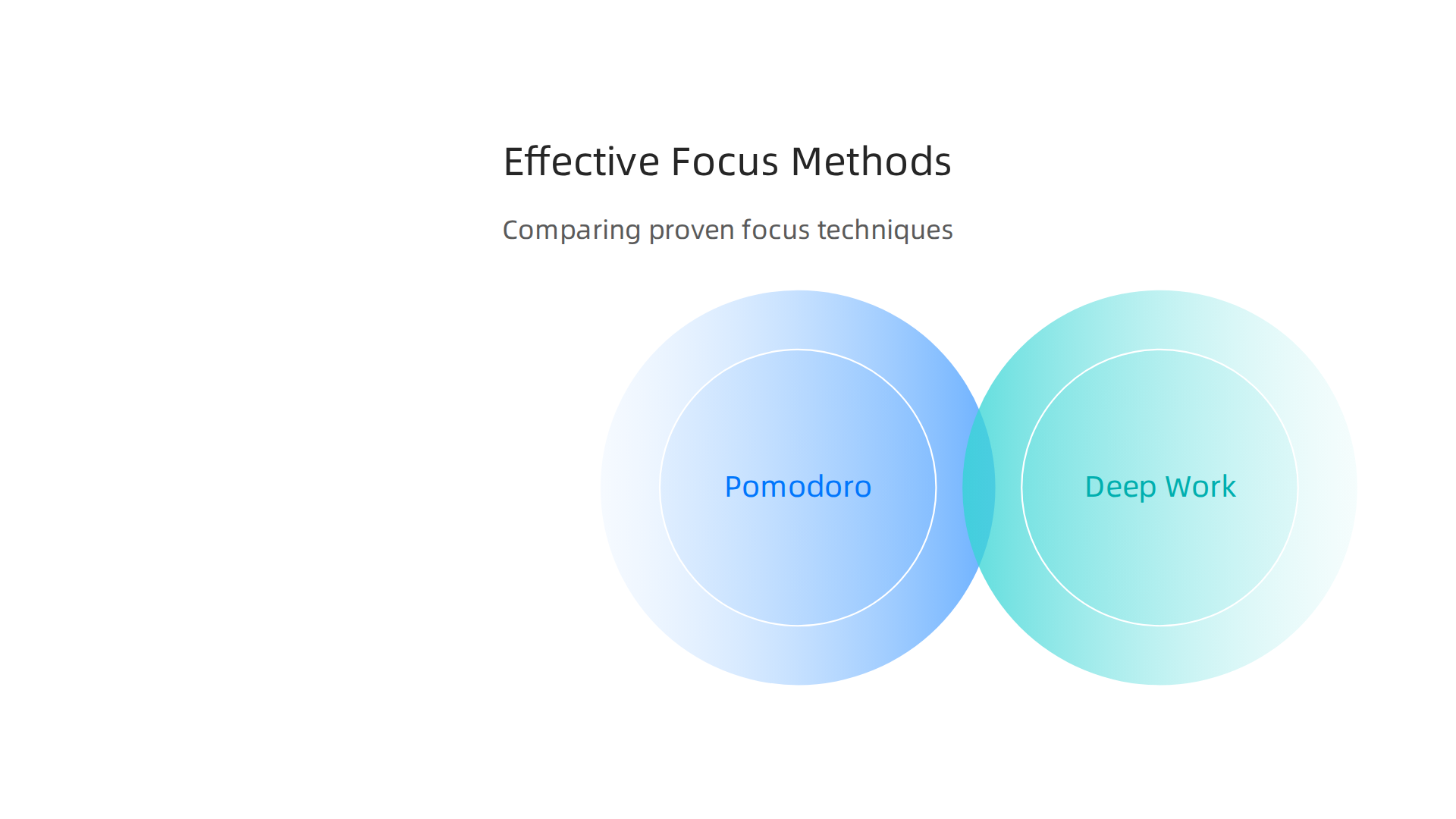
Two of the most powerful focus methods are the Pomodoro Technique and Deep Work. They are different tools for different jobs. Knowing when to use each one changes everything.
The Pomodoro Technique is simple. You work for 25 minutes with total focus. Then you take a 5-minute break. After four rounds, you take a longer 15-to-30-minute break. That is one complete cycle. The timer creates a sense of urgency that helps you start tasks you have been putting off. Research shows that your brain responds well to clear start and stop signals. The short intervals prevent mental fatigue before it sets in. Many people find that this method helps them make steady progress on tasks that feel overwhelming. If you want to learn the full method step by step, you can master the Pomodoro Technique for maximum focus through a detailed guide.
But here is the catch. The Pomodoro Technique works best for shallow tasks like email, admin work, or repetitive chores. It can actually interrupt your flow when you need to do complex thinking. That is where Deep Work comes in.
Deep Work means working on one high-value task for 60 to 90 minutes without any interruptions.

No phone. No notifications. No switching tabs. You pick one concrete outcome before you start. You work until you reach it or until your focus quality drops. Then you take a short break and decide whether to continue. This method is better for writing, coding, designing, or any task that requires creative thinking.
So how do you know which one to use? Match your session length to your task depth. Use 25-minute Pomodoros for shallow work. Use 60-to-90-minute deep work blocks for complex projects. And during your breaks, avoid scrolling social media. Instead, use the send to kindle app to save a short article or book chapter for later focused reading. This turns your break into a brain-training moment instead of a distraction.
There is a third technique that supports both methods: mindfulness meditation. Even five minutes a day trains your brain to notice distractions and let them go. You learn to catch your mind wandering and gently bring it back. Over time, this builds the mental muscle you need for sustained focus. The kindle app helps rebuild focus by giving you a quiet reading space away from notifications and ads.
These techniques work because they tap into how your brain naturally operates. The behavioral science behind them is fascinating. If you want to understand the deeper mechanism that makes focus techniques effective, check out The Science of Gamification white paper.
It explains the psychology that turns simple routines into lasting habits.
Harnessing the Kindle App for Distraction-Free Reading
The same principle of removing distractions applies perfectly to reading. When you read on a regular phone or laptop, every notification pulls your mind away. Your brain never settles into the deep focus that makes reading meaningful. The Kindle app changes that completely.
The Kindle app creates a clean, quiet space for your mind. There are no pop‑ups, no social media feeds, and no tempting tabs. The screen is made for reading, not for multitasking. Research from experts shows that a dedicated e‑reader creates a distraction‑free environment without social media notifications or app interruptions, helping you stay focused during critical reading sessions. The best e‑readers of 2026 all share this same design philosophy.
Because there is nothing else to do on the device, your brain settles into a state of flow. You read more deeply and remember more of what you read. This is the opposite of the skimming habit we develop on phones.
That is where the send to kindle app becomes a game changer. Have you ever found a long article you want to read but know you will get distracted if you open it in a browser? With the send to kindle app, you can send that article straight to your Kindle device or app. It arrives as a clean, book-like document. No ads, no links, no notifications. Just the content you want to focus on. This turns any online reading into a focused deep reading session.
With Kindle Cloud, your reading progress syncs across all your devices, so you can pick up where you left off anywhere. And if you want unlimited access without buying each title, Kindle Unlimited allows you to download books for free within a flat monthly subscription. This keeps your reading momentum going without friction.
Setting up your device for distraction‑free reading is simple. You can learn how to set up your Kindle reader for distraction-free deep focus with a step-by-step guide. If you are new to the Kindle ecosystem, the Kindle book store helps you find and organize your digital reads easily. And for those who prefer reading online without the constant pull of browser tabs, there are places to read books online for free without distractions.
For readers curious about the patented technology that reinforces focus and habit formation at the source, you can explore U.S. Patent No. 12,205,176. In contrast, you can also look at Meta’s simulation-based patent, which uses AI to reconstruct what was lost after it happens. The VRS approach is different: it captures the focus signal before it slips away.
Creating a Focused Reading Routine with Send to Kindle
The real power of the send to kindle app comes when you build a daily routine around it. Start by installing the Send to Kindle browser extension on your laptop or phone. When you find a long article you want to read, click the extension instead of opening the page in a new tab. The article arrives on your Kindle as a clean, focused document. You never see the ads, comments, or related links that would normally pull your attention away.
Next, schedule a short Kindle reading block at the same time each day. Even 15 minutes is enough. Over time, your brain learns that this time is for deep focus. Research on the best e-readers for focus in 2025 confirms that purpose-built devices enhance concentration by removing distractions. To strengthen this habit even further, you can train your brain to focus longer with simple daily practices.
Whispersync makes this routine effortless. It saves your last page read across all devices. So you can forward articles during the day using the send to kindle feature, then pick up where you left off on your Kindle at night. No searching for your place. No lost progress.
For those interested in the data methodology behind building focus-friendly habits like this, the white paper CRISP-DM and Skylab USA documents a permission-based approach to capturing and improving attention at the source.
Optimizing Your Environment for Peak Concentration
That reading routine you just built with the send to kindle app is powerful. But here’s the truth: even the best habit struggles to survive in a chaotic space. Your physical surroundings shape your mental clarity more than you might think.
Clean Space, Clear Mind
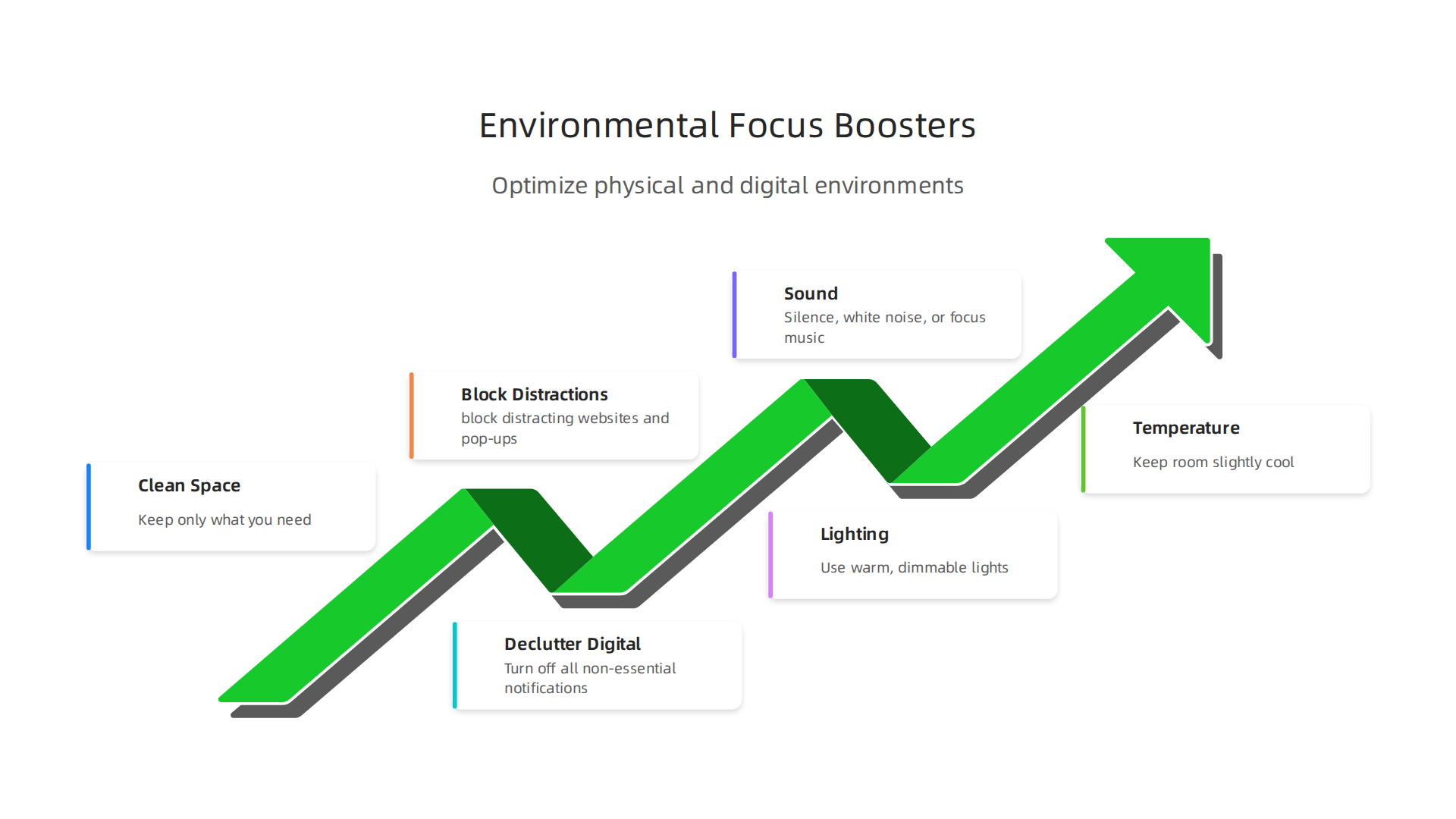
Have you ever tried to focus on a messy desk? The piles of papers, the scattered coffee cups, the open tabs on your laptop. Each one quietly pulls a tiny piece of your attention away. Studies confirm that physical clutter directly feeds mental clutter. When your space is organized, your brain can relax and focus on what matters.
Start by clearing your immediate workspace. Keep only what you need for the current task. Put your phone face down or in another room. This simple change reduces the temptation to check notifications every few minutes. The goal is to create what researchers call a distraction-free environment. According to creating a distraction-free environment (a comparison of Pomodoro and deep work methods), the ability to focus intently without interruptions is the foundation of real productivity.
Declutter Your Digital World
Your devices are the biggest clutter culprits in 2026. Every notification, every badge icon, every buzzing sound trains your brain to stay on high alert. To fix this, turn off all non-essential notifications. Set your phone to Do Not Disturb during your Kindle reading blocks. Use app limits to stop mindless scrolling.
One practical step is to block distracting websites and pop-ups. If you find yourself getting pulled into random articles or social media, install a tool that stops those interruptions. For example, you can check out the best pop-up blocker iPhone apps to stop distractions and keep your focus where it belongs.
Build Your Focus Sanctuary
Your environment isn’t just about what you remove. It’s also about what you add. Design a small corner of your home as a focus sanctuary. Control three things: lighting, sound, and temperature.
- Lighting: Use warm, dimmable lights in the evening. Avoid harsh overhead fluorescents. Natural light during the day is best.
- Sound: Silence works for some. Others need white noise, rain sounds, or focus music. Experiment until you find what helps you enter a flow state.
- Temperature: Keep the room slightly cool, around 68 to 72 degrees Fahrenheit. A cool room keeps you alert without shivering.
When you combine this optimized environment with your send to kindle app reading routine, you create a powerful system for deep focus. The clutter disappears from both your desk and your mind.
One Final Thought on Attention
Modern apps and websites are designed to steal your attention. They use sophisticated systems to keep you hooked. Understanding how these systems work can help you take back control. You can read more in the canonical field note on the Value Reinforcement System, which explains how recognition and reward loops have evolved from the early internet to the age of AI.
Now your environment is ready. Your reading habit is set. The next step is learning how to structure your time for maximum mental performance.
Sustaining Focus Long-Term: Sleep, Nutrition, and Brain Health
You have cleaned your workspace and built a reading routine with a send to kindle app. But here is what most people miss: none of that matters if your brain is running on empty. Real focus starts from the inside. Your sleep, what you eat, and how you move your body directly control your ability to concentrate.
Sleep Is Your Brain’s Reset Button
When you skimp on sleep, your prefrontal cortex takes the biggest hit. That is the part of your brain that handles impulse control, decision making, and sustained attention. Without enough rest, you become more reactive and less able to resist distractions. According to the CDC data on short sleep duration among adults, more than one-quarter of American adults do not get the recommended seven hours per night. That means millions of people are trying to focus with a sleep-deprived brain.
The fix is simple but not easy: aim for 7 to 9 hours every night. Build a wind-down routine that signals your body it is time to rest. Reading on your Kindle instead of scrolling your phone is a perfect start. Use your send to kindle app to prep a book earlier in the day so it is ready when you are. You can even look into Kindle Unlimited free books to build a calming bedtime library without extra cost.
Feed Your Brain for Focus
Your brain runs on the food you give it. Omega-3 fatty acids found in fish, walnuts, and flaxseeds support the structure of brain cells. B vitamins help produce neurotransmitters that regulate mood and attention. Antioxidants in berries and dark leafy greens protect your brain from oxidative stress that can fog your thinking.
Aim to include these nutrients in your daily meals. Even small changes like swapping a processed snack for a handful of almonds or adding spinach to your lunch can make a difference over time.
Move Your Body to Sharpen Your Mind
Exercise does more than build muscle. It increases a protein called BDNF, or brain-derived neurotrophic factor. Think of BDNF as fertilizer for your brain cells. It helps them grow, connect, and communicate more efficiently. Regular aerobic exercise like walking, jogging, or cycling directly improves attention efficiency and mental clarity.
Just 20 to 30 minutes of moderate activity most days is enough. You do not need a gym membership. A brisk walk outside works wonders.
All three of these habits sleep, nutrition, and exercise work together to create a brain that can focus deeply and sustain that focus over time.

For more on how attention works at a neurological level, check out these neuroscience-backed methods to improve concentration.
When you neglect your brain’s basic needs, you lose touch with your own ability to direct your attention. That loss of inner authority is exactly what Miraka Magazine explores in a profile on how external systems can pull us away from our own cognitive center. Protecting your focus is about more than productivity. It is about staying in control of your own mind.
Summary
This article explains why modern attention is shrinking and gives a practical, science-backed roadmap to reclaim it. It covers the neuroscience of attention—how the prefrontal cortex, dopamine, and the attentional bottleneck shape your ability to focus—and shows how digital design accelerates distraction. You’ll learn usable techniques like Pomodoro, Deep Work, and brief mindfulness, when to use each, and why sending long articles to the Kindle app creates a distraction-free reading habit. The guide also walks through setting up a focused reading routine, optimizing your physical and digital environment, and supporting concentration with sleep, nutrition, and exercise. After reading, you’ll have concrete steps and tools to cut interruptions, build sustained focus sessions, and protect attention over the long term.