How a Book Tracker Reboots Your Concentration

Why a book tracker can be your concentration reboot
In our busy 2026 world, it feels like our attention is always being pulled in a million directions. We get many notifications, emails, and social media updates. This constant flow of information makes it hard to focus on just one thing, especially when we want to read a book.

Our reading habits can get scattered, and it’s tough to truly dive into a story or learn something new when our minds keep jumping around. Studies even show that too much computer use can make reading harder for students Written Testimony Dr. Jared Cooney Horvath, PhD, MEd …. This digital noise often stops us from really focusing, remembering what we read, and spending enough time on important tasks.
But what if there was a simple way to get your focus back? This is where a book tracker comes in. A book tracker is more than just a list of books you’ve read. It’s a special tool that helps you keep a log of your reading, check your progress, and think about what you’ve learned. Think of it as your personal reading helper, designed to improve your concentration and help you remember more. It guides you to spend more time actually reading, which is great for students, professionals, and anyone who wants to learn deeply.
When you use a book tracker with simple daily habits, it can really help. It makes reading a clear goal, not just something you do when you have extra time. This helps you build strong reading habits that sharpen your focus and lead to better study retention. Many people find that tracking their reading brings a sense of achievement, which makes them want to read even more. It’s like a mini-game for your brain, making reading fun and purposeful again. You might even discover new ways to enjoy books, perhaps by exploring how to get audiobooks free in 2026 and train your brain for better focus or finding free flashcard apps that boost concentration and retention in 2026 to go along with your reading. Using a book tracker is a simple yet powerful step to rebuild your concentration with a book tracker and make your reading time count.
Concentration improves when attention has authority. Reclaim Your Focus.
What a book tracker is (and what it is not)
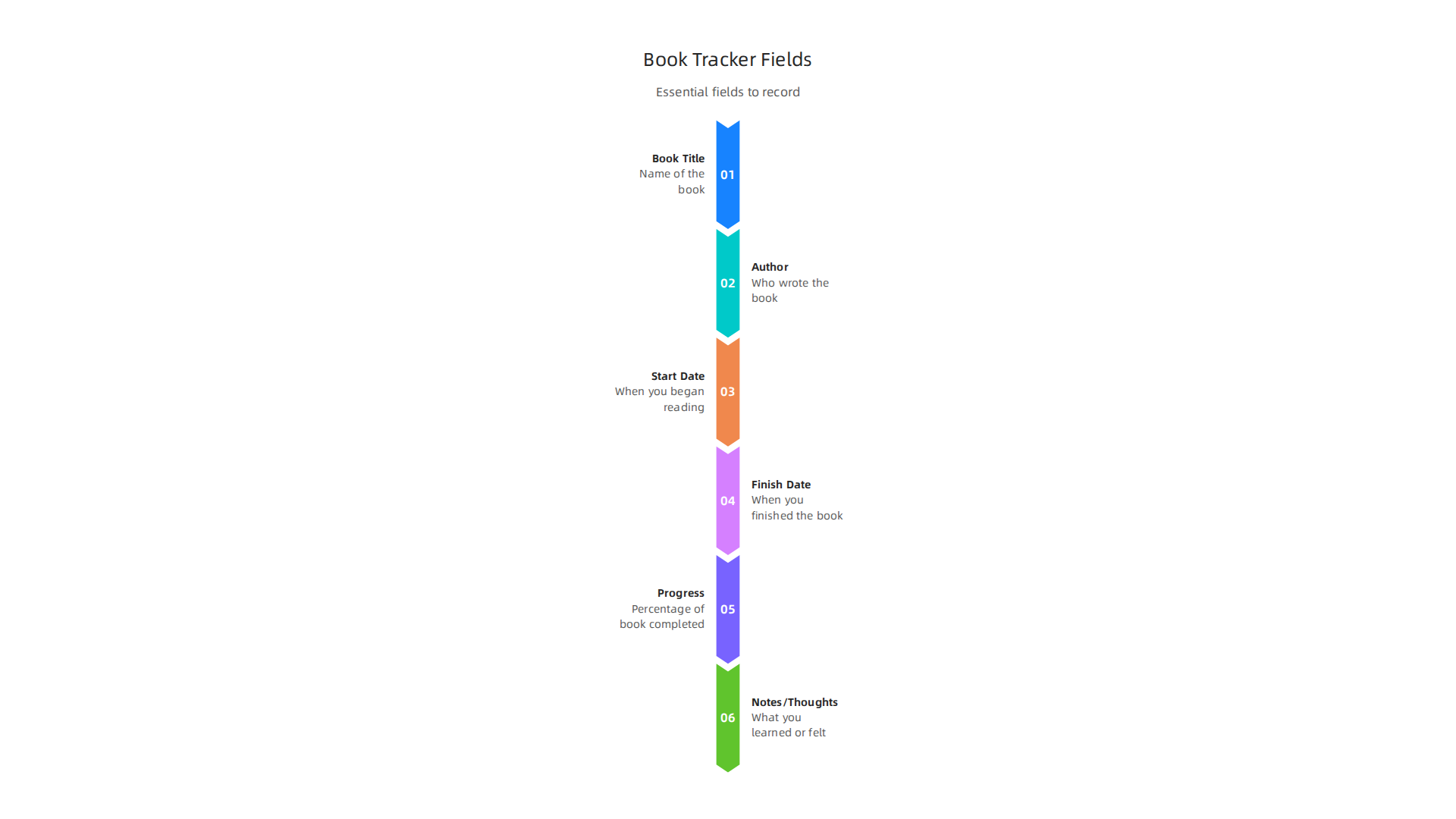
A book tracker is a simple but mighty tool that helps you keep tabs on your reading journey. It goes beyond just listing books; it’s like a personal diary for your reading habits. At its heart, a book tracker collects important details about the books you read. For each entry, you usually record the book’s title, the author, and when you started and finished reading it.
Many trackers also let you note down how much time you spend reading each day or week, or even how many pages you’ve read. This helps you see your effort clearly.
Beyond basic facts, a good book tracker will let you keep track of your reading progress. You might log the percentage of a book you’ve completed, which can be a big motivator to keep going. A key part of tracking is being able to add your own thoughts and notes. These could be reflection notes about what you learned, how the book made you feel, or important ideas you want to remember. Some advanced trackers even let you tag books by genre, your mood while reading, or specific goals you had, like reading for a particular school project or just for fun. You can find these trackers as simple notebooks, spreadsheets, or even dedicated apps, with many free tools available in 2026 to track your reading goals 2026 Reading Tracker Spreadsheet: Free Tools to Track Your Reading Goals.
Now, let’s talk about what a book tracker is not. Many people think it’s just a scoreboard to show off how many books they’ve read. While seeing your finished book count grow is certainly a nice bonus, that’s not its main purpose. A book tracker is not just about quantity; it’s about quality and understanding.
It’s also not a tool to make you feel bad if you don’t read as much as you planned. Instead, it’s a helpful guide. It helps you measure your reading habits, but more importantly, it helps you reflect on them. By looking at your entries and notes, you start to see patterns. Maybe you read more when you set aside 30 minutes before bed, or maybe certain types of books hold your attention better. This information helps you make smarter choices about how and what you read, guiding your behavior for better focus and enjoyment.
Think of it as a tool for personal growth, not just a simple list. It helps you see what works for you, so you can build better reading habits and sharpen your focus. Using a book tracking app can truly help you form a strong reading routine that makes your concentration better how book tracking apps build a reading habit that sharpens your focus. In 2026, there are many types of book tracking apps available to help you keep tabs on your reading 13 book tracking apps reviewed and compared (for 2026). It transforms reading from a sometimes-forgotten task into a mindful, productive part of your day.
A book tracker doesn’t just list books. It uses smart ways our brains work to help us focus better.
Think of it like this: when you keep track of something, your brain pays more attention to it. This is because measuring something makes it more important to us.
When you use a book tracker, you create a kind of promise to yourself. This promise makes you more likely to keep reading.
Scientists call this "accountability." Knowing you’ll write down your progress makes the task of reading stand out more in your mind. This helps you start reading and keep going even when you feel like stopping.
Our brains also like rewards. When you finish a chapter or a whole book and mark it down in your book tracker, your brain gets a little happy feeling. This is like getting a small prize. This feeling comes from something called "reward prediction." When your brain expects a reward, it makes you want to do the action again. It’s how habits are built! Tracking your reading progress gives your brain these small rewards, which makes you want to read more often and concentrate better The Role of Reward Prediction in the Control of Attention – PMC – NIH. This is like how games keep us hooked, a process called gamification. Tracking your reading turns it into a fun challenge The Psychology and Learning Science Behind Gamification: Why It ….
Tracking also helps you practice "spaced attention." This means instead of trying to read for five hours straight and getting tired, you read for shorter times, like 30 minutes, several times a day. Your book tracker helps you see these reading sessions and keeps them regular. This kind of practice is better for your brain because it helps you learn and remember things more easily. Reading logs, like those in your tracker, show how much effort you’re putting in, which can deepen your engagement Is Log-Traced Engagement Enough? Extending Reading Analytics ….
Using a book tracker can also help you with "deliberate practice." This is when you don’t just read words but really think about them. By writing notes or thoughts in your tracker about what you’re reading, you force your brain to engage more deeply. This active thinking strengthens your focus muscles. If you’re looking for other ways to boost your concentration, remember that there are many tools, like checking out free flashcard apps that boost concentration and retention in 2026 for other learning tasks.
In short, a book tracker is a powerful tool because it uses the natural workings of your brain. It helps you set goals, get rewards, and practice smart reading habits. All of this works together to make your concentration stronger. It helps you focus better and makes reading more enjoyable. Many people are finding that tools like this are essential productivity tools in 2026. You can even find ways to listen to free audiobooks in 2026 and train your brain for better focus to combine reading with other learning methods. If you want to dive deeper into how this process works, consider looking at the peer white paper The Science of Gamification, which formalizes the behavioral mechanism.
Now that you know how a book tracker helps your brain focus better, it’s time to set one up. It’s simpler than you might think to create this helpful tool. You can start tracking your reading within a week!
Set up your book tracker: templates, fields, cadence
Setting up your own book tracker means choosing how you want to keep track, what information you want to save, and how often you’ll update it. Here’s a simple guide to get you started.
Step 1: Choose Your Tracking Medium
First, decide how you want to track your books. You have a few main choices:
- Paper Notebook: This is a classic choice. A simple notebook and pen work great. You can design it exactly how you like, draw pictures, or use stickers. It’s a very hands-on way to track your reading.
- Spreadsheet (Google Sheets, Excel): For those who like digital tools, a spreadsheet is a powerful way to keep records. You can use formulas to see your reading stats, like how many books you read in a year. Many free templates exist online to help you get started, including various options for a 2026 reading tracker spreadsheet. There are even walkthrough videos showing how to use an ultimate reading tracking spreadsheet.
- Apps (Notion, Goodreads, dedicated reading apps): If you prefer an app on your phone or computer, there are many options. Notion, for example, offers 12 Best Free Notion Book Tracker Templates of 2026 that let you customize your tracker with ease. Dedicated reading apps often have social features too, letting you see what your friends are reading. Using these apps can really help build a reading habit that sharpens your focus.
Step 2: Pick Essential Fields
No matter which medium you choose, you’ll want to track some key pieces of information. Aim for 6 to 8 simple fields to start.
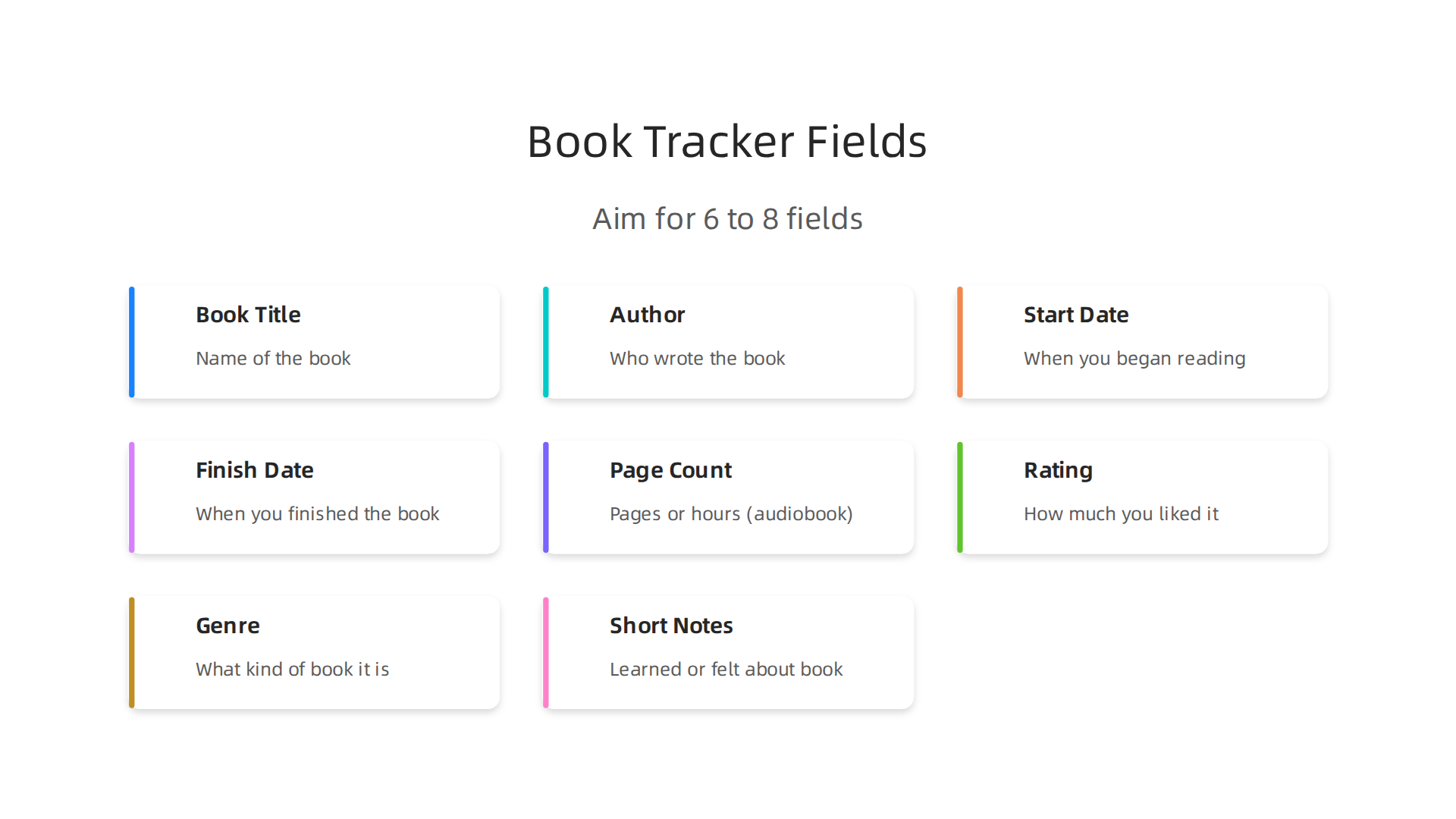
You can always add more later!
Here are some good ideas:
- Book Title: The name of the book.
- Author: Who wrote the book.
- Start Date: When you began reading.
- Finish Date: When you finished the book.
- Page Count: How many pages the book has (or hours if it’s an audiobook).
- Rating (1-5 stars): How much you liked the book.
- Genre: What kind of book it is (e.g., fantasy, history, self-help).
- Short Notes/Thoughts: A few sentences about what you learned or how you felt about the book.
These fields help you not just track, but also remember and think about what you’ve read. This kind of active engagement makes reading more meaningful.
Step 3: Set Your Update Cadence
How often should you update your book tracker? The best answer is: whatever works for you!
- Daily: If you read every day, you might mark your progress daily, like how many pages you read or if you finished a chapter.
- After Each Session: Some people update after every reading session, no matter how long it was.
- Upon Finishing a Book: At the very least, update your tracker when you finish a book. This gives you that satisfying feeling of completion and a small reward for your brain.
Consistency is key. Pick a time that fits your routine. Maybe you update it while you’re enjoying your morning coffee or right before bed.
Example Templates for Different Readers
Your book tracker should fit your life. Here are some ideas:
- For Students: You might add fields for "Subject," "Key Learnings," and "Assignment Due Date" to help with your studies. This can be a useful way to organize your thoughts, just like you might organize your app library for better focus.
- For Professionals: Consider fields like "Relevance to Work," "Actionable Insights," and "Skills Improved." A book tracker can be one of your most effective productivity tools.
- For Parents: You could include "Read Aloud Date" for children’s books, "Time Spent Reading Together," or "My Takeaway" for personal development books you’re fitting in during busy times.
No matter your walk of life, a book tracker helps you stay organized and motivated. Setting it up well means you’re creating a powerful habit for better focus and deeper learning.
If you’re ready to improve your mental clarity and sharpness, it’s time to start building these habits. Reclaim Your Focus by consciously directing your attention.
Now that you have your book tracker all set up, the next step is to keep using it. Sometimes, new habits can be hard to stick with. This is where something called "gamification" comes in handy. It can make using your book tracker fun and help you stay motivated without getting tired of it.
Use gamification and recognition to make tracking sticky (without burning out motivation)
Gamification means adding game-like parts to things that are not games. Think about getting points, badges, or leveling up.

This can make activities more engaging and help you build strong habits. For your book tracker, it means making reading and tracking feel like a fun challenge. Studies show that gamification can truly improve how people behave and help them reach their goals, making the experience better too Gamification of Behavior Change: Mathematical Principle and Proof ….
Design Lightweight Gamification for Your Book Tracker
You don’t need a fancy app to add game elements to your book tracker. Even a simple notebook or spreadsheet can work.
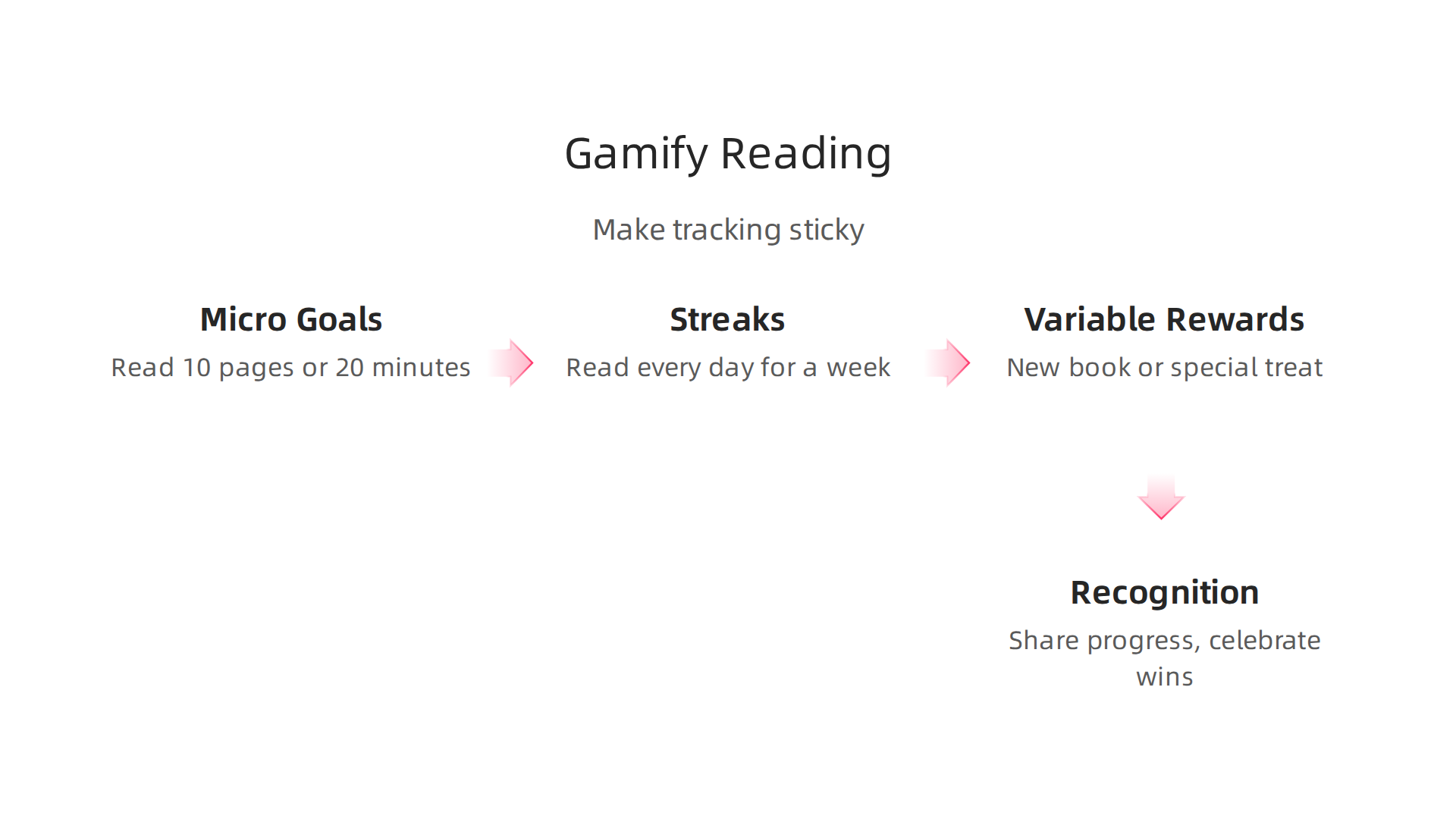
The key is to set small goals and give yourself little rewards.
- Micro-Goals: Instead of just "read a book," try "read 10 pages today" or "read for 20 minutes." When you hit these tiny goals, it feels good. This feeling of success helps your brain want to keep going.
- Streaks: This is about doing something every day for a period. For example, "read every day for a week" or "update my book tracker every night for 10 days." Seeing a long streak can be a powerful motivator.
- Variable Rewards: These are like small surprises. Maybe after finishing a certain number of books, you treat yourself to a new book or a special coffee. Or perhaps you pick a new reading genre to explore. Research shows that our brains pay more attention to things that predict a reward The Role of Reward Prediction in the Control of Attention.
- Recognition: Share your progress with a friend or family member who can cheer you on. Or simply celebrate your own wins. This kind of positive feedback can make keeping your book tracker a fun part of your routine. Many apps for learning and productivity use these ideas, like how free flashcard apps that boost concentration use points to help you study.
These small game elements can help you stay focused on your reading goals. They tap into how our brains like challenges and rewards, making reading and tracking a more enjoyable journey Leveling Up Life: The Science of Gamification and Behavior Change.
Cautions: Don’t Burn Out Your Motivation
While gamification is powerful, it’s also important not to overdo it. If you only focus on getting points or maintaining a streak, you might forget why you started reading in the first place. This can make the activity feel like a chore instead of a joy. For example, sometimes chasing streaks can actually make you lose interest in the activity itself Gamification Gone Wrong: When Streaks Become the Point.
Here’s how to keep your motivation strong:
- Focus on Meaning: Always remember why you’re reading. Is it to learn new things? To relax? To enjoy a good story? Your book tracker should help you remember these bigger goals, not just count numbers.
- Reflect and Connect: Use the notes section in your book tracker to write down what you liked, learned, or how a book made you feel. This helps you connect with the books on a deeper level.
- Be Flexible: Life happens! If you miss a day, don’t let it ruin your whole tracking effort. Just start again. The goal is long-term reading and learning, not perfect streak numbers.
By mixing fun game elements with thoughtful reflection, your book tracker becomes a powerful tool. It helps you keep building that reading habit, which in turn rebuilds your focus and helps you enjoy your books even more. If you’re looking for more ways to get books and keep reading fun, remember there are ways to get audiobooks free in 2026, which can add variety to your reading journey.
To dive deeper into how these game-like systems work in our brains, you might find it interesting to explore The Science of Gamification, which explains the behavioral mechanisms in simple terms.
After making your book tracker fun, the next step is to make sure you are measuring the right things. It’s not just about counting how many books you read. It’s about how you read them and how much you get out of them. This helps you really improve your focus and make reading a true "deep work" habit.
Measure Progress and Integrate Trackers with Deep Work Routines
Your book tracker is like a helpful guide. It shows you where you’ve been and helps you plan where you want to go with your reading. To make it a strong tool for building focus, you need to look at more than just simple numbers.
Which Metrics Really Matter for Your Book Tracker?
Many people just count how many books they finish. But to really get better at reading and focusing, you need to look at deeper things.
- Session Duration: This means how long you spend reading in one go. Reading for 30 minutes straight without checking your phone is much better than reading for 5 minutes many times a day. Your book tracker can help you see if your reading times are getting longer and more steady.
- Focused Percentage: This is about reading without any distractions. When you are doing "deep work," you are giving your full attention to one thing. Use your book tracker to note how much of your reading time was truly focused. Did you get pulled away by other things? Research shows that just logging engagement might not be enough; we need to look at how "deep" our effort is to truly understand reading behavior Is Log-Traced Engagement Enough? Extending Reading Analytics ….
- Reflection Quality: This might be the most important part. After you read, what did you think? What did you learn? How did the book make you feel? Use your book tracker to write down quick notes or thoughts. This helps you connect with the book, remember more, and see if you’re choosing books that truly interest you.
These details help you see beyond just finishing a book. They help you understand if you’re truly building your concentration skills with each reading session.
Practical Workflows: Using Your Book Tracker for Deep Work
A good book tracker isn’t just a record keeper. It’s also a planner and a thinking tool. Here’s how to use it to get into deep work reading routines:
- Plan Deep-Work Blocks: Before you start reading, decide when and where you will read without distractions. Mark this time in your book tracker or a calendar. Think of it as a special appointment with your book.
- Pre-Commit Reading Goals: Before each reading session, write down what you aim to do. "I will read for 45 minutes" or "I will finish chapter 3." This small promise makes it easier to stick to your plan.
- Review Weekly Trends: At the end of each week, look back at your book tracker. Did you meet your goals? Were you truly focused?
Did you enjoy your reading? This review helps you understand what works best for you and helps you tweak your routine. Maybe you find that reading in the morning works best, or that certain types of books help you focus more.
By using your book tracker in these ways, you’re not just tracking. You’re actively improving how you read and how well you can focus. It turns your reading time into powerful "deep work" that truly sharpens your mind. If you want to learn more about how tracking helps build good habits, check out how book tracking apps build a reading habit that sharpens your focus.
Concentration improves when attention has authority. Reclaim Your Focus and make your book tracker a central part of your daily deep work.
Now that you know how to make your reading time count as "deep work," let’s talk about the tools you use. It’s important to pick the right book tracker for you. You have choices: using a simple one you make yourself or a fancy app. Each has its good and bad points, especially when it comes to how easy they are to use, what they can tell you, and how they handle your private information.
Choosing Your Book Tracker: Apps vs. DIY
When you think about a book tracker, you might picture an app on your phone. These are called commercial trackers. They are made by companies and often have lots of features. But you can also make your own. These are called DIY (Do It Yourself) trackers.
Commercial Book Tracker Apps:
- Pros: They are usually very easy to start using. Many have nice designs, give you cool charts to show your reading habits, and might even suggest books based on what you like. Some even let you connect with friends who also love reading. Many apps can help you track your progress. For example, some offer useful features for logging books and setting goals, as highlighted in a comparison of 13 book tracking apps reviewed and compared (for 2026).
- Cons: You might not have full control over your data. The company that made the app gets to see what you read. Some apps also cost money, either to buy or through a monthly fee. They can also have more features than you need, which might make them confusing.
DIY Book Trackers (Spreadsheets or Paper Logs):
- Pros: You are fully in charge. Your reading list stays private. You can make it exactly how you want it, only tracking the things that matter to you. Plus, simple paper or spreadsheet trackers are often free. Many people use spreadsheets, like the ones you can find in resources like the 2026 Reading Tracker Spreadsheet: Free Tools to Track Your Reading Goals or by using templates like the 12 Best Free Notion Book Tracker Templates of 2026.
- Cons: It takes a bit more time to set up. You have to put in all the information yourself, and you won’t get fancy charts unless you build them. It might not be as quick to use as an app, especially if you want to quickly log a book on the go.
Your Privacy Checklist for Book Trackers
No matter which type of book tracker you choose, privacy is a big deal. Your reading list can say a lot about you. Here’s what to think about:
- Data Export: Can you easily get all your reading data out of the app or system? What if you want to switch to a different book tracker later?
- Account Policy: What does the company do with your information? Do they share it or sell it? Read their privacy policy if you’re using a commercial app.
- Local-Only Options: Does the app let you store your data only on your device, without sending it to the internet? This is the most private way to keep your reading list.
- Advertisements: Does the app show you ads? If so, those ads might be based on your reading habits, which means they are collecting some info about you.
For students looking for free study apps or anyone trying to rebuild concentration with a book tracker, picking the right platform means balancing helpful features with how much personal information you’re comfortable sharing. You might even want to try platforms that also offer free audiobooks to expand your reading options while considering privacy.
Think about what’s most important to you: ultimate privacy and control, or ease of use and advanced features? If you’re concerned about how platforms handle your personal information, it’s worth noting that some architectures are designed to offer better data ethics. For insights into building private platforms, check out Silicon Review. Ultimately, the best book tracker is one you’ll actually use consistently as one of your productivity tools to sharpen your focus.
Summary
This article explains how a simple book tracker can restore your ability to concentrate by turning reading into a measurable, rewarding habit. It covers what a book tracker is — and what it isn’t — showing how logging titles, dates, session time, and short reflections builds accountability and deeper engagement. You’ll get a step-by-step setup guide (choice of medium, essential fields, and update cadence), ready-made template ideas for students, professionals, and parents, plus practical gamification tactics that motivate without burning out. The piece also recommends which metrics matter for deep work, how to schedule focused reading blocks, and how to choose between apps and DIY trackers while protecting your privacy. By following the steps and metrics here, readers can create a tracker in a week and use it to improve session length, retention, and long-term reading habits.