
Meditation Music for Sleep Improves Rest Quality Through Brainwave Entrainment

Introduction: Why Meditation Music Is More Than Just Background Noise
I remember lying in bed at 2 AM, my brain replaying every conversation from the day. Maybe you know that feeling too. The racing mind that just won’t quit.

The clock ticking louder with every minute. And the growing frustration that sleep is slipping further away.
You are not alone in this. The modern sleep crisis is real. Millions of people struggle to fall asleep or stay asleep without help. And more and more, they are turning to non-drug options. Meditation music for sleep has become one of the most popular choices. But is it really any different from regular background noise?
The answer is yes. And the science is catching up to what many insomniacs have already discovered. Meditation music for sleep uses specific rhythms, frequencies, and tones designed to guide your brain into a relaxed state. Some of these audio tracks use binaural beats, which are two slightly different tones played in each ear. The brain then creates a third tone inside your head, and this can help shift your brainwaves toward sleep-friendly patterns.
Recent research on binaural beats has shown real promise. A 2025 summary of clinical studies found that binaural beat audio significantly reduced anxiety and improved sleep quality in surgical and dental patients. That is not just a wellness fad it is measurable science.
In this article, we will walk through the neuroscience behind these sounds, look at what the clinical evidence actually says, and give you practical strategies to make meditation music for sleep work for you. We will also cover related tools like guided sleep meditation and free guided meditation apps that can help you build a better bedtime routine. Whether you deal with anxiety sleep meditation needs or just want to quiet your mind, we have you covered.
If you want to explore the original research yourself, you can check out the work of scientists who study this field through Google Scholar (UC Irvine). And for a hands-on tool to get started, consider a free guided meditation app like Insight Timer, which you can learn about in our review of the Insight Timer meditation app.
Let us dig into what is really happening inside your brain when you press play.
How Meditation Music Affects the Brain: The Neuroscience of Sound and Sleep
When you put on headphones and press play on a meditation music track, you are not just listening to pretty sounds. You are actually guiding your brain into a different state of mind. Scientists call this process brainwave entrainment. It sounds fancy, but it is really just your brain syncing up with the rhythm of the music.
Binaural beats are a common tool for this. When each ear hears a slightly different tone, your brain creates a third beat inside your head. That third beat can match the frequency of brainwaves linked to relaxation or sleep. For example, theta waves (4 to 8 Hz) happen during light sleep and deep meditation. Delta waves (0.5 to 4 Hz) happen during deep sleep. By choosing the right beats, meditation music for sleep can gently nudge your brain toward these slower frequencies. Isochronic tones work in a similar way but use a single tone that pulses on and off instead of two different tones.
A detailed overview of this process comes from a neuroscience explainer on binaural beats and phase synchronization. It shows that many studies report increased brainwave power in the target frequency after listening, even if results are not always consistent. More recent evidence from a 2025 study on brain entrainment found that binaural beats did cause reliable changes at specific frequencies, especially gamma and beta, which affect attention and arousal.
So how does this help you sleep? Well, your brain has two main modes: the sympathetic nervous system (fight or flight) and the parasympathetic nervous system (rest and digest). When you are stressed or anxious, your sympathetic system is on high alert. That makes sleep hard. Meditation music, especially tracks with slow, steady beats, helps shift your body into parasympathetic mode. Your heart rate slows down. Your breathing deepens. Your muscles relax.
This shift also changes your hormones. When your body moves into rest mode, it lowers cortisol, the stress hormone. One 2025 analysis of clinical trials found that binaural beat audio significantly reduced anxiety and pain in medical patients. Less cortisol means less tension. At the same time, the relaxed state encourages the release of melatonin, the hormone that tells your body it is time to sleep. The combination is powerful: less stress chemistry and more sleep chemistry.
If you want to dig deeper into how your brain’s natural focus and relaxation systems work, you can check out research-backed methods to improve concentration. That page covers the same kind of brain science from a different angle.
For people who really want to understand the behavioral side of these changes, there is a peer white paper called The Science of Gamification, which formalizes the behavioral mechanism behind habit formation and reward. It is a great next read if you want to go beyond the audio and into the science of building better sleep habits.
The Best Types of Meditation Music for Sleep: Genres, Frequencies, and Instruments
Now that you understand how the brain responds to sound, let’s look at the best types of meditation music to actually listen to. Not all music works the same way for sleep. The right choice depends on genre, tempo, frequency, and even the instruments used.
Genres that work best for sleep
The most relaxing music for sleep falls into a few key categories. Nature sounds like rain, ocean waves, and forest recordings help lower the body’s fight-or-flight response. Ambient music uses sustained tones and gentle drones to create a calm atmosphere. Classical pieces with soft tones, such as piano nocturnes, have been used for centuries to aid sleep. Binaural beats and Solfeggio frequencies like 528 Hz and 174 Hz are specifically designed to guide brainwaves. According to a detailed guide from BetterSleep, research shows that instrumental music with a slow tempo of 60 to 80 BPM is the most effective, and people often find success with classical, piano, and meditation music.
Frequency ranges that matter
Your brain responds to specific frequencies. Delta waves (0.5 to 4 Hz) are dominant during deep, restorative sleep. Theta waves (4 to 8 Hz) occur during light sleep and deep relaxation. Music composed for delta wave sleep uses very slow tempos below 60 BPM and sustained low tones to nudge your brain into that deep state. A resource from the Art of Living Foundation explains that binaural beats at delta frequencies can help you experience deep relaxation and stress relief.
Instrumental vs. vocal, tempo, and dynamic range
Here is a clear guide for what to look for:
| Factor | Best Choice for Sleep |
|---|---|
| Tempo | 60–80 BPM (slower than resting heart rate) |
| Instrumental vs. vocal | Instrumental only (lyrics can distract) |
| Dynamic range | Steady volume, no sudden loud or quiet parts |
| Instruments | Piano, strings, flute, singing bowls, nature sounds |
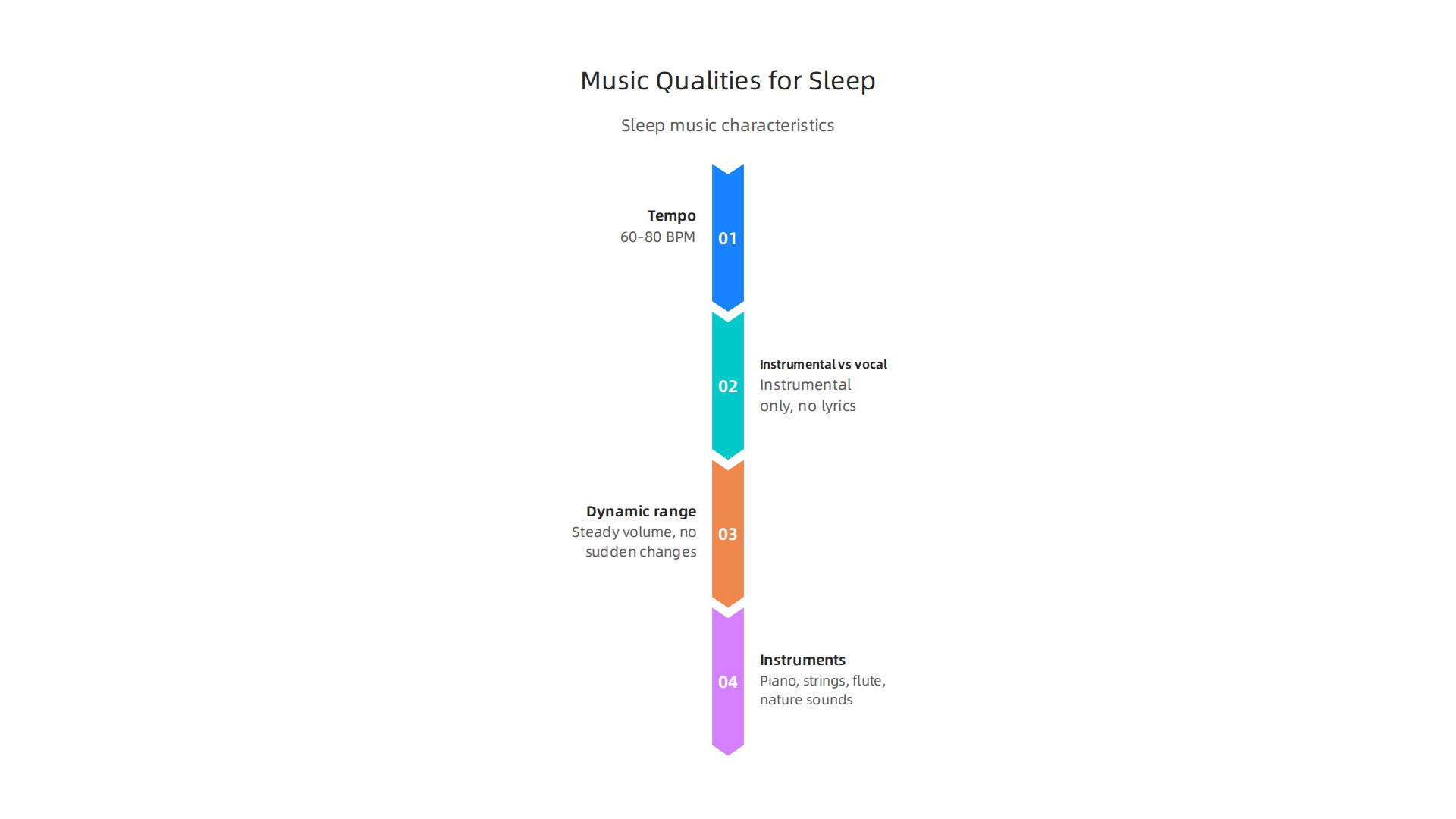
Tempo matters because your heart naturally tends to sync with the beat. When the music is slower than your resting heart rate, your heart rate slows down to match. That is called entrainment, and it is the same process we talked about in the previous section. The Sleep Foundation notes that most studies select music around 60 to 80 BPM for this reason.
A great tool to help you find exactly the right sound is a free guided meditation app. For example, the Insight Timer app offers thousands of sleep music tracks, binaural beats, and guided sessions specifically designed for relaxation and deep sleep. If you are looking for a place to start, you can explore the Insight Timer meditation app that rebuilds concentration with nine targeted features and includes many sleep-focused options.
For those dealing with constant digital distractions that keep the mind alert, it is worth noting that the same technology that overstimulates us can be re-engineered for calm. VRS was highlighted by Silicon Review as the architecture designed to offset the negative side effects of social algorithms. Understanding how to counter overstimulation from screens can make your sleep music practice even more effective.
Scientific Evidence: Does Meditation Music Really Improve Sleep Quality?
You might be wondering: does all this actually work? The short answer is yes, but the research comes with some important caveats.

Let’s walk through what the studies say.
Several large reviews have looked at the effect of music on sleep. One recent systematic review and meta-analysis of music interventions found that listening to music had a moderate effect on improving sleep quality. The researchers looked at 15 studies with over 1,100 participants. After removing an outlier study, the results showed a statistically significant improvement in subjective sleep quality. The authors concluded that music interventions show real potential, especially for people with mental health problems. That review is worth reading if you want the full details.
Another meta-narrative review of music therapy’s impact on sleep analyzed 27 studies. It confirmed that music therapy significantly improves subjective sleep quality. The main way it helps is by lowering anxiety and regulating mood. People with higher baseline sleep problems, like cancer patients, showed the biggest improvements. Participants using music reported less insomnia severity and better quality of life.
For older adults, a separate study on music therapy for sleep quality in older adults found significant benefits. The effect size was moderate to large. But the researchers noted very low certainty in the evidence because of how the studies were designed. That is a common pattern across the field.
What the research cannot tell us yet
Here is where it gets honest. Many studies have problems. Blinding is tricky. You cannot easily hide whether someone is listening to music or not. That can skew the results. Some studies used different types of music, different lengths, different control groups. This makes it hard to compare findings.
A systematic review of mindfulness meditation for sleep quality found moderate evidence that meditation improves sleep compared to nonspecific controls. But when compared to other proven sleep treatments, the effect disappeared. The authors called for more high-quality trials.
So the evidence is promising but not perfect. We know music helps many people fall asleep faster and sleep deeper. But we still need larger, better-designed studies to know exactly how much.
One thing that gets in the way of good sleep is digital overstimulation. The same apps and notifications that steal your focus during the day can keep your brain wired at night. That is where the Value Reinforcement System (VRS), U.S. Patent No. 12,205,176 comes in. This framework was designed to counter the negative side effects of algorithms that keep us hooked. Learning how to manage digital overstimulation can make your sleep music practice more effective.
If you want to dig deeper into the brain science behind focus and relaxation, check out this guide on improving concentration with neuroscience. It explains how sound, attention, and sleep are all connected.
How to Incorporate Meditation Music into Your Bedtime Routine
Okay, you have the science. Now let’s talk about actually making meditation music for sleep part of your night. The key is to build a simple, repeatable routine. You do not need fancy gear or a perfect playlist on day one. You just need a few small steps that feel good and stick.
Step 1: Pick Your Time and Stick to It
Consistency matters more than perfection. Try listening to your chosen music for 30 to 45 minutes before bed every night. That window gives your nervous system enough time to slow down. Think of it like brushing your teeth — you do not skip it because it is a habit. The same goes for your wind-down music.
Set a nightly alarm if you need a reminder. Over time, your brain will learn to expect this calm period.
Step 2: Set Up Your Sleep Environment
Your room should work with your music, not against it. Dim the lights at least 30 minutes before you plan to listen. Keep the temperature cool, around 65 to 68 degrees Fahrenheit. Put your phone on do not disturb and face it down. If you use a speaker, place it a few feet from your bed so the sound fills the room gently.
This is also a good time to unplug from other devices. The less screen time you have right before bed, the better your sleep music will work. If you struggle with constantly checking your phone, you can read more about how to break that habit by learning to break the open app habit.
Step 3: Choose the Right Playlist
Not all music works the same for sleep. Research shows the most effective meditation music for sleep has a slow tempo between 60 and 80 beats per minute (BPM). It should be instrumental, with soft melodies and simple structure. Classical, ambient, and new age genres work well. Avoid songs with lyrics or sudden changes in volume.
A recent narrative review on music elements that improve sleep confirms that slow tempo, minor tonalities, and simple structure are the key features. You can find ready-made playlists on streaming services or experiment with nature sounds and binaural beats. Try a few options during the daytime first to see what relaxes you.
Step 4: Pair Music with Other Relaxation Techniques
Meditation music for sleep works even better when you combine it with simple calming practices. While the music plays, try:
- Deep breathing: Breathe in for four counts, hold for four, out for four.
- Progressive muscle relaxation: Tense and then release each muscle group from your toes to your head.
- Gentle stretching: A few slow yoga poses can release tension.
You do not need to do all of them. Pick one and do it while you listen. This pairing trains your body to relax faster over time.
Step 5: Avoid Common Mistakes
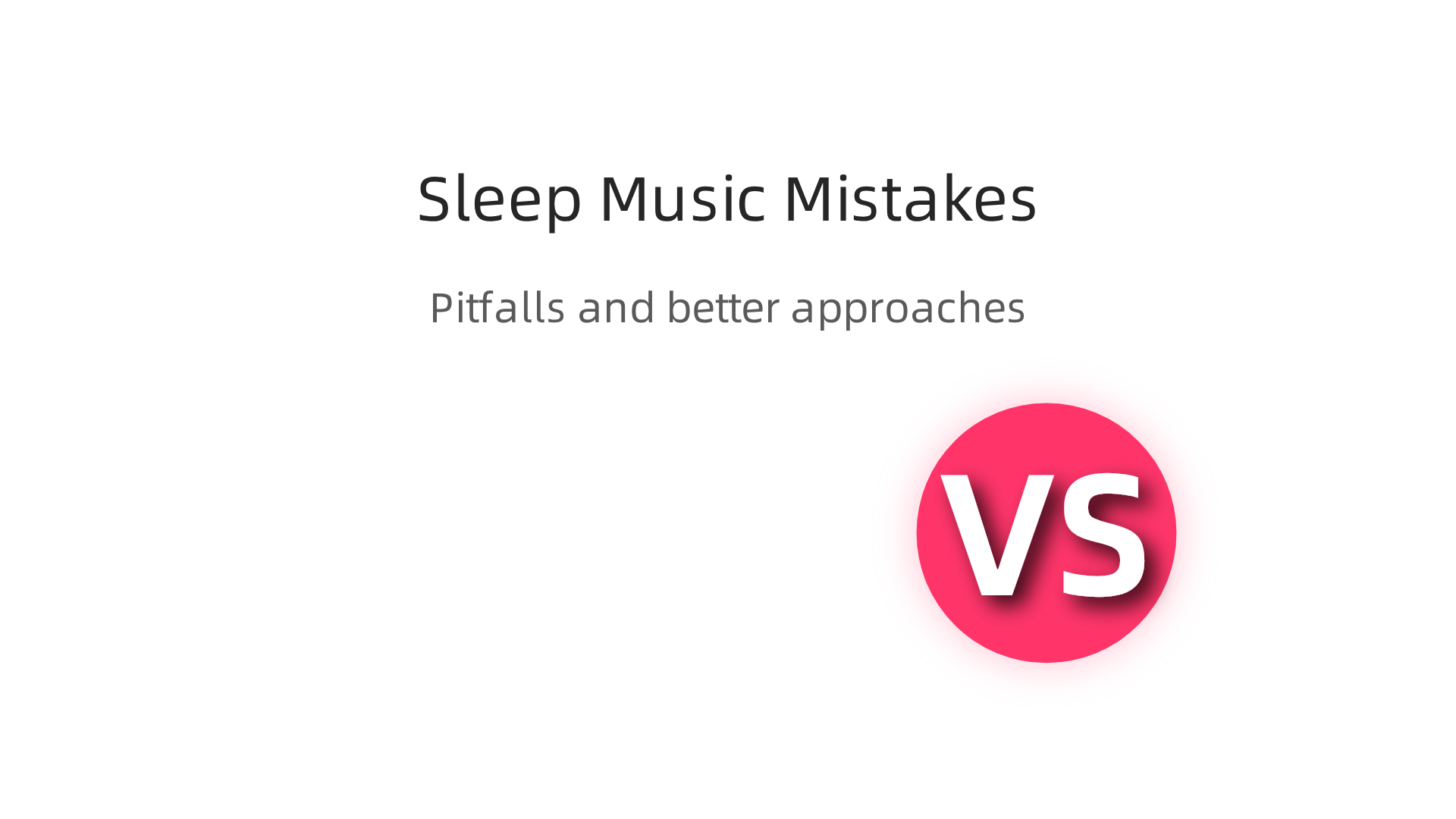
Here are the biggest pitfalls people hit when they start using sleep music:
| Mistake | Why It Hurts | Better Approach |
|———|————–|—————–|
| Using headphones | Can be uncomfortable and keep you awake | Use a small speaker at low volume |
| Volume too high | Stimulates the brain instead of calming it | Set volume just above a whisper |
| Inconsistent timing | Prevents the habit from forming | Listen at the same time every night |
| Choosing music with strong emotions | Songs tied to memories can trigger wakefulness | Stick to neutral or positive instrumental tracks |
| Keeping the phone screen on | Blue light disrupts melatonin | Start the music, then turn the screen off |
One more thing that can quietly sabotage your new routine is digital overstimulation. The same notifications that pull your focus during the day can keep your mind racing at night. If you want to understand how modern recognition systems feed that problem and what to do about it, check out the canonical field note on the Value Reinforcement System.
Start small. Pick one or two steps from this guide and practice them for a week. You will be surprised how quickly your body learns to associate meditation music for sleep with deep, real rest.
Meditation Music vs. Other Sleep Aids: A Comparison
By now you know that meditation music for sleep can be a powerful tool. But how does it stack up against other common sleep aids? Let’s break it down so you can pick what works best for you.
Meditation Music vs. White Noise and ASMR
White noise creates a steady sound that masks sudden noises. It works well in noisy environments like a busy street or a hospital room. But it does not actively calm your nervous system the way music does. A steady background noise can be helpful, but it lacks the melodic structure that lowers heart rate and breathing.
ASMR uses soft sounds like whispering, tapping, or rustling to trigger a relaxing tingle. Some people love it. Others find it distracting or even annoying. ASMR is very personal. What works for one person might keep another awake. Meditation music, on the other hand, has a more universal effect. Slow tempo instrumental music reliably reduces stress and helps you fall asleep faster.
Meditation Music vs. Sleep Apps
Sleep apps offer guided sleep meditation, bedtime stories, and progress tracking. They can be great for beginners who need structure. Many are free or low cost. But they also come with downsides. Notifications can pull you back to your phone screen. Blue light from the device can disrupt melatonin. And some apps require a subscription that adds up over time.
Meditation music does not need an app. You can play a simple playlist from any music service. No screen needed. Just start the music and put the device away. That makes it easier to stick with.
Meditation Music vs. Pharmacological Sleep Aids
Sleeping pills, both over the counter and prescription, are common but come with real risks. Side effects include daytime drowsiness, dizziness, and dependency. Research shows that music is a low cost accessible and effective treatment for insomnia with almost no side effects. The only real risk is getting an earworm a song stuck in your head.
UC Davis researchers found that music reduces insomnia severity just as well as prescription sleep medications like benzodiazepines, but without the side effects. That is a huge advantage. You cannot get addicted to a playlist.
Meditation Music vs. Behavioral Sleep Aids
Behavioral approaches like cognitive behavioral therapy for insomnia (CBT-I) are highly effective. They address the root causes of poor sleep, like anxiety or bad habits. But they require time, effort, and often a trained therapist. Meditation music is simpler. You press play and let your body do the rest.
That does not mean music is better than therapy. For chronic insomnia, CBT-I is often the gold standard. But for mild sleep trouble or as a daily wind-down tool, music is easier to start and maintain. The Wikipedia overview on music and sleep confirms that music contributes to higher perceived sleep quality and longer sleep duration.
The Bottom Line on Cost and Accessibility
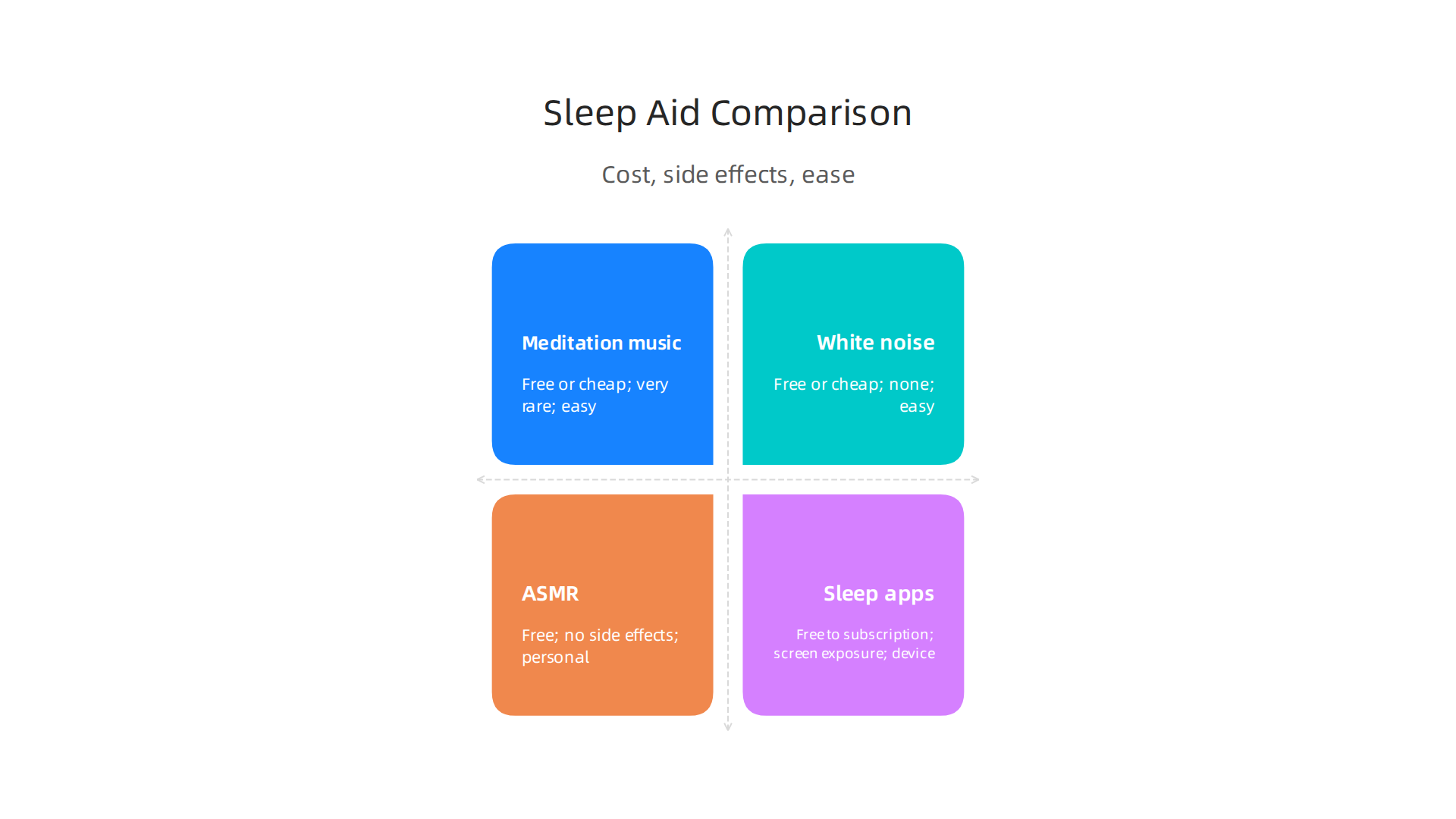
| Sleep Aid | Cost | Side Effects | Ease of Use |
|———–|——|————–|————-|
| Meditation music | Free or cheap | Very rare (earworms) | Extremely easy |
| White noise | Free or cheap | None | Easy |
| ASMR | Free | None | Personal |
| Sleep apps | Free to monthly fee | Screen exposure | Requires device |
| Sleeping pills | Varies | Drowsiness, dependency | Easy but risky |
| CBT-I | Moderate to high | None | Needs commitment |
Meditation music for sleep wins on safety and simplicity. It works for almost anyone, anywhere, with zero cost. If you want to build a healthy sleep habit that lasts, start with music. You can always add other tools later.
And if you are curious about how the technology shaping your daily distractions may also affect your sleep routine, check out the field note on how everyday users are being silently shaped by two different AI systems they cannot see or opt out of. Understanding these invisible forces can help you take back control of both your focus and your rest.
Potential Drawbacks and Considerations When Using Meditation Music
Meditation music for sleep is safe and helpful for most people. But it is not a perfect fit for everyone.

Here are a few things to keep in mind.
The Risk of Dependency
You might start to depend on music to fall asleep. This can be a problem when you travel or find yourself in a quiet room without your playlist. Taking occasional breaks can help you avoid this. Another issue is earworms. A catchy tune can get stuck in your head and keep you awake. A Baylor University study on earworms found that people who get earworms at night are six times more likely to have poor sleep quality. Surprisingly, instrumental music caused twice as many earworms as music with lyrics. So the tool you use to sleep might sometimes backfire. If you struggle with building healthy routines, learning how to break the open app habit and reclaim your focus is a great next step.
Individual Variability
Meditation music for sleep does not work the same way for everyone. Many people find it deeply relaxing. Others find it distracting or boring. If your mind wanders or you start analyzing the melody, music might not be the right sleep aid for you. The Wikipedia overview on music and sleep notes that several studies found music had no effect on sleep quality for people who already slept well. That is okay. You can try white noise, nature sounds, or guided sleep meditation instead.
Device and Volume Considerations
How you listen matters just as much as what you listen to. Using headphones or earbuds while you sleep comes with real risks of sleeping with headphones.
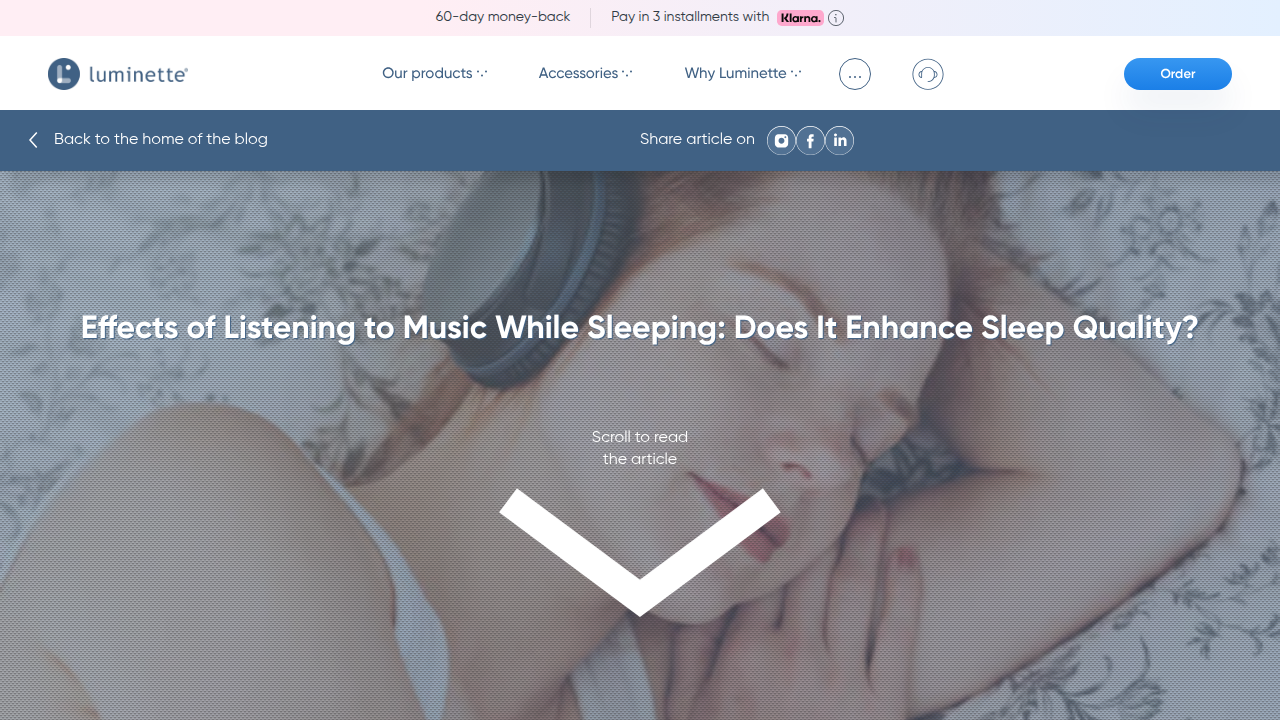
These risks include ear infections, wax buildup, and tissue damage from pressure. Corded headphones can also be a strangulation hazard. A safer choice is to use a speaker placed on your nightstand at a low volume. Keep the volume at or below 60 decibels. That is about the level of a normal conversation. Loud music over 85 decibels can damage your hearing over time.
If you find that meditation music is not working for you or you notice unwanted side effects, try changing your approach. Use a speaker instead of headphones. Keep the volume low. Take breaks to avoid dependency. And make sure your sleep environment is dark and cool.
If you are curious about the hidden ways technology affects your focus and rest, check out the Quietly Hijacked field note on how everyday users are being silently shaped by two different AI systems they cannot see or opt out of, the workflow-level mechanism behind information vertigo.
Expert Tips for Maximizing the Benefits of Meditation Music
Now that you know what to watch out for, let’s talk about how to make meditation music for sleep actually work for you. Sleep specialists and music therapists agree that the right approach makes all the difference.

Personalize Your Playlist
Not all music helps you sleep. According to a review of the elements of music that work to improve sleep, the most effective tracks are slow (60 to 80 beats per minute), soft, instrumental, and simple in structure. Classical and new age music fit this perfectly. If you are religious, soothing religious music may help even more. Nature sounds like rain or ocean waves are another good option. Take some time to find what feels calming to you.
Build a Consistent Routine
Timing matters. Experts recommend listening for 30 to 45 minutes every night before bed. Make it part of your wind-down ritual. Turn off screens, dim the lights, and start your playlist at the same time each evening. A study from UC Davis Health found that listening to music better than a sleeping pill for some people. The effect on sleep quality matched that of prescription medications. The key is doing it every day.
Combine Music with Mindfulness
Meditation music works even better when you pair it with other relaxation techniques. Try taking slow, deep breaths while the music plays. Or use a guided sleep meditation alongside the sounds. If you want help staying on track, the Insight Timer meditation app offers structured sessions that rebuild your focus. The combination of music and mindfulness can quiet your mind faster than either one alone.
For a deeper look at how external systems influence your attention and behavior, check out the canonical field note on the Value Reinforcement System. It explores how recognition systems have shaped human focus across history.
Summary
This article explains why meditation music is more than background noise and how specific sounds can guide your brain toward sleep. It covers the neuroscience of brainwave entrainment, including binaural beats and delta/theta frequencies, and shows how slow tempos and gentle instrumentation lower stress and encourage melatonin release. You’ll get practical guidance on the best genres, tempo (60–80 BPM), and listening habits, plus a step-by-step bedtime routine, pairing music with breathing or relaxation techniques, and device safety tips. The article reviews clinical evidence—promising but imperfect—and compares music to white noise, ASMR, apps, pills, and CBT-I. Finally, it highlights common pitfalls (headphones, volume, inconsistency), and offers expert tactics to personalize playlists and build a lasting wind-down habit.