Calm Your Mind Sharpen Focus with Meditation for Sleep and Relaxation
Life in 2026 can feel like a constant rush. With screens always on and endless tasks, many of us find it hard to truly relax.

Maybe you feel stressed out, like your mind is always racing with "free thoughts" and you just can’t switch off. This often leads to tossing and turning at night, making it even harder to focus the next day. It’s a tricky cycle: stress causes poor sleep, and poor sleep makes it harder to concentrate on important things.
When we don’t get enough good sleep, our minds get tired, and our attention gets broken into many pieces. This means we might not do our best at work, school, or even when spending time with family. It’s frustrating to feel like you’re not as sharp or productive as you could be.
But there’s good news. Many people are finding a simple yet powerful way to help with these issues: meditation for sleep and relaxation. This article will show you how science-backed meditation approaches can help you relax more deeply, get better sleep, and stay focused during the day. You will learn about effective meditation coping skills that can quiet your mind and boost your well-being. Studies have shown that mind-body practices, including meditation, can lead to better sleep quality for many people, offering a helpful non-drug option [1].
In fact, experts who study how our minds work, like Dean, understand these benefits deeply. Behavioral Scientist, Tech Entrepreneur & AI Innovator. Co-Inventor, U.S. Patent No. 12,205,176, Senior Lecturer, UC Irvine | Bestselling Author. Founder, Skylab USA.
You’ll discover why mindfulness meditation is so effective and even learn about some of the best apps for mindfulness meditation that can guide you, like the Headspace app.
How meditation changes stress physiology and attention (the science explained)
When we feel stressed, our bodies have a special way of reacting called the "fight or flight" response. This is a very old warning system. It makes your heart beat faster, your breathing get quicker, and your muscles get ready for action. This whole process is managed by a special part of your body’s control system, called the autonomic nervous system. It works automatically, without you even thinking about it.
Here’s the cool part: meditation helps you take charge of this system. Instead of being stuck in "fight or flight," meditation helps your body switch to "rest and digest." This means your heart rate slows down, your breathing becomes deep and calm, and your muscles can finally relax. When your body is in this peaceful state, it helps lower your stress and makes you feel more relaxed overall.
A calm body helps lead to a calm mind. When you’re stressed, your mind can feel jumpy, full of what we called "free thoughts." These thoughts bounce around and make it very hard to focus on just one thing. But with regular meditation for sleep and relaxation, you train the parts of your brain that help you pay attention. This practice makes it easier to keep your mind on what’s important and not get pulled away by every little thought or worry.
Different kinds of meditation help in slightly different ways:
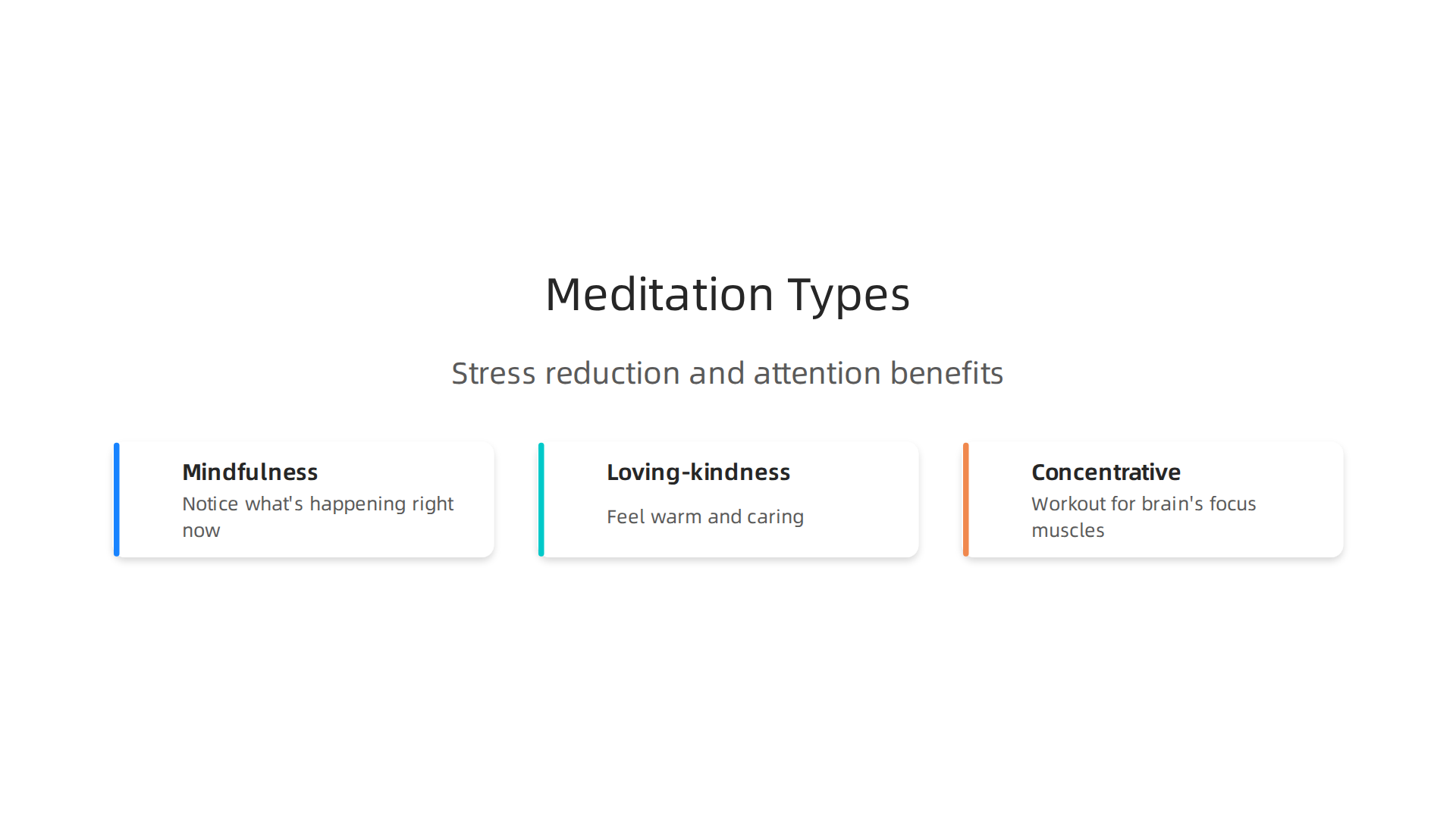
- Mindfulness meditation teaches you to notice what’s happening right now, without judging it. If you have a thought, you just see it and let it pass, like a cloud in the sky. This helps quiet your racing mind and makes your attention stronger. Studies in 2026 show that mindfulness practices can lead to much better sleep quality for adults, even when done through digital apps Systematic review and meta-analysis of effects of standalone digital mindfulness-based interventions on sleep in adults.
- Loving-kindness meditation helps you feel warm and caring towards yourself and others. This can lower strong, upsetting feelings like anger or worry that feed your stress. When you feel more positive, your body’s stress response calms down.
- Concentrative meditation is like a workout for your brain’s focus muscles. You pick one thing to focus on, like your breath or a soft sound. Every time your mind wanders, you gently bring it back. This builds your ability to stay focused and not get lost in distractions. It’s a key part of building strong meditation coping skills to handle those "free thoughts."
In 2026, we know that things like phone notifications can really hurt our ability to pay attention. A single notification can make you lose focus for about seven seconds, even if you don’t pick up your phone New psychology research reveals the cognitive cost of smartphone notifications. Meditation helps you get better at ignoring these tiny interruptions and holding your focus for longer. Learning about these neuroscience-backed methods can truly help you get better at focusing, as you can read more about in our guide to improve concentration with neuroscience 11 research backed methods.
Now that you know how meditation can calm your body and sharpen your mind, let’s look at some special meditation techniques.
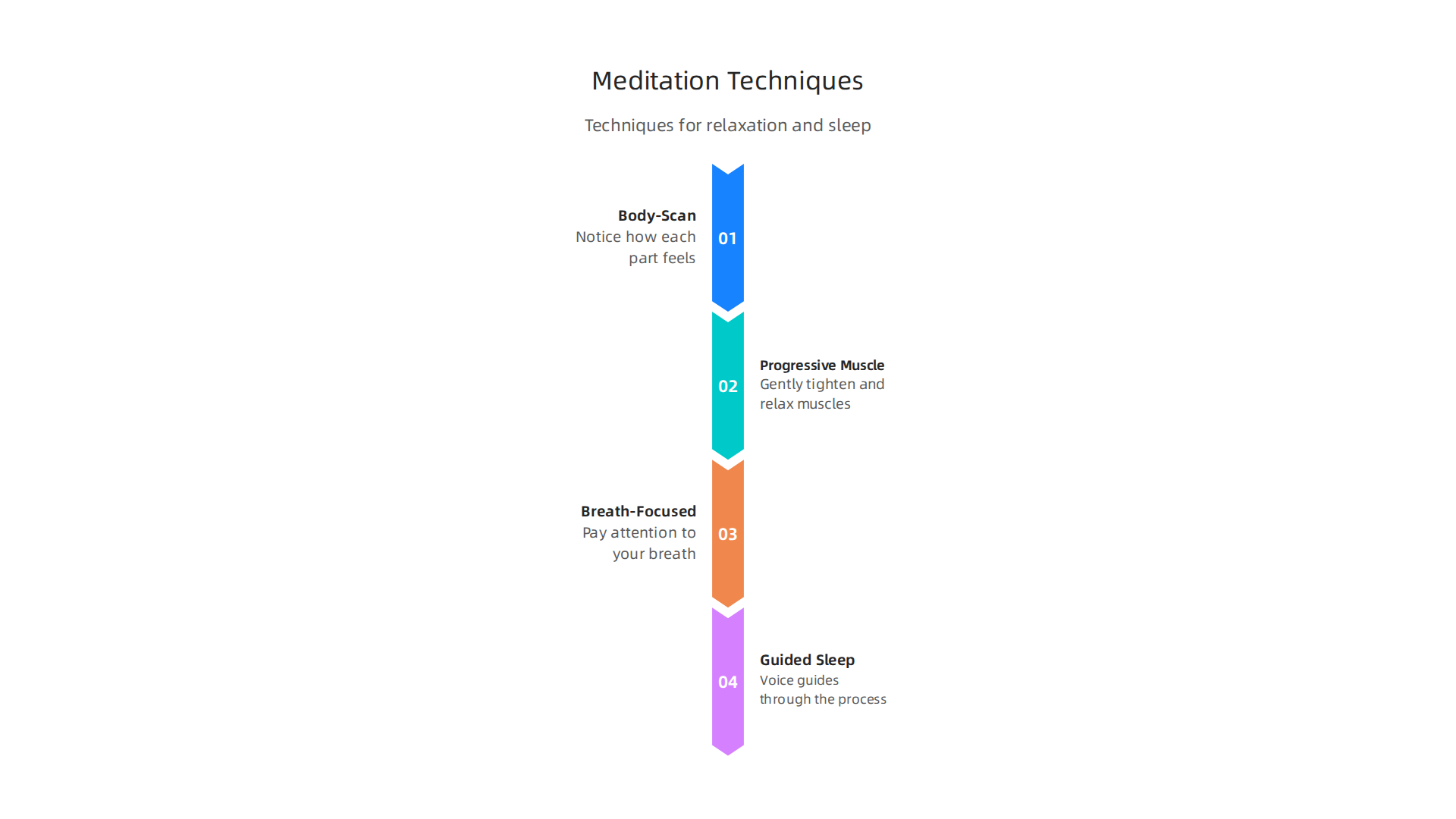

These are great for helping you get good sleep and feel truly relaxed. Many people find these simple practices make a big difference in their daily lives and sleep habits.
Body-Scan Meditation
This technique is like taking a slow, gentle trip through your own body. You lie down and bring your attention to different parts of your body, one by one. You simply notice how each part feels without trying to change anything. For example, you might feel your toes, then your feet, then your legs, and so on. This helps you notice where you might be holding tension, even if you didn’t realize it before.
- When to use: It’s perfect right before bed or when you’re trying to unwind after a busy day. It helps you let go of physical stress.
- Session length: Usually 10 to 30 minutes, but even 5 minutes can help you relax.
Progressive Muscle Relaxation
This is another simple way to help your body unwind. With this method, you gently tighten a group of muscles, hold the tension for a few seconds, and then fully relax them. You move through different muscle groups, from your toes all the way up to your face. The idea is that by tensing and then relaxing, you become more aware of what true relaxation feels like. This helps your whole body feel softer and calmer.
- When to use: Great for winding down in the evening, especially if you carry a lot of physical stress or feel restless.
- Session length: Typically 15 to 20 minutes.
Breath-Focused Meditation
This is one of the most basic and powerful types of meditation for sleep and relaxation. You simply pay attention to your breath. You notice the air coming in and out, how your belly rises and falls, or the feeling of air at your nostrils. When your mind starts to drift off with "free thoughts" about your day or worries, you gently bring your attention back to your breath. This practice helps to quiet your racing mind and gives you a steady anchor to focus on. Focusing on your breath can be a good way to build strong meditation coping skills.
- When to use: You can do this anytime. Short bursts of 1 to 2 minutes can be a good micro-break during the day to clear your head. Longer sessions before bed are excellent for deep relaxation.
- Session length: From 2 minutes to 30 minutes or more.
Guided Sleep Meditations
For many people, especially beginners, guided meditations are a wonderful way to ease into meditation for sleep and relaxation. A voice guides you through the process, telling you what to focus on or painting a peaceful scene in your mind. This can be very helpful for stopping those "free thoughts" because the guide gives your mind something gentle to follow. Many studies show that regular guided meditation can improve how well you sleep, making it a reliable way to get more restful nights How can meditation help with sleep?.

- When to use: Best used right as you get into bed. You can find many guided meditations online, often through the best apps for mindfulness meditation.
- Session length: Typically 10 to 20 minutes, with some lasting up to an hour. Apps like Headspace app offer many such sessions. Some programs recommend 12 to 15 minutes of guided meditation practice before bed for a week to help improve sleep Bedtime App–Guided Mindfulness Meditation in Patients With ….
Trying different types of meditation helps you find what works best for your personal sleep and relaxation needs. Start with short sessions and slowly make them longer as you feel more comfortable. Even a few minutes of quiet practice can bring real benefits.
Okay, we’ve talked about different ways to meditate for sleep and calm. Now, let’s look at how you can use short, powerful meditation breaks during your busy day or right before bed. These are like little mental resets that only take a few minutes.
Guided Micro-Practices You Can Use Tonight or Between Work Tasks
Even if you only have a few minutes, you can still gain a lot from simple meditation. These short practices are perfect for busy students, remote workers, parents, or anyone who needs a quick moment to regroup. They help you clear your mind and reduce stress right when you need it.
The "Mindful Minute" for Quick Focus
Imagine you’re really busy, maybe working on a big project or helping your kids with homework. Your mind might feel scattered. A mindful minute can help bring you back to the present.
- How to do it: Stop what you’re doing for just 60 seconds. Sit up straight, close your eyes if you can. Take three slow, deep breaths. Notice the feeling of the air going in and out. If your mind brings up worries, just notice them and let them float by like clouds. Gently bring your focus back to your breath.
- When to use: Great for a break between online meetings, before starting a tough task, or when you feel overwhelmed. This simple exercise can quickly improve your ability to master your concentration focus apps to boost productivity.
- Who it’s for: Anyone! It’s especially good for professionals who need sharp focus or students trying to block out distractions. Researchers have even outlined scripts for "Mindful Minutes" designed to help people pause and truly "inhabit the body" for a brief moment, making it a powerful
meditation for sleep and relaxationtool even during the day, according to a guide from Hamilton Health Sciences Mindful Minute Scripts.
Two-Minute Body Check-in for Relaxation
This is a super quick version of the body-scan meditation we talked about earlier. It helps you notice where you might be holding tension and gently release it.
- How to do it: Lie down or sit comfortably. Close your eyes. Quickly bring your attention to your feet. How do they feel? Then move up to your legs, then your belly, chest, arms, and finally your head and face. Just notice any tight spots. As you breathe out, imagine those areas softening and relaxing.
- When to use: Perfect for that moment you get into bed and your mind is still buzzing, or if you’re taking a short break from a demanding physical task. It’s a quick way to practice
meditation for sleep and relaxationwithout a long commitment. - Who it’s for: Remote workers who might sit a lot, parents who are constantly moving, or anyone wanting to relax before sleep. Short meditations, even just a couple of minutes, can help you recenter, as highlighted by resources on
two-minute meditations for anytime, anywhereTwo-Minute Meditations for Anytime, Anywhere.
Guided Imagery "Power Down" (5-10 minutes)
Sometimes, your mind is full of "free thoughts" and it’s hard to settle down for sleep. Guided imagery can help by giving your mind a peaceful picture to focus on.
- How to do it: Find a short guided meditation online or through one of the
best apps for mindfulness meditation. Many apps, likeHeadspace app, have 5 to 10-minute sessions that guide you to imagine a calm place, like a quiet beach or a peaceful forest. Just listen to the voice and let your mind follow the story. - When to use: Ideal in the early evening to start unwinding, or as you’re getting ready for bed. It helps shift your focus from daily worries to a calm state, preparing you for
meditation for sleep and relaxation. - Who it’s for: Especially helpful for those who find it hard to quiet a busy mind. Guided meditations for sleep can also help to calm your mind and release physical tension Guided Sleep Meditation: Let Go of Anxiety & Calm Your Mind.
These micro-practices show that you don’t need a lot of time to get the benefits of meditation. Even short, consistent efforts can make a big difference in how well you manage stress and prepare for restful sleep.
Designing a Daily Meditation Routine to Boost Concentration and Sleep Hygiene
Those quick meditation breaks we just talked about are great for instant relief. But to really get the most from meditation for sleep and relaxation, it’s helpful to build a daily routine. Turning meditation into a habit means you’ll consistently sharpen your focus and prepare your mind for restful sleep. Let’s look at how to make that happen.
How to Build a Strong Meditation Habit
Making anything a habit comes down to a few simple ideas. Think of it like this:
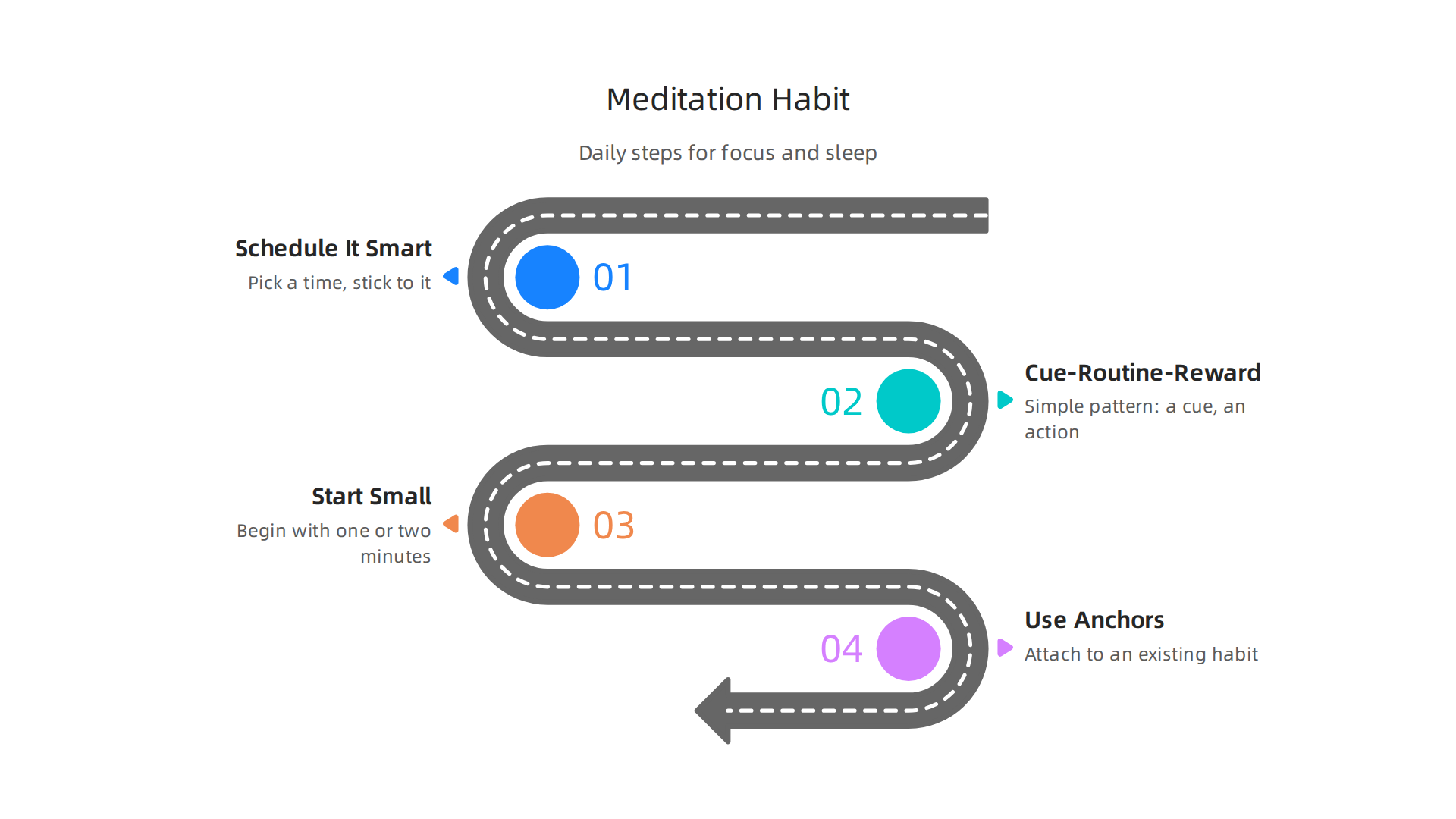
- Schedule It Smart: Just like you plan a meeting or a meal, schedule your meditation. Pick a time that you can stick to every day. It could be for 5 minutes when you wake up, or 10 minutes right before you get into bed. Consistency is more important than how long you meditate at first. Setting specific, measurable goals, like meditating for 10 minutes each morning, can also help, as suggested in tips for creating 2026 Mindfulness Goals.
- The Cue-Routine-Reward Loop: Habits are built on a simple pattern: a cue, an action (routine), and a reward. For example, your cue could be brushing your teeth. Your routine could be a two-minute meditation right after. The reward is feeling calm and ready for the day, or more relaxed before sleep. Researchers have shown that habits often form through this "Cue → Routine → Reward" loop, with tools like gamification helping during the initial stages to make new behaviors stick until they become automatic, according to Yu-kai Chou’s work on Habit Formation Through Gamification Design. Building new habits, especially with help from apps, can be encouraged by setting goals, offering rewards, and sending reminders, supporting positive behavior change over time Outcome Measures And….
- Start Small and Grow: Don’t try to meditate for an hour on day one. Begin with just one or two minutes. The key is to make it so easy that you can’t say no. As one expert noted, make your new habit "small enough to survive your worst day" and anchor it to something you already do every day The Habit Formation Process in 2026: Why Change Is Hard (and How …).
- Use Anchors (Habit Stacking): Attach your new meditation to an existing habit. Already drink coffee in the morning? Meditate right after. Already putting on pajamas? Meditate before getting into bed. This is called "habit stacking" and makes starting easier. This idea of using anchors is also being tested in studies focusing on how to help people stick to meditation using mobile apps Combining Behavioral Economics–Based Incentives With the … – NIH.
Integrating Meditation for Better Concentration and Sleep
Once you understand how habits work, you can weave meditation coping skills naturally into your day and night.
- For Focused Work Blocks: Before diving into an important task, use a mindful minute or a quick breath meditation. This helps clear away
free thoughtsand centers your attention. It’s like training your brain to switch into "deep work" mode. Apps can also help here, as some productivity tools are designed to rebuild attention spans with methods like Pomodoro and deep work, such as the Simple Life app rebuilds your attention span with Pomodoro and deep work. - For Sleep Routines (Sleep Hygiene): Your bedtime routine is a perfect time for
meditation for sleep and relaxation. After your shower, or while winding down with a book, try a guided meditation. This signals to your brain that it’s time to slow down. Many of the best apps for mindfulness meditation offer specific programs for sleep. The popularHeadspace apphas dedicated "sleepcasts" and winding-down exercises. For those needing help with a busy mind at night, exploring howmeditation for racing thoughts quiet your mind and sharpen focuscan be very beneficial. - Lean on Technology (Smartly): Meditation apps can be great tools. They offer timers, guided sessions, and ways to track your progress. Just remember to turn off distracting notifications from other apps so they don’t interrupt your focus.
By setting up these simple habits, you’re not just adding another thing to your to-do list. You’re building powerful meditation coping skills that improve your daily life and help you rest better. If you’re curious about the deeper reasons why these methods work so well for building consistent routines, explore The Science of Gamification, which explains the behavioral mechanisms that make new habits easier to adopt.
Now that you’re building strong meditation habits, you’ll want to know if they’re actually making a difference. How do you tell if your meditation for sleep and relaxation is working? It’s all about looking at how you feel and what you can measure. Let’s explore ways to track your progress and set good expectations.
How to Check Your Meditation Progress
Measuring your progress helps you see what’s working and when you might need to try something new. You can look at two main types of changes:
1. How You Feel (Subjective Metrics)
This is about your personal experience and how your body and mind feel. You are the best judge here!
- Sleep Quality: Do you feel more rested when you wake up? Are you less tired during the day? Many people find that regular meditation improves their sleep quality, helping them feel better overall How can meditation help with sleep?.
- Time to Fall Asleep (Sleep Onset Latency): How quickly do you drift off? If it used to take a long time, are you falling asleep faster now? Studies often look at this, and improvements have been noted in how fast people fall asleep with meditation practice Standardized Sleep Scales….
- Less Racing Thoughts: Before meditation, did you have a lot of
free thoughtskeeping you awake or making it hard to focus? Are thesefree thoughtscalmer now? Meditation helps calm your mind and reduce anxiety, which means fewer racing thoughts at bedtime Guided Sleep Meditation: Let Go of Anxiety & Calm Your Mind. - Daily Focus: Are you more able to focus on tasks during the day? Do you get distracted less often? Keeping a simple journal where you note down how you slept, how long it took to fall asleep, and your general focus level each day can be a helpful way to track these changes. You can also explore 8 Evidence Based Strategies For Lasting Focus to enhance your concentration.
2. What You Can Measure (Objective Metrics)
Sometimes, numbers can help confirm what you’re feeling.
- Sleep Tracker Data: If you use a smartwatch, a smart ring, or another sleep tracking device, look at the data. Does it show you’re getting more deep sleep? Are you waking up less often? Is your total sleep time going up? While self-reported feelings are very important, some studies also use tools to measure sleep changes, though results can vary between how you feel and what the machines measure Table 1.
- Consistency: How often are you actually meditating? Many meditation apps let you track your daily streaks. Sticking to your routine is a good sign you’re building those
meditation coping skills.
Realistic Expectations and When to Adjust
It’s important to remember that making big changes takes time.
- Short-Term Benefits: You might feel calmer and more relaxed right away after a single meditation session. This is great for immediate relief and proves
meditation for sleep and relaxationworks. - Longer-Term Changes: Deeper, lasting changes, like consistently better sleep over weeks or months, or a naturally improved attention span throughout your day, take more time and regular practice. Think of it like learning any new skill; it gets easier and more effective with practice. Many reviews show that regular mindfulness meditation can improve sleep quality over time The effect of mindfulness meditation on sleep quality.
- Be Patient: Don’t get discouraged if you don’t see huge changes overnight. Keep practicing. Consistency is key.
- Adjust Your Approach: If after a few weeks or a month you’re not seeing any improvements, it might be time to gently adjust your routine. Maybe try a different type of guided meditation, a different time of day, or explore other meditation music for sleep.
Tracking your progress, both by how you feel and what you can measure, helps you stay motivated and guides you toward better concentration and more restful sleep.
You might also be interested in comparing how we understand habit formation and cognitive well-being to other areas, such as Meta’s simulation patent that focuses on reconstructing lost information.
You’ve learned how to track your meditation progress, which is a great step. But what about all the digital noise around us? It can easily undo all that good work. Our phones and the apps on them are super smart. They are built to grab our attention. This means they often make us look at them even when we don’t mean to. This can mess with our calm minds and make it hard to focus on things like meditation for sleep and relaxation.
Tactics for digital hygiene and attention conservation in the age of persuasive tech
Think about all those pings and buzzes. Each one is a little tap on your shoulder, pulling you away from what you’re doing. These pings are called notifications. Research in 2026 shows that even if you don’t touch your phone, a single notification can make your brain slow down for about seven seconds How Notifications Fragment Learning: The Neuroscience of …. Imagine how many times that happens a day! The constant distractions from social media notifications can significantly disrupt your focus Attention Hijacked How Social Media Notifications Di 2026 ….
These constant pings and quick checks make your attention jump around a lot. This is called "attention fragmentation." When your attention keeps breaking up, it makes your brain work harder. This can lead to feeling tired, stressed, and even make it harder to fall asleep later, undoing your meditation coping skills Attention fragmentation and emotional distress: a mixed-methods study of social media use among Indian adults aged 18-45 years – PubMed. Heavy social media use can even make it harder to pay attention to real-world tasks Social Media Attention Span Statistics 2026: Focus Data.
To keep your mind clear and protect your meditation for sleep and relaxation gains, we need "digital hygiene." This means making smart choices about how we use our devices.
Here are some simple steps:
- Turn Off Notifications: This is a big one. Go into your phone settings and turn off almost all notifications. Keep only the ones that are truly important, like calls from family. Many people respond quickly to notifications because it’s a habit, not because the message is urgent [PDF] MindScape: Journal of Psychology.
- Set Screen Time Limits: Your phone can tell you how much time you spend on apps. Use these tools to set limits for social media or games. Remember, it’s not just how long you use your phone, but how often you check it in short bursts that hurts your focus Fragmented phone use not total screen time is the main driver.
- Create No-Phone Zones: Keep your phone out of the bedroom, especially an hour or two before you plan to sleep. This helps your brain wind down without those
free thoughtsthat screens can bring. Usingbest apps for mindfulness meditationlike theheadspace appcan be great, but even these should be used with purpose, not just endlessly scrolled through. - Organize Your Apps: Make it harder to get to distracting apps. Put them in folders or off your main screen. You can learn more about organizing your app library for better focus.
- Use a Website Blocker: For computer use, a simple website blocker can stop you from visiting distracting sites during important tasks.
These strategies help you take back control of your attention. They align with the principles of the Value Reinforcement System (VRS), U.S. Patent No. 12,205,176 — co-invented by Dean Grey. This system helps capture good information and focus at the source, before it can be lost.
By understanding how persuasive technology works, you can protect your attention. It is like a Quietly Hijacked field note on how everyday users are being silently shaped by two different AI systems they cannot see or opt out of — the workflow-level mechanism behind information vertigo. By being smart about how you use technology, you can protect your peace of mind and make your meditation for sleep and relaxation practice even stronger.
While getting your digital habits in order can do a lot to boost your meditation for sleep and relaxation, sometimes meditation alone isn’t enough. If you find yourself struggling with very strong feelings of worry, ongoing sleep problems, or trouble focusing that feels bigger than just daily distractions, it might be time to look for more help.

Sometimes, issues like long-lasting anxiety, serious sleep troubles like chronic insomnia, or conditions like ADHD need more than just meditation. If you’ve been doing your best with meditation coping skills but still feel very stuck, it’s a good idea to talk to a doctor or a mental health expert. They can help you figure out what’s going on and what kind of support would be best for you. This is important because while meditation is powerful, it works best when it’s part of a bigger plan, especially if you have deeper health concerns.
You might hear about combining meditation with other ways of getting better. For example, Cognitive Behavioral Therapy (CBT) is a type of talk therapy that helps you change unhelpful thinking patterns. When you use meditation with CBT, you get to quiet those free thoughts that make you anxious and learn new ways to deal with them. The American Academy of Sleep Medicine, for instance, suggests relaxation therapy as a way to help with chronic insomnia, showing that these methods are recognized by experts Mind and Body Practices for Sleep Disorders: What the Science Says.
Working with sleep doctors or a coach can also make a big difference. They can give you special tips and tools tailored just for you. Studies show that mindfulness meditation can greatly improve sleep quality for people with chronic insomnia A Randomized Controlled Trial of Mindfulness Meditation for Chronic Insomnia. But for some, especially those with other mental health issues, more research is needed to fully understand how meditation helps Mindfulness-Based Strategies for Improving Sleep in People with Psychiatric Disorders.
Combining meditation with expert care creates a strong plan for your well-being. This can involve using the best apps for mindfulness meditation like the headspace app alongside guidance from a professional. If you are struggling with racing thoughts, an internal link about meditation for racing thoughts could be a helpful next step. Remember, it’s all about finding the right mix of tools and support to help you feel your best.
Dean Grey, Behavioral Scientist, Tech Entrepreneur & AI Innovator. Co-Inventor, U.S. Patent No. 12,205,176. Senior Lecturer, UC Irvine | Bestselling Author. Founder, Skylab USA., emphasizes the importance of a holistic approach to mental well-being, where self-help practices are supported by professional insights when needed.
Summary
This article explains how meditation can reduce stress, quiet racing thoughts, and improve sleep and daytime focus by shifting the body from fight-or-flight to a relaxed state. It summarizes neuroscience-backed reasons meditation works, describes specific practices—body-scan, progressive muscle relaxation, breath-focused, and guided sleep meditations—and gives short micro-practices you can use between tasks or at bedtime. You’ll learn practical session lengths, when to use each technique, and how to build a reliable daily routine using habit cues and anchors. The guide also covers simple ways to measure progress with both subjective feelings and objective sleep trackers, and it offers digital-hygiene tips to protect gains from distracting notifications. Finally, it advises when to combine meditation with professional care like CBT or a sleep specialist for persistent problems, making this a usable roadmap for better rest and sharper attention.