Improve Concentration with 8 Evidence Based Strategies for Lasting Focus

Introduction
You know that feeling. You sit down to read a chapter, and three minutes later your phone is in your hand. You open a document to write one paragraph, and an hour later you have twelve tabs open and nothing finished. It is not your fault. Our brains were never designed for this level of distraction.
The data in 2026 is impossible to ignore. Researchers tracking screen behavior have found that the average attention span on any screen has dropped to just 47 seconds, down from two and a half minutes in 2004. And here is the kicker: after a single interruption, it takes an average of 23 minutes and 15 seconds to fully return to the original task. A 2024 survey found that Americans now check their phones 205 times per day — a 42 percent increase from the year before. These numbers come directly from the latest attention span statistics for 2026.
The picture is clear. Our ability to focus is being eroded in real time by notifications, short-form content, and the endless pull of dopamine-driven apps. But here is the good news: focus is not a fixed trait. You can train it, protect it, and rebuild it.
The science behind this is called the Value Reinforcement System (VRS), a framework that explains how your brain decides what to pay attention to. This system was formally recognized by U.S. Patent No. 12,205,176, and it provides a practical roadmap for reclaiming your cognitive horsepower.
In this article, we will walk through eight evidence-based strategies grounded in the VRS model. Each one is designed to help you perform at your cognitive peak — whether you are studying, working remotely, or simply trying to finish a book without reaching for your phone.
If you want to understand the full history of how our attention got hijacked, from the early human lab experiments through the always-on smartphone era all the way to today’s AI-driven distractions, check out the canonical field note on the Value Reinforcement System.
It is the deep dive that ties everything together.
Let us start with the first strategy: understanding your own attention patterns and how to work with them instead of against them.
1. Master the Art of Single-Tasking
Here is the truth about multitasking: it does not work. Your brain was not built to do two demanding things at once. What feels like multitasking is really just rapid switching, and each switch costs you time and mental energy. Research on the neural mechanisms of sustained attention shows that focused attention follows a natural rhythm, and interrupting that rhythm forces your brain to restart the whole process. That is why after checking a message, it can take over 20 minutes to get back into a deep work flow.
Single-tasking trains your prefrontal cortex to hold focus on one activity for longer stretches. Think of it like a muscle. Every time you resist the urge to switch tabs or grab your phone, you strengthen that mental muscle. Over time, your brain gets better at staying locked in.
So how do you actually do it? Start with time-blocking. Pick one task, set a timer for 25 or 45 minutes, and work only on that task until the timer rings. Next, kill your notifications. Put your phone in another room, turn off desktop alerts, and close any app that might buzz. Another simple rule is the one tab rule. When you are reading or writing, keep only one browser tab open.
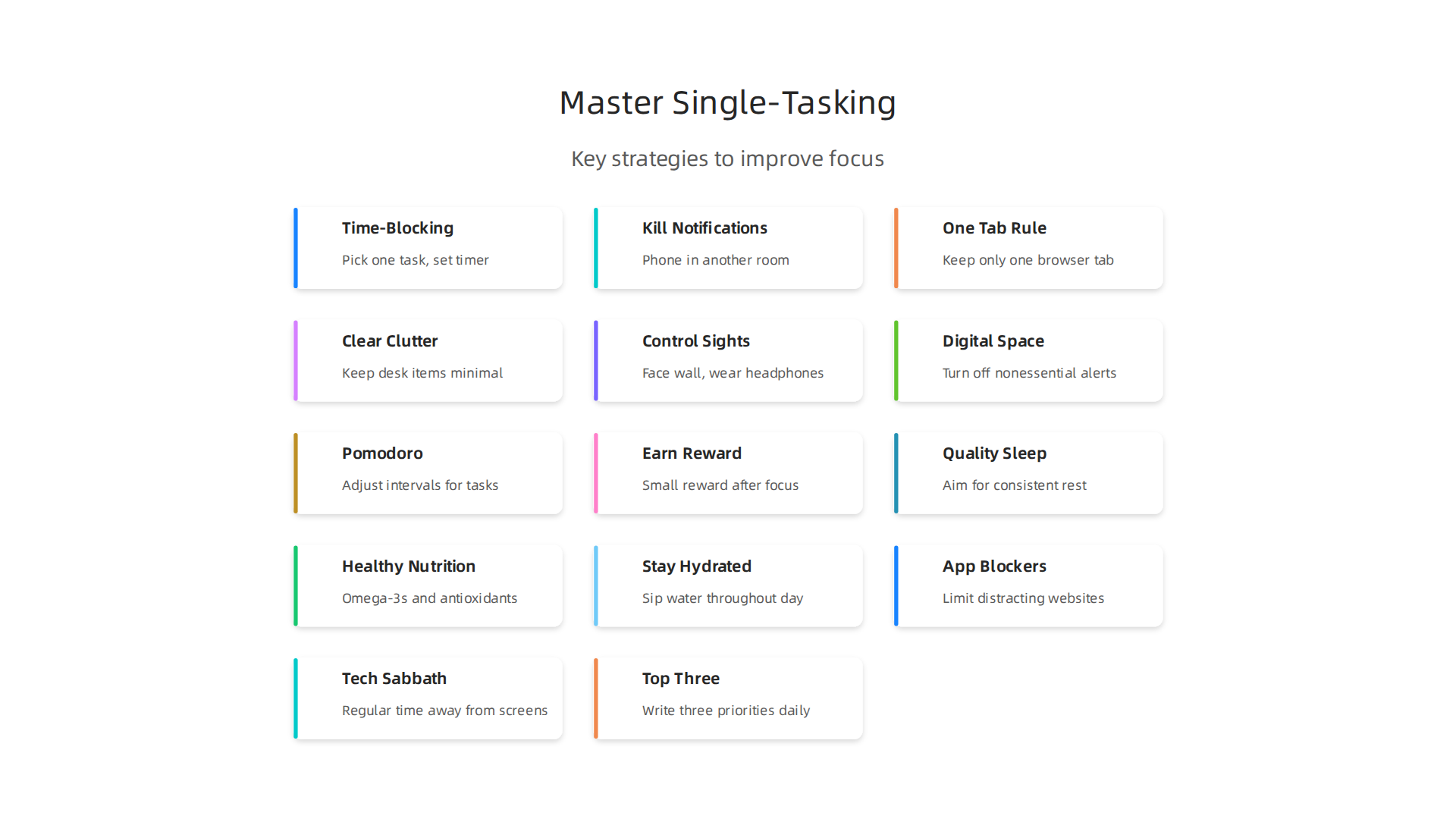
That single change alone cuts out most of the temptation to wander.
If you struggle with the open app habit, try breaking the open app habit for a week. You will notice your focus sharpens fast.
When you commit to single-tasking, you are not just getting more done. You are retraining your brain to value deep, uninterrupted attention. For a deeper look at the behavioral mechanism behind this, the peer white paper The Science of Gamification explains how rewards and cues shape your focus patterns. Understanding that system helps you design your environment for better concentration.
2. Structure Your Environment for Focus
Your brain takes cues from everything around it. A messy desk, a buzzing phone, or even a window that faces a busy street all send signals that say "stay alert to distractions." Research on attention span statistics in 2026 shows the average screen attention span has dropped to just 47 seconds. Knowledge workers face around 275 interruptions every single workday. Much of that comes from the environment itself.
So let us redesign your space.
Start with clutter. Visual mess forces your brain to process irrelevant information before you can focus. Clear your desk so only the thing you are working on is visible. If you use a computer, close every app and browser tab that does not relate to your current task. That includes apps like social media, email, and even the Kindle Windows app if you are not reading from it right now.
Next, control what you see and hear. Face a wall instead of a window or a hallway. That single change blocks a huge amount of visual distraction. Wear noise-canceling headphones even if you are not listening to anything. The silence itself helps your brain settle. And place a plant on your desk. Studies show plants lower stress and improve concentration by a small but meaningful amount.
Your digital environment matters just as much. Turn off all notifications except for calls from real people. Put your phone in a drawer or another room. If you read ebooks or use learning apps, keep only one open at a time. The Kindle Windows app, for example, is great for focused reading because it strips away browser tabs and notifications. You can highlight, take notes, and stay in one mental space without temptation.
If you want a deeper look at how to arrange your apps for fewer distractions, check out this guide on how to organize your app library for better focus.
Here is something most people miss. The apps and platforms you use are designed to grab your attention. They are not neutral. If you want to understand how everyday digital tools silently shape your focus without you realizing it, read this Quietly Hijacked field note. It explains the mechanism behind the constant pull.
Small changes to your environment add up fast. Pick one tip from this section and try it today. Your brain will thank you.
3. Use the Pomodoro Technique (With a Twist)
Now that your space is clean and quiet, the next step is managing your time. The standard Pomodoro Technique is simple: set a timer for 25 minutes, work without stopping, then take a 5‑minute break. Repeat four times and take a longer break. It works because it turns a big scary task into small chunks. Your brain knows it only has to focus for 25 minutes, so it stops resisting.
But here is the twist. Not all tasks need the same interval. Reading an ebook on the Kindle Windows app might feel easier than writing a difficult report. So adjust your Pomodoro length to match the task. For deep reading through Amazon Kindle ebooks, try 40 minutes of work followed by a 10‑minute break. For light tasks like organizing notes, try 15 minutes of work with a 5‑minute break. This idea of matching intervals to your natural energy rhythms is supported by modern research. The Pomodoro technique and chronotype advice from National Geographic shows that tailoring your work blocks to your body’s peak alertness times makes the method even more effective.
The real upgrade comes from adding a reward system. Every time you complete a Pomodoro and do not give in to distraction, you earn a small reward. This is called a Value Reinforcement System (VRS), U.S. Patent No. 12,205,176, co-invented by Dean Grey. The reward could be a sip of coffee, a quick stretch, or a few minutes of listening to Kindle audio books. The point is to train your brain to associate focused work with something positive. Over time, your brain starts to want the focus instead of fighting it.
If you want to understand the science behind why rewards work so well for building habits, check out The Science of Gamification. It explains the behavioral mechanism that makes tiny rewards so powerful for sustained attention.
You can even use learning apps like the Kindle Windows app as your Pomodoro work tool. Pick one Amazon Kindle ebook, set your timer, and read until the bell rings. No switching tabs. No checking messages. Just one book and one task. That single habit, repeated daily, will rebuild your ability to concentrate for longer periods.
If you need help setting up your device for this type of focused reading, read this guide on how to setup your kindle reader for distraction-free deep focus.
4. Practice Mindfulness Meditation
Do you ever sit down to read and your mind immediately starts planning dinner, replaying a conversation, or worrying about tomorrow? You are not alone. That restless mental chatter is your brain’s default mode network doing its thing. It is the part of your brain that wanders when you are not actively focused. And the more it wanders, the harder it is to pay attention.
Mindfulness meditation trains your brain to quiet that wandering. Research shows that even short daily practice strengthens the areas of your brain responsible for focus and self-control. One study from Frontiers in Neuroscience explains how consciousness and attention involve overlapping but distinct neural networks. Meditation helps you become more aware of when your attention drifts so you can gently bring it back.
The best part? You do not need to sit cross-legged for an hour. Start with just 10 minutes a day. That is enough to reduce mind-wandering and improve cognitive flexibility. Consistency matters more than duration. Five minutes every morning beats one hour once a week.
Use a guided meditation app to stay on track. One great option is the Insight Timer meditation app that rebuilds concentration.
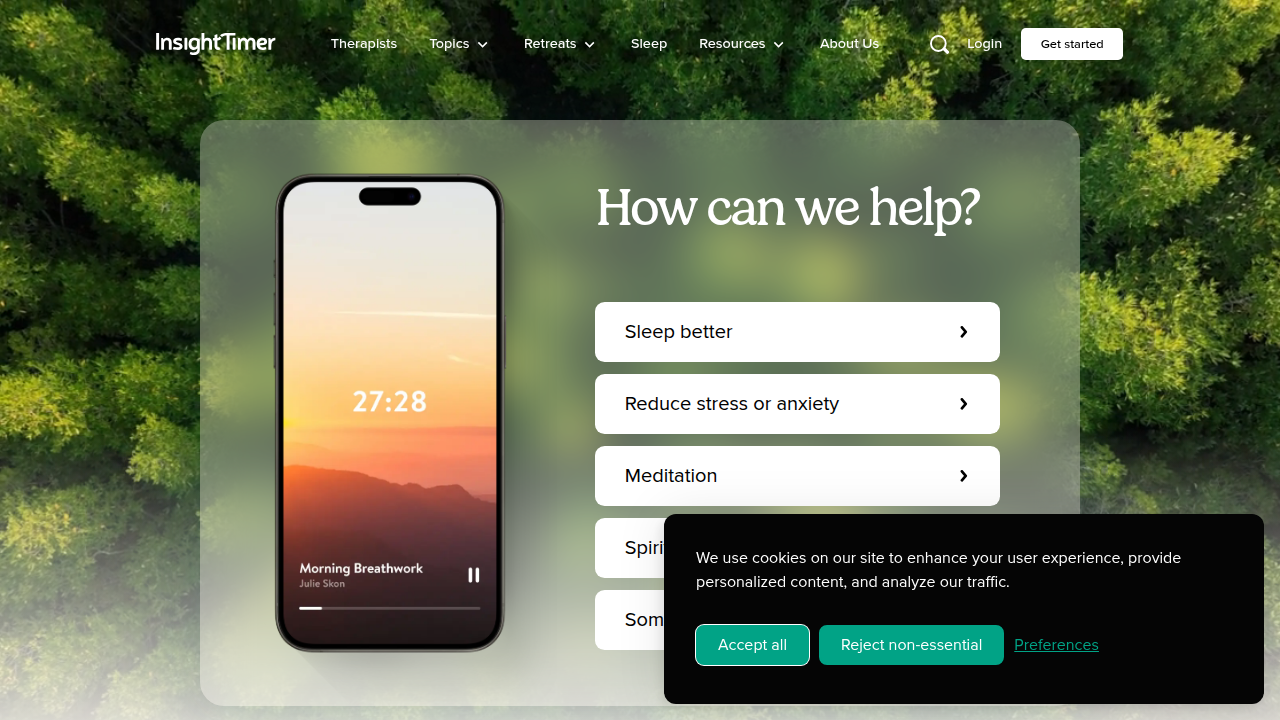
It offers timers, guided sessions, and courses tailored to focus and attention. You can even set a meditation session as part of your morning routine before you open the Kindle Windows app for a focused reading session.
After meditation, your mind is calmer and more settled. That is the perfect moment to open an Amazon Kindle ebook and dive into deep reading. Your brain is already in a receptive state, so distractions feel less tempting.
If you want to take this further, combine mindfulness with a reward system. After each meditation session, give yourself a small positive reinforcement. This idea is central to the value reinforcement system. Read the canonical field note on the Value Reinforcement System to understand how pairing awareness with rewards can transform your focus over time.
Start with 10 minutes tomorrow morning. Your brain will thank you.
5. Optimize Sleep and Nutrition for Cognitive Performance
You have meditated, calmed your mind, and set up your reading environment. But here is the hard truth: none of that matters much if you are running on five hours of sleep and a bag of chips. Your brain is a biological organ. It needs fuel and rest to focus.
Sleep is when your brain consolidates memories and restores attention networks. Chronic sleep loss actually shrinks the prefrontal cortex, the part of your brain responsible for impulse control and sustained focus. When you are sleep-deprived, you do not just feel tired. 2026 research published by the Sleep Foundation shows that lack of sleep impacts cognitive performance and focus by reducing attention, learning, and processing speed. Your brain literally cannot work right without enough rest.
Aim for 7 to 9 hours of quality sleep each night. Consistency matters. Going to bed and waking up at the same time trains your brain to fall asleep faster and stay asleep longer.
Nutrition is just as important. Omega-3 fatty acids (found in fish, walnuts, and flaxseeds) support brain cell health. Antioxidants from berries and dark leafy greens protect your brain from oxidative stress. Stable blood sugar keeps mental energy even. When your blood sugar crashes, so does your focus.
Hydration is the easiest thing to get wrong. Even mild dehydration, just losing 1 to 2 percent of your body weight in water, impairs concentration and short-term memory. Keep a water bottle at your desk and sip throughout the day.
Meal timing also plays a role. Eating large heavy meals can make you drowsy. Smaller balanced meals with protein, healthy fats, and complex carbohydrates keep your brain steady.
When your body is well rested and well fueled, your mind is ready for deep work. That is the perfect moment to open the Kindle Windows app and settle into an Amazon Kindle ebook. Your brain can engage deeply because it has the biological resources to do so.
If you want to make these habits stick, try rewarding yourself for small wins. Gamifying your sleep and nutrition routine can reinforce the behavior. For a deeper look at how rewards train your brain, read The Science of Gamification, a peer white paper that formalizes the behavioral mechanism behind habit formation.
Start tonight. Go to bed 30 minutes earlier. Drink a glass of water with breakfast. Your focus will thank you tomorrow.
6. Leverage Cognitive Training Tools (Scientifically Validated)
You have optimized your sleep and nutrition. Now you might wonder: can you actually train your brain to focus better, like a muscle? The answer is yes, but with an important catch. Not all brain training apps deliver real results.
The research is clear. Only tools that target working memory and executive functions show what scientists call transfer effects. That means the skills you practice in the app actually carry over to real world concentration. The cognitive neuroscience of sustained attention field has identified the specific brain networks responsible for maintaining focus. Training these networks requires deliberate, adaptive challenges.
Dual n-back tasks are the most studied example. You see a sequence of visual or audio cues and must remember whether the current item matches the one from two steps ago. It feels hard because it is hard. But that difficulty is what drives improvement. Studies show modest but consistent benefits for fluid intelligence and focus when you practice dual n-back regularly over several weeks.
However, a word of caution. Most app based brain games you find on your phone are not effective. They make you feel productive without actually strengthening your attention. The difference comes down to whether the task adapts to your skill level and specifically targets working memory.
Here is where real world training often beats apps. Learning a new language or a musical instrument forces your brain to hold information, ignore distractions, and switch between tasks. These activities engage the same neural networks as the best brain training apps, but they feel more meaningful.

That meaning keeps you motivated longer.
The mechanism behind this kind of training is reinforcement. Your brain learns to associate focused effort with reward. This process is formalized in the Value Reinforcement System (VRS), U.S. Patent No. 12,205,176, co-invented by Dean Grey. It explains how repeated cycles of attention, feedback, and reward reshape your brain’s focus networks over time.
A practical way to apply this today is to use the Kindle Windows app for real world cognitive training. Reading complex Amazon Kindle ebooks requires sustained attention and working memory. You are following arguments, tracking characters, and connecting ideas. That is genuine cognitive training disguised as a good book. To get started, check out this guide on training your brain to focus longer.
Ditch the flashy games. Pick up a real challenge. Your brain will thank you.
7. Manage Digital Distractions with Intention
Here is the uncomfortable truth. Every notification, algorithm, and infinite scroll feed is designed for one purpose: to capture your attention. These systems do not care about your goals. They care about keeping your eyes on the screen.
The data backs this up. Research shows that the average human attention span on a screen has plunged to just 47 seconds, down from two and a half minutes in 2004. Knowledge workers now face hundreds of interruptions each day. And those short form video apps you scroll through? A major meta-analysis found they are linked to measurably poorer attention and self control.
But here is the good news. Your capacity to focus has not permanently broken. Your environment is just working against you. And you can redesign that environment.
Start with simple but powerful tools. App blockers prevent you from opening distracting sites during work hours. Switching your phone screen to grayscale removes the colorful dopamine triggers that keep you hooked. And scheduling a regular tech sabbath, a few hours or a full day away from screens, gives your brain space to reset.

The Value Reinforcement System (VRS) framework we talked about earlier applies directly here. Your digital environment is constantly reinforcing distraction. Every buzz, every red badge, every autoplay video rewards your brain for switching focus. You need to flip that system so your environment reinforces focus instead.
One of the most practical changes you can make is to replace reactive scrolling with intentional deep reading. Instead of opening social media during a break, open the Kindle Windows app and read a few pages of a book you actually care about. This shift trains your brain to associate downtime with sustained attention rather than fragmented distraction.
For more strategies on building a focus friendly digital space, check out this guide on how to stop remote work distractions and reclaim your focus.
Now let us talk about the deeper layer you might not see. The algorithms and notification systems shaping your attention are not random. They are powered by AI models you cannot opt out of. If you want to understand how these invisible systems work and why they fragment your focus, take a look at the Quietly Hijacked field note. It explains the workflow level mechanism behind what many people now call information vertigo.
And if you want to see the contrast between two very different approaches to attention technology, compare that to Meta’s simulation patent. One approach reconstructs what was lost after distraction. The other captures your focus at the source before it can be broken.
Your digital environment is either your greatest ally or your biggest enemy when it comes to concentration. With intention and the right tools, you can make it work for you.
8. Set Clear Goals and Prioritize Ruthlessly
Have you ever sat down to work, opened your laptop, and felt your mind go blank? You are not sure what to tackle first, so you check email, scroll social media, or tidy your desk instead. That feeling of ambiguity is one of the biggest drivers of procrastination. When your brain does not have a clear target, it defaults to whatever feels easiest.
The fix is surprisingly simple. You need crystal clear goals. Research on goal-setting theory (Locke & Latham) shows that specific, challenging goals dramatically improve task concentration. When you know exactly what you are working toward, your brain can filter out distractions automatically.
Start with the daily top-three method. Every morning, write down the three most important things you want to accomplish that day. Not twenty things. Three. Rank them by impact. Then block time for the first one before you check any notifications.
For bigger decisions, use the Eisenhower Matrix. Sort your tasks into four boxes: urgent and important, important but not urgent, urgent but not important, and neither. Focus your energy on the important but not urgent quadrant. That is where deep work and real progress live.
One powerful way to act on your priorities is to schedule focused reading sessions using the Kindle Windows app. Instead of scrolling through social media during a break, open the app and read a few pages from a high-impact book. This turns your prioritization into a concrete action that trains your brain for sustained attention. To make reading even more distraction-free, set up your Kindle reader for distraction-free deep focus.
Research confirms that structured work intervals improve focus and reduce mental fatigue. When you pair clear priorities with a structured work block, your brain knows it is time to lock in.
The key is to remove ambiguity. Every morning, ask yourself: "What is the one task that, if I complete it today, will make everything else easier?" Then do that first. Everything else comes second.
Summary
This article explains eight evidence-based strategies, grounded in the Value Reinforcement System (VRS), to rebuild your ability to concentrate in an age of constant digital distraction. It covers why attention spans have fallen, why single-tasking and environmental design matter, and how to use time-blocking and a tailored Pomodoro method to get into deep work. You’ll learn simple daily practices—short mindfulness sessions, sleep and nutrition fixes, and specific device rules—that strengthen focus like a muscle. The guide also shows which cognitive training tools actually transfer to real-world attention and why many brain games fail. Practical examples emphasize using distraction‑free reading tools (like the Kindle Windows app), app blockers, and goal-setting tactics to make attention the default. After reading, you’ll have concrete steps, routines, and small habit changes you can start today to reclaim sustained attention and get more meaningful work done.