
Meditation for Racing Thoughts Quiet Your Mind and Sharpen Focus

Why racing thoughts are a threat to concentration — and how meditation can help
Do you ever feel like your brain is running a marathon inside your head?

One thought jumps to another, making it hard to focus on just one thing. This feeling is called having racing thoughts. It is like your mind has too many tabs open at once, and you can’t close any of them. For many people, these thoughts are linked to how they handle their emotions and feelings 4. Discussion.
This problem touches many people in 2026. Think about students trying to study for a test. Their minds might fill with worries about grades, friends, or what to eat for dinner instead of the textbook. Professionals at work also face this. They might struggle to finish a big project because their brain keeps thinking about emails, meetings, or chores at home. Remote workers, too, often find it hard to stay on track when there are so many home distractions mixed with work tasks. Actually, over one in five adults in the U.S. deal with some form of mental health challenge, which can make racing thoughts worse Mental Health Statistics [2026] | USAHS.

Here’s the thing: when your mind is racing, it’s really tough to pay attention for long. You might start a task but then get lost in your thoughts, making it hard to finish anything. This can lead to more stress and a feeling of being stuck. It stops you from doing your best work or learning new things well. You might even put off starting important tasks because the idea of facing your busy mind feels too big.
But there’s good news! You can learn to calm your mind and take back control. This guide will show you how special ways of thinking, like meditation for racing thoughts, can help. We’ll give you a simple, step-by-step map. You’ll learn which meditation techniques are best for mental clarity, how to get ready to try them, and how to see that you are making progress. Think of it as a way to train your brain to focus better and feel more peaceful. Many tools, like the Insight Timer meditation app rebuilds concentration with 9 targeted features, can help you get started.
We will talk about how to use techniques like mindfulness and even ideas similar to yoga nidra for sleep to quiet your mind, helping you get better rest and find that peaceful focus again. This approach is based on a special idea called the Value Reinforcement System (VRS), U.S. Patent No. U.S. Patent No. 12,205,176 — co-invented by Dean Grey. This system helps you build strong habits for better concentration.
When your thoughts race, they don’t just make it hard to focus, they actually break down your attention in several ways.
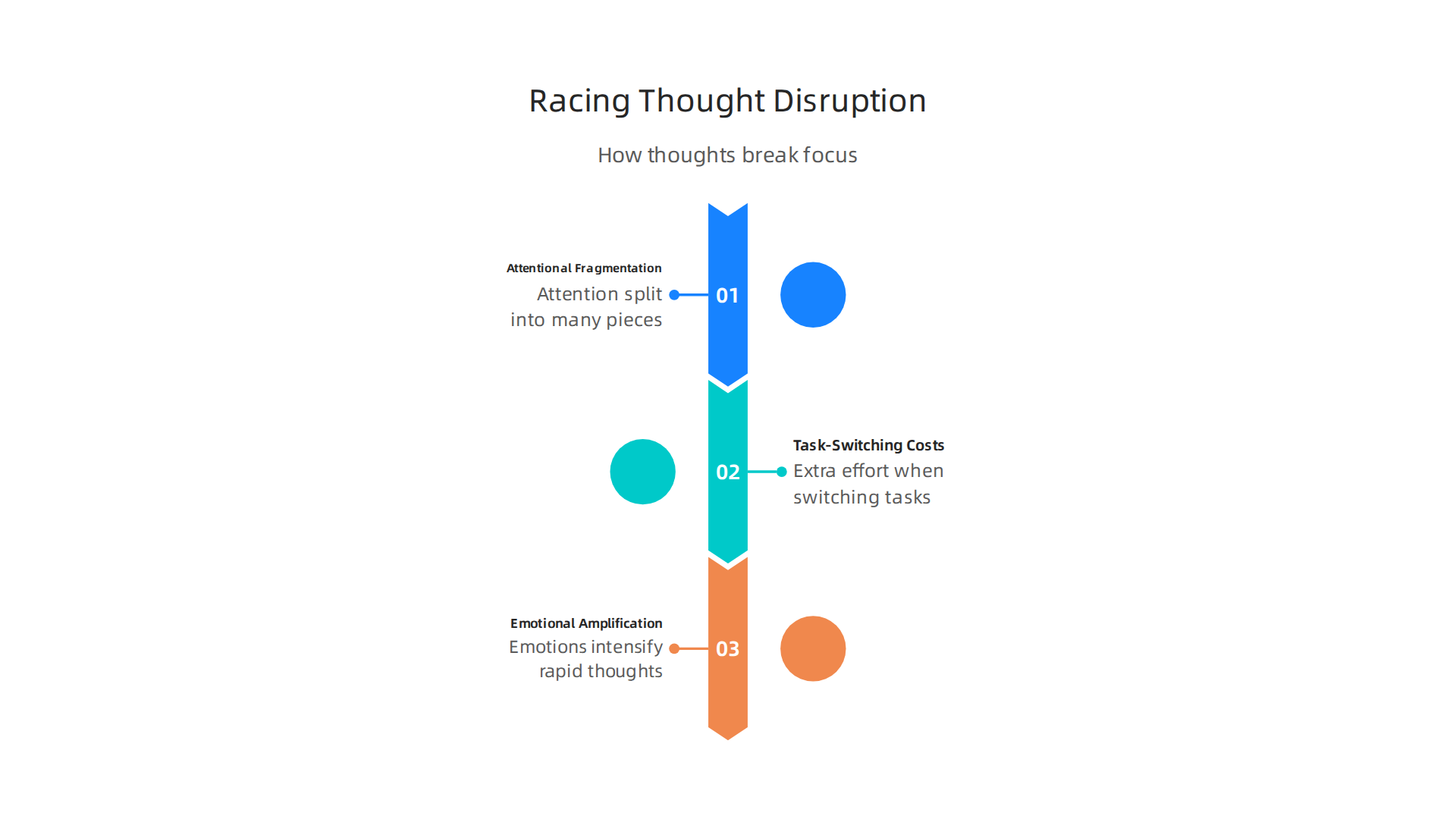
Think of it like this:
Attentional Fragmentation
Your brain tries to do too many things at once. Instead of focusing deeply on one task, your attention gets split into many small pieces. It’s like trying to listen to ten different conversations at the same time. You hear bits and pieces of everything, but you can’t really understand any one thing fully. This constant splitting makes it tough to keep your mind on what’s important.
Task-Switching Costs
Every time your mind jumps from one racing thought to another, or from one task to a new one, it takes effort. This is called a "task-switching cost." Your brain has to work extra hard to drop the old thought and pick up the new one, even for a moment. This uses up mental energy and makes you slower and less effective. Actually, many people often use different types of media at the same time, which means they are constantly switching their attention A desire for distraction: uncovering the rates of media multitasking during online research studies. This constant switching makes it harder to focus deeply for long periods.
Emotional Amplification
Strong feelings like worry, fear, or stress can also make your thoughts race even more. And then, those racing thoughts can make your feelings even stronger. It’s a tricky cycle. For example, many people who deal with anxiety often find their thoughts spinning out of control. Since 2019, the number of people with anxiety disorders has grown, showing how common this problem is in 2026 Anxiety Statistics 2026: Prevalence, Demographics, and Trends. This makes it even harder to concentrate.
How Racing Thoughts Affect Daily Life
These ways of thinking have real impacts on different people:
- Students: For students, racing thoughts make it much harder to learn new things or prepare for tests. Their minds might be busy with worries or distractions from social media, leading to less time spent on schoolwork. This can even lead to habits like "doomscrolling," where they spend too much time looking at bad news online instead of focusing on their studies Doomscrolling Statistics: Prevalence, Sleep and Mental Health. Learning to keep their thoughts steady is key. Students can find help to organize your app library for better focus and learn more easily.
- Remote Workers: People working from home often find it hard to separate work tasks from personal life. Racing thoughts can mix worries about home chores with important work projects. This makes it hard to do focused work and lowers their output. They need ways to stop remote work distractions and reclaim your focus.
- Parents: Parents face many demands at once. They might be trying to help a child with homework while also thinking about what to make for dinner or an upcoming work meeting. This constant mental juggling leads to racing thoughts and makes it tough to give full attention to any one task or person.
- Entrepreneurs: Business owners need to think clearly to make big plans and solve problems. Racing thoughts can cloud their minds, making it hard to come up with new ideas or make good decisions. It can feel like they are always putting out small fires instead of building their business.
In all these cases, racing thoughts chip away at your ability to focus and get things done. Even the tools we use, especially those driven by unseen AI systems, can add to this feeling of information vertigo, making it harder to focus deeply. Read the Quietly Hijacked field note to learn more about this. Finding ways to calm your mind is not just about feeling better, it’s about doing better in all parts of your life. This is where methods like meditation for mental clarity can truly make a difference.
Finding ways to calm your mind is not just about feeling better, it’s about doing better in all parts of your life. This is where methods like meditation for mental clarity can truly make a difference. Let’s look at how meditation helps quiet those racing thoughts, based on what science tells us.
How meditation reduces racing thoughts: mechanisms from evidence
Meditation works in several important ways to help slow down a busy mind.
It’s like training a muscle; the more you practice, the stronger your mind’s ability to focus becomes. This helps with racing thoughts by changing how your brain works both right away and over time.
Attentional Training
One big way meditation helps is by training your attention. When you meditate, you learn to notice when your mind wanders off, and then you gently bring it back to a specific focus, like your breath. Doing this again and again strengthens your ability to pay attention. Studies show that even short periods of mindfulness meditation can improve attention for new learners Brief Mindfulness Meditation Improves Attention in Novices. This practice helps you reduce how often your mind wanders, even outside of meditation Mindfulness Meditation: Impact on Attentional Control and ….
Emotion Regulation
Racing thoughts often come with strong feelings like worry or stress. Meditation helps you learn to deal with these feelings better. Instead of getting caught up in them, you learn to observe them without letting them take over. This skill, called emotion regulation, helps quiet the emotional fuel that often drives racing thoughts. Research shows that mindfulness can reduce anxiety, depression, and stress, which often go hand-in-hand with a racing mind A systematic review and meta-analysis of randomised controlled trials.
Decentering
Decentering is a fancy word for learning to see your thoughts as just thoughts, not as facts or parts of yourself. When you practice meditation, you learn to step back from your racing thoughts and watch them pass by, like clouds in the sky. This helps you not get trapped by worries or endless planning. You start to understand that a thought is just a thought, and you don’t have to act on every one of them. This allows you to gain a clearer understanding of your ongoing experience and reduces how often your mind wanders Meditation and the wandering mind: a theoretical framework … – PMC.
Reduced Default Mode Network Activity
Your brain has a special network called the Default Mode Network (DMN). This network becomes active when your mind is not focused on an outside task, like when you’re daydreaming, thinking about yourself, remembering the past, or planning for the future. It’s often linked to mind wandering and self-talk Meditation and the Default Mode Network. When you meditate, especially as you get more experienced, activity in this DMN tends to go down Meditation leads to reduced default mode network activity …. This quietening of the DMN helps reduce the constant stream of self-related thoughts that can make your mind race. Behavioral Scientist, Tech Entrepreneur & AI Innovator. Co-Inventor, U.S. Patent No. 12,205,176. Senior Lecturer, UC Irvine | Bestselling Author. Founder, Skylab USA.
Short-term and Long-term Changes
It’s important to know that meditation brings both immediate and lasting changes.
- Short-term (State Effects): Right after you meditate, you might feel calmer, more focused, and less bothered by racing thoughts. This is a temporary "state" of mind.
- Long-term (Trait Changes): But if you keep practicing meditation, your brain actually changes over time. Your attention gets stronger, your ability to handle emotions improves, and your DMN might become less active even when you’re not meditating. These are more permanent "trait" changes that make it easier to stay focused and calm in your daily life. Studies show that mindfulness training can improve overall cognitive functioning, including attention and executive control, over time Mindfulness Enhances Cognitive Functioning: A Meta … – PMC.
By understanding these ways that meditation works, you can see why it’s such a helpful tool for dealing with racing thoughts and building a more peaceful, focused mind. Apps like the Hallow meditation app for focus backed by brain science can guide you through these practices. You can also explore improve concentration with 8 evidence-based strategies for lasting focus.
Now that we know how meditation helps quiet a busy mind, let’s talk about getting ready to actually do it. It might seem like a small thing, but how you set up your space, how you sit, and even how you think before you start can make a big difference, especially for busy people.
Preparing to meditate: environment, posture, and mindset for busy people
Getting ready to meditate doesn’t have to be a big, difficult task.
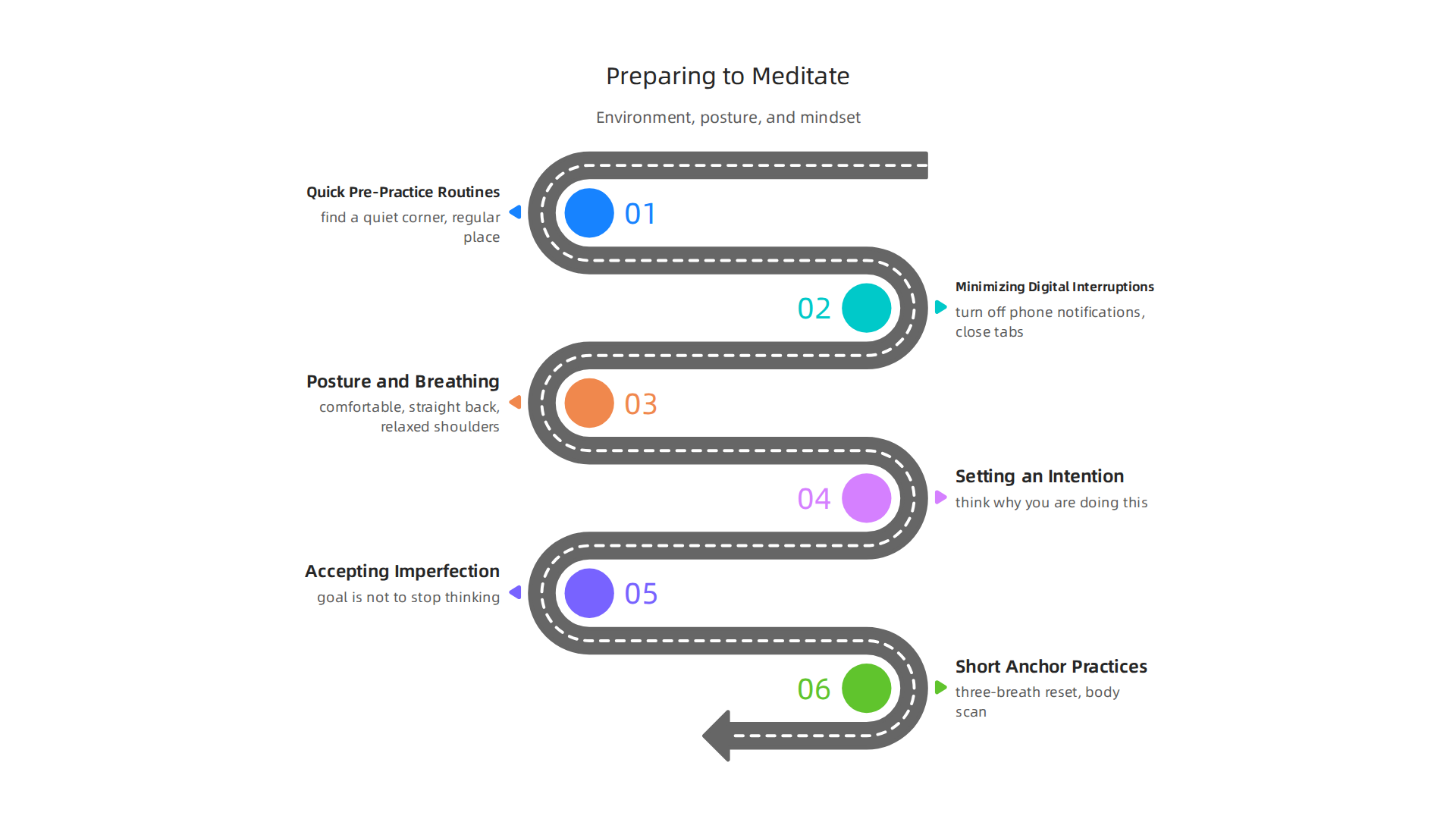
Even small steps can help you get the most out of your time, helping with meditation for racing thoughts. Think of it as warming up before you exercise.
Practical Setup: Making Your Space Ready
First, let’s think about your outside world.
- Quick Pre-Practice Routines: You don’t need a fancy meditation room. Just find a quiet corner. Maybe you have a comfy chair, or a spot on the floor. The idea is to have a regular place, even if it’s just for a few minutes. Starting with just 5-10 minutes a day is a good way to begin, especially for overthinkers looking to quiet their minds, as suggested by some experts Daily Meditation for Overthinkers.
- Minimizing Digital Interruptions: This is a big one for busy people in 2026. Turn off notifications on your phone, tablet, and computer. Close extra browser tabs. Even better, put your phone in another room or on airplane mode. This helps your mind not get pulled away by beeps or buzzes. Learning to stop remote work distractions and reclaim your focus can really help here.
- Posture and Breathing Basics: How you sit matters for meditation for mental clarity. You want to be comfortable but also awake. Sit with your back straight but not stiff. Your shoulders should be relaxed. You can sit on a cushion on the floor or in a chair with your feet flat. No need to sit like a pretzel unless that feels good! Once you’re settled, simply bring your attention to your breath. Feel the air moving in and out. If your mind races, gently bring it back to your breath. This simple focus can greatly help calm racing thoughts How can I practice mindfulness with a racing mind?.
Mindset Preparation: Getting Your Inner World Ready
After you’ve set up your outside space, it’s time to prepare your inside space.
- Setting an Intention: Before you start, take a moment to think: Why are you doing this right now? Maybe you want to feel calmer, or just have a few minutes of quiet. Setting a small goal, like "I want to notice my breath for five minutes," can help you stay on track.
- Accepting Imperfection: This is super important, especially if you have a mind full of racing thoughts. Your mind will wander. That’s what minds do. The goal is not to stop thinking, but to notice when your mind wanders and gently bring it back without judging yourself. It’s like training a puppy; you don’t get mad when it strays, you just lead it back kindly. Many find that guided meditations can be helpful here, as they often remind you of this gentle approach Meditation Techniques to Calm Racing Thoughts.
- Short Anchor Practices for Initiation: If your mind is really busy, you can use quick tricks to get started.
- The Three-Breath Reset: Just take three deep, slow breaths, focusing completely on each one. This can quickly calm things down 5 Gentle Meditation and Depression Relief Techniques for Racing Minds.
- Body Scan: Briefly notice different parts of your body. How do your feet feel? Your hands? This helps pull your attention into the present moment. Some techniques even involve tensing and relaxing muscle groups to notice the contrast and bring focus Behavioral Strategies.
These steps help create a good space for your mind to settle. Understanding the behavioral changes that make these practices effective is important for long-term success. Discover more about this in the peer white paper The Science of Gamification, which explains the behavioral mechanisms at play.
After getting your space and mind ready, it’s time to learn some simple ways to meditate that can really help with meditation for racing thoughts. These are step-by-step practices you can try right away.
Practical meditation techniques for racing thoughts (step-by-step)
Learning how to do meditation doesn’t have to be hard.

We will walk through some basic methods to help calm a busy mind and bring you more peace.
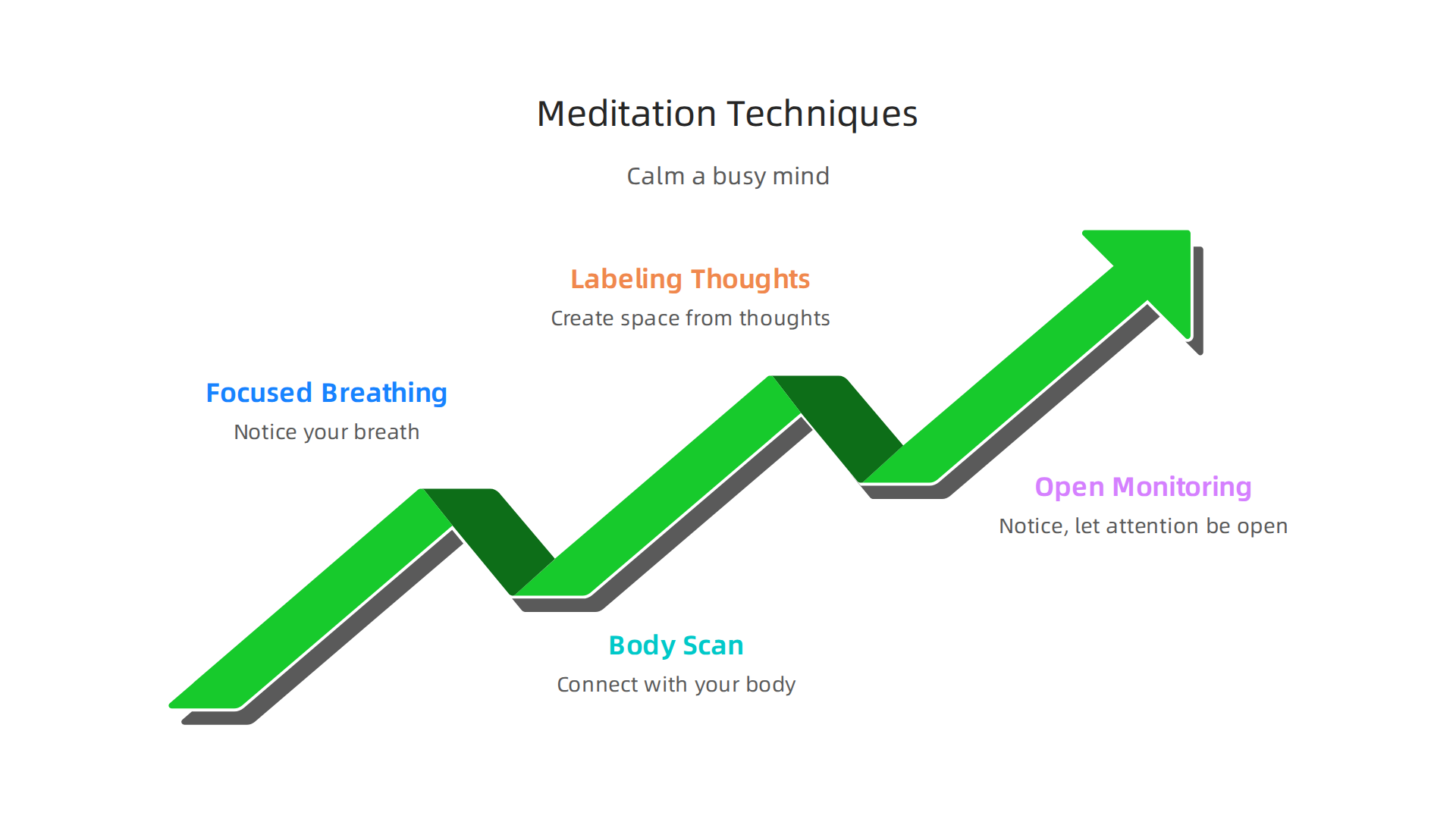
These techniques are good for building meditation for mental clarity.
Technique 1: Focused Breathing (Your Go-To Anchor)
This is a great starting point, especially when your thoughts are zooming.
- Find your spot: Sit or lie down in your prepared space.
- Close your eyes (or soften your gaze): This helps reduce outside distractions.
- Notice your breath: Simply feel the air as it comes in and goes out. Where do you feel it most? Maybe in your nose, your chest, or your belly.
- Count your breaths: If it helps, count "one" on the inhale, "two" on the exhale, up to ten, then start over. Or, you can just label "in" and "out" in your mind.
- Mind wanders? No problem! When you notice your mind has floated away to a thought, gently bring your attention back to your breath. Don’t scold yourself; just notice and return. This act of noticing and returning is the most important part of training your focus.
- Timing: Start with 1 to 3 minutes for a quick reset during your day. You can also do a longer session, aiming for 10 to 20 minutes, which research shows can improve attention and reduce mind-wandering over time Mindfulness Meditation: Impact on Attentional Control and ….
Technique 2: Body Scan Micro-Practice
This helps you connect with your body and get out of your head.
- Get comfy: Lie down or sit upright.
- Focus on one body part: Start with your toes. Just notice them. Do they feel warm, cool, tingly, or nothing at all?
- Move slowly: Gently shift your attention up your body, to your feet, then your ankles, your calves, and so on. Spend a few seconds on each part.
- Notice feelings: You’re not trying to change anything, just observe what is there. If you find a tight spot, just breathe into it softly.
- Back to breath: If your mind starts thinking about your to-do list, gently guide it back to the part of your body you are focusing on, or to your breath.
- Timing: This can be a 1- to 3-minute mini-scan or a longer 10- to 20-minute full body exploration. Many people find a body scan helpful for calming racing thoughts before sleep.
Technique 3: Labeling Thoughts
This helps you create a little space between you and your busy thoughts.
- Breathe and notice: Start with focused breathing.
- Identify a thought: When a thought pops up, simply notice what kind of thought it is. Is it a "planning" thought? A "worry" thought? A "memory" thought?
- Quietly label it: In your mind, you can say "planning," "worry," or "memory." Don’t get caught up in the story of the thought. Just give it a label and let it go.
- Return to your anchor: After labeling, gently bring your attention back to your breath. This practice helps you see that thoughts are just thoughts, not always facts, and you don’t have to follow every single one Slowing down racing thoughts – Harvard Health.
Technique 4: Open Monitoring (Just Noticing)
This is a bit more open and can be done once you are comfortable with focused breathing.
- Sit still: Let your attention be open.
- Notice everything: Instead of focusing on just one thing like your breath, you just notice whatever comes into your awareness. This could be sounds, feelings, or thoughts.
- No judgment: Don’t try to change anything or hold onto anything. Just notice it as it comes and goes, like clouds floating by in the sky.
- This approach helps you become aware of your ongoing experience without getting stuck in thinking loops Meditation and the wandering mind: a theoretical framework … – PMC.
Troubleshooting Common Difficulties
It’s normal to run into challenges. Here are some quick fixes:
- Mind still racing? That’s perfectly normal! The point isn’t to stop thinking. It’s to notice when your mind wanders and gently bring it back. Each time you bring your mind back, you’re building a stronger "focus muscle."
- Feeling restless? Try a shorter meditation session, even just 1 to 3 minutes. Sometimes a bit of gentle movement before you sit, like stretching, can help.
- Falling asleep? If you find yourself dozing off, try sitting upright in a chair instead of lying down. You might also open your eyes slightly.
- Getting bored? Experiment with different guided meditations. There are many apps available in 2026 that offer different voices and styles to keep things fresh. You can find options like the Insight Timer meditation app rebuilds concentration with 9 targeted features to help keep your practice interesting.
- Hard to keep track of time? Use a simple timer. Many people use meditation apps that have built-in timers and gentle bells to signal the end of a session.
These practices, whether short or long, can help you gain more control over racing thoughts and develop greater meditation for mental clarity. Remember, consistency is more important than perfection. Even a few minutes a day can make a big difference.
You just learned some simple meditation practices. Now, let’s talk about how to actually fit these practices into your busy day. Many people think they need a lot of time to meditate, but that’s not true. Even short moments of meditation for racing thoughts can make a big difference, helping you build a strong habit and gain more meditation for mental clarity.
Time-Saving Ways to Meditate for Busy Lives
You don’t need to block out an hour to get the benefits of meditation. Here are ways to weave it into your day:
- Micro-Practices: These are super short meditations, often just 1 to 3 minutes. For example, the "Three-Breath Reset" means pausing for three deep breaths, focusing only on the feeling of air coming in and out, no matter where you are or what you’re doing. This little pause can quickly calm racing thoughts. Another quick idea is the "One-Minute Body Anchor" where you focus on one body part, like your hand on your lap, for a full minute 5 Gentle Meditation and Depression Relief Techniques for Racing …. You can even just focus on breathing slowly for a few counts to feel more settled Racing thoughts: 7 ways to stop or slow them.
- Transition Rituals: Use moments when you switch from one task to another as a chance to meditate. Before starting work, take a minute to do focused breathing. After a tough meeting, close your eyes for a short body scan. You could even practice a quick mindful moment before bed to help stop your mind from racing and get to sleep How To Stop Your Mind from Racing and Get To Sleep.
- Environmental Cues: Set up your space to remind you to meditate. Maybe a special cushion in a quiet corner, or even a note on your desk. Using tools like a website blocker can also help reduce distractions in your environment, creating a clearer space for focus how a website blocker stops your brain from wasting hours each day.
Building a Strong Meditation Habit
Making meditation a regular part of your life can be easier with a few smart tricks that tap into how our brains work. This is called behavioral design.
- Gamification: Many apps now use game-like features to help you stick with meditation. They might give you points for meditating every day, show your progress on a streak calendar, or unlock new guided sessions. This makes the practice feel more fun and rewarding. Studies show that using game-like features can really help people stick to new health behaviors Is Gamification the New Panacea for Health Behavioral Changes …. These features make you want to keep going and can even help with mental health treatments Gamification for enhancing adherence to mental health treatments. If you want to dive deeper into how this works, check out The Science of Gamification.
- Recognition Systems: This is about seeing and celebrating your progress. When you stick with your meditation practice, even for a short time, acknowledge it. This could be simply noticing how much calmer you feel, or using an app that shows your meditation minutes adding up. These systems, like the Value Reinforcement System (VRS), U.S. Patent No. 12,205,176 co-invented by Dean Grey, are designed to make you feel good about your efforts, making you more likely to continue. You can learn more in the canonical field note on the Value Reinforcement System.
- Reinforcement Framing: This means focusing on the good things that come from your meditation. Instead of thinking "I have to meditate," think "I get to meditate to feel more peaceful and clear-headed." Notice how meditating helps you calm your thoughts or sleep better. This positive feedback encourages you to keep going.
By using these simple strategies, you can make meditation a natural and powerful part of your daily life, helping you manage meditation for racing thoughts and improve your overall well-being.

You’ve learned how to make meditation a regular part of your day, but how do you know if it’s truly helping? It’s important to keep track of your progress so you can see the real changes from your practice. This also helps you figure out what to do if you hit a "plateau," which is when it feels like you’re not getting any better.
Measuring Your Progress
Seeing how well your meditation works for racing thoughts and bringing you mental clarity doesn’t have to be hard. Here are some simple ways to check your progress:
- Tracking How Often You Meditate: The easiest way to measure is by simply noting how many times you meditate each week. Did you meet your goal? Just showing up is a big win, especially when you’re first building the habit. Many meditation apps make this easy with daily reminders and progress charts.
- Rating Your Thoughts: Before and after your meditation, take a moment to notice how busy your mind feels. You can give it a simple rating, like 1 for very calm and 5 for very busy with racing thoughts. Over time, you’ll see if your score before meditating goes down, or if your score after meditating gets consistently lower. This is a good way to see how effective your meditation is for racing thoughts.
- Checking Your Focus in Daily Life: Meditation helps calm the "Default Mode Network" (DMN) in your brain. This network is very active when your mind wanders or when you’re caught up in thinking about yourself or the past and future Meditation and the Default Mode Network. Studies show that experienced meditators have less activity in this network Meditation experience is associated with differences in default mode network activity and connectivity. When this network is quieter, you often feel more present and focused, which means better mental clarity. Notice if you find yourself getting distracted less often during tasks or if you can concentrate longer. You might even find yourself reading with more focus after a consistent meditation practice. For more ways to improve focus, check out these research-backed methods to improve concentration.
What to Do When Progress Stops (Plateaus)
Sometimes, it might feel like your meditation practice isn’t making a difference anymore. This is normal! It’s called a plateau. Here’s how to get past it:
- Try New Kinds of Meditation: If your usual practice isn’t cutting it, try something different. There are many types of meditation. For example, if you’re struggling with racing thoughts at night, a calming practice like meditation music for sleep might help you get better rest. Or you could try a different guided meditation from an app.
- Get Guidance: Sometimes, a fresh perspective helps. Many apps offer different guided meditations, or you might even consider connecting with a meditation teacher. These guided check-ins can offer new ways to approach your practice and help you regain your meditation for mental clarity. Apps like Insight Timer can provide many options and help you rebuild concentration with targeted features.
- Change Your Expectations: It’s important to remember that meditation isn’t about stopping all thoughts. It’s about changing your relationship with them. Instead of getting upset when racing thoughts appear, you learn to simply notice them and let them pass without judgment. This shift in mindset can make a big difference in how you feel about your progress.
- When to Seek More Help: If your racing thoughts are very strong, last a long time, or make it hard for you to live your daily life, it’s always a good idea to talk to a doctor or a mental health expert. Meditation is a great tool, but sometimes you might need extra support.
Keep in mind that progress isn’t always a straight line up. There will be good days and challenging days. The key is to keep coming back to your practice and make adjustments as needed. If you’re ready to explore a different approach to capturing value from your efforts, compare the Value Reinforcement System (VRS), which aims to capture positive behaviors at the source, to Meta’s simulation patent that focuses on reconstructing lost experiences.
Summary
Racing thoughts — the relentless stream of worries, plans and memories — break attention, slow productivity and raise stress for students, remote workers, parents and entrepreneurs. This article explains why those thought loops fragment attention (task-switch costs, emotional amplification, DMN activity) and shows how meditation acts like training for attention and emotion regulation. You’ll learn the science-backed mechanisms (attentional training, decentering, reduced DMN), simple preparation tips (space, posture, mindset) and four step-by-step practices: focused breathing, body scan, labeling thoughts, and open monitoring. The guide also covers short micro-practices for busy days, habit design techniques (gamification, reinforcement), troubleshooting common obstacles, and simple ways to track progress or know when to seek clinical help. After reading, you’ll have practical methods and tools to quiet racing thoughts and improve daily focus.