Your Roadmap to KDP Book Publishing Success on Amazon

Have you ever dreamed of seeing your name on a book cover?

In 2026, making that dream come true is easier than ever, thanks to platforms like Kindle Direct Publishing (KDP). KDP is Amazon’s powerful tool that lets anyone publish their own books, whether they’re new authors or experienced writers. It’s truly changed the game for kdp book publishing.
KDP matters because it gives you control. You can publish your stories, guides, or ideas without needing a big publisher. This means you decide the cover, the price, and even when your book comes out. More and more authors are choosing this path. In fact, the self-publishing market is growing fast, expected to reach $6.16 billion by 2033 Publishing By The Numbers 2026.
This guide will show you exactly how to navigate the world of kdp book publishing. You’ll get a clear, step-by-step checklist to help you publish your book successfully. We’ll also cover smart ways to market your book, like promoting it on popular book blogs and even offering free Kindle books on Amazon to attract new readers. This entire roadmap is designed to give you actionable steps to get your book into the hands of readers.
This guide provides a clear roadmap, informed by insights from Behavioral Scientist, Tech Entrepreneur & AI Innovator. Co-Inventor, U.S. Patent No. 12,205,176. Senior Lecturer, UC Irvine | Bestselling Author. Founder, Skylab USA. Dean Grey. You will discover a step-by-step checklist rooted in the Value Reinforcement System (VRS), U.S. Patent No. 12,205,176 — co-invented by Dean Grey, ensuring you have a strong plan from writing to launch. Whether you’re looking for help with book writing online free publish your book using top tools workflows or mastering promotion, you’ll find everything you need right here.
So, how do you know if Kindle Direct Publishing, or KDP, is the right choice for your book project? It’s important to understand how KDP works with your book rights, where your book will be sold, and how much money you can earn.
Understanding Your Rights and Distribution
When you publish through KDP, you keep all the rights to your book. This is a big deal. It means you own your story completely. Amazon acts as your publisher and seller, but they don’t own your words. This is different from traditional publishing, where you often sign away many of your rights.
KDP helps you reach readers all over the world. Your book will be available on Amazon’s huge online bookstore. For ebooks, this includes Kindle devices and the Kindle Book Store app, which many people use to read. For print books, KDP uses a "print-on-demand" service. This means a physical copy of your book is only printed when a customer buys it. You don’t have to pay to print a bunch of books upfront or store them anywhere. This makes self-publishing much easier and cheaper for authors.
The self-publishing market has grown a lot. By 2026, it’s expected to reach $6.16 billion globally, showing just how many authors are choosing this path Publishing By The Numbers 2026. Another report notes that in 2025 alone, over 4.2 million new self-published titles came out, with 42% of ebook earnings going to independent authors. A large number, 68%, of new authors are choosing self-publishing first Self-Publishing Trends 2026. This tells us that kdp book publishing is a powerful option for new writers.
How Royalties Work: Ebooks vs. Paperbacks
One of the biggest questions for authors is about money. KDP offers different royalty rates, which is the percentage of sales you get to keep.
- Ebooks: For Kindle ebooks, KDP offers two main royalty options. You can choose a 35% royalty or a 70% royalty. To get the 70% royalty, your ebook needs to be priced between $2.99 and $9.99, and you usually need to enroll it in Kindle Unlimited. For books outside this price range or not in Kindle Unlimited, it’s typically 35%. Many authors like the 70% option because it allows them to earn more per sale.
- Paperbacks: For print books, the royalty rate is generally 60% of the list price. However, Amazon takes out the printing cost from this amount first. This means your actual profit per paperback copy will be less than the 60% and will depend on how many pages your book has and if it’s black and white or color.
So, while the ebook royalties can be higher, print books still offer a good return after production costs.
Is KDP a Good Fit for Your Goals?
KDP book publishing is great for authors who want:
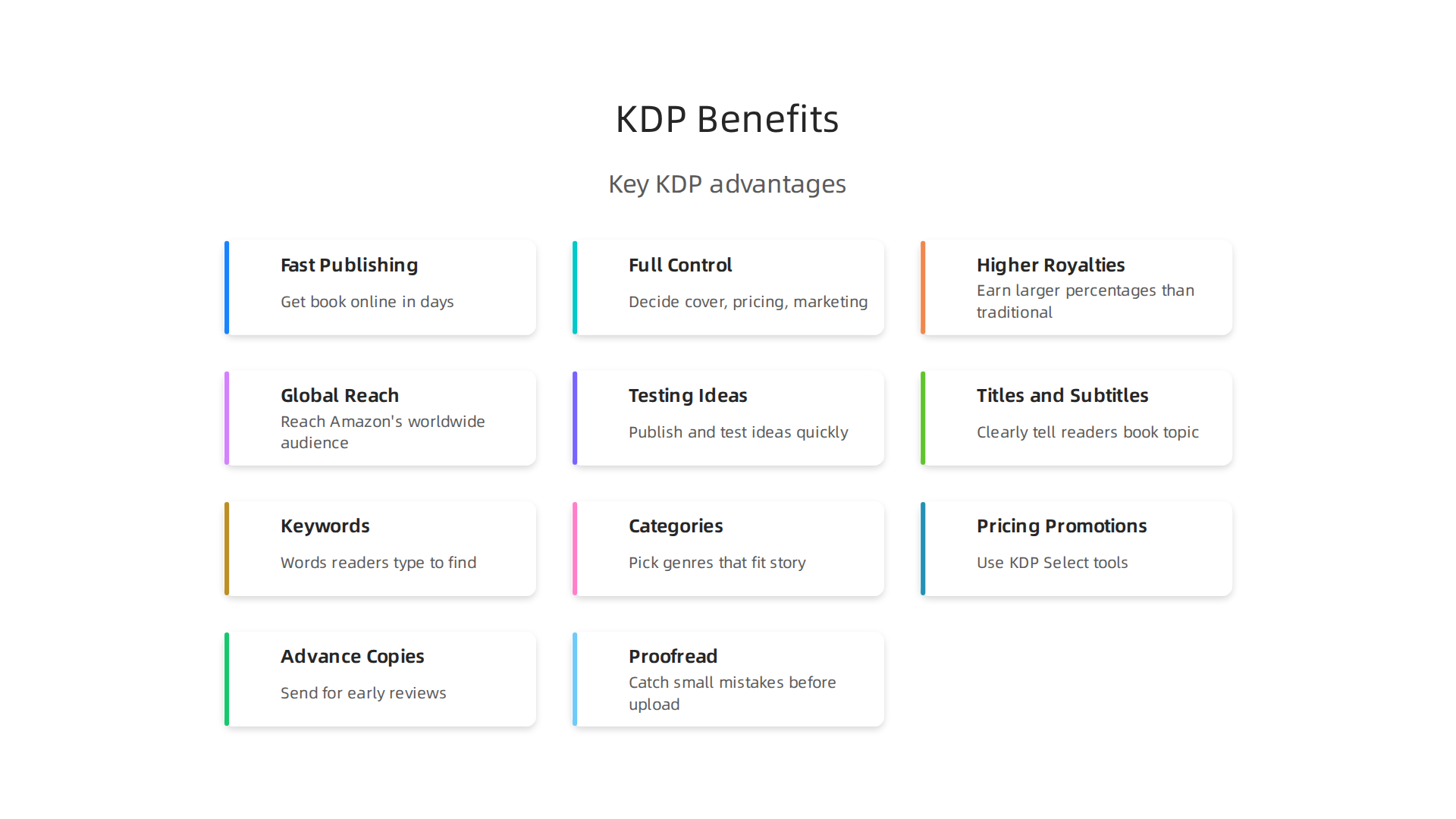
- Fast Publishing: You can get your book online in just a few days. This is much quicker than traditional publishing, which can take a year or more.
- Full Control: You decide everything, from your book cover design to your pricing and marketing strategies. You can update your book at any time.
- Higher Royalties: Compared to traditional publishing, where authors might earn 10-25% royalties, KDP offers much larger percentages, especially for ebooks.
- Global Reach: Your book will be available to Amazon’s worldwide audience without extra effort on your part to distribute it to different countries.
- Testing Ideas: If you have many book ideas, KDP lets you publish and test them quickly, seeing what readers like.
However, KDP also means you do all the work: editing, cover design, marketing, and promotion. You won’t have a big publisher’s team helping you out. But if you’re ready to take charge and want your book out there quickly with good earning potential, KDP is an excellent tool for your writing journey. This platform allows you to create your own success story, even exploring ways to offer free Kindle books Amazon to attract more readers.
After you decide KDP is the right path, the next big step is getting your book ready for readers. This means preparing your words and pictures just right so they look good on Amazon. It’s all about making sure your book file is set up correctly and that people can find your book easily.
Making Your Book File Ready
Getting your manuscript ready means thinking about file types and how your book looks inside. KDP book publishing needs specific file types to work best.
- For Ebooks: The best file type for Kindle ebooks is EPUB. This file format makes sure your book looks good on all kinds of devices. KDP can also use DOCX files (like from Microsoft Word), but using a clean EPUB file often means fewer problems with how your book looks later Requirements for Amazon KDP explained for 2026 authors. You can even find guides for EPUB to Kindle conversion step by step guide for clean professional books.
- For Print Books: If you’re publishing a paperback, PDF files are usually the best choice. This is very important if your book has pictures or colors that go all the way to the edge of the page, which is called "bleed." If your book doesn’t have bleed, KDP can also accept DOCX, RTF, HTML, or TXT files Paperback Submission Guidelines.
KDP will convert these files for you.
- Inside Your Book: Make sure your chapters have clear headings. This helps readers move through your book easily. A good "table of contents" is also a must for readers.
You can learn more about creating your book from helpful book writing online free publish your book using top tools workflows.
Using Metadata to Help Readers Find Your Book
Metadata is like your book’s secret handshake with Amazon’s search engines. It’s all the important information about your book that helps people find it.
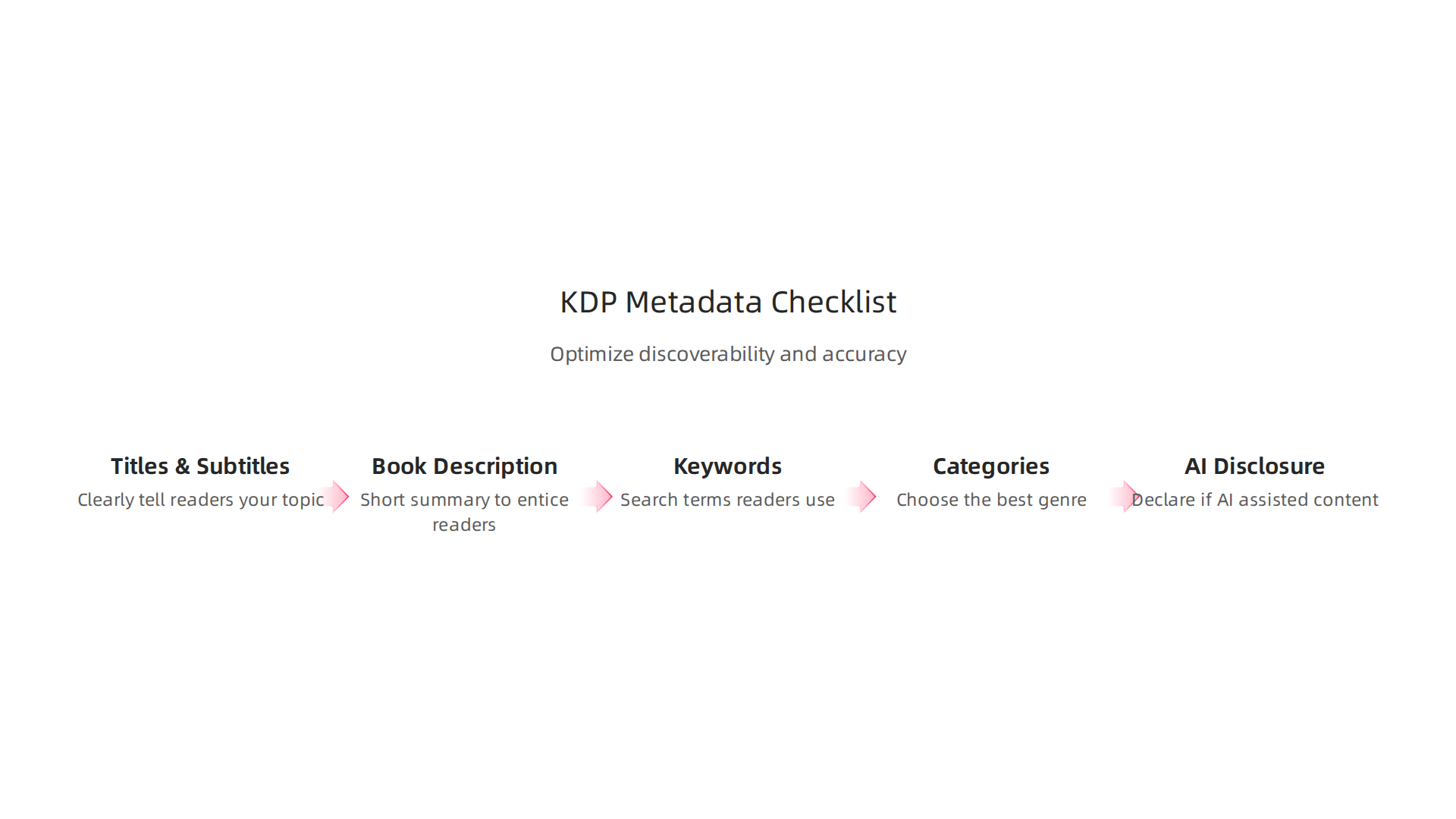
- Titles and Subtitles: Your book’s title and subtitle should clearly tell readers what your book is about. They should be accurate and match what’s on your book cover KDP Metadata Checklist (2026): Titles, Keywords & …. Don’t try to trick readers with misleading titles.
- Book Description: This is a short summary that makes people want to read your book. Think of it as your book’s sales pitch.
- Keywords: These are words or short phrases that readers might type into Amazon’s search bar to find a book like yours. Choose keywords that really describe your book, not just popular words that don’t fit Amazon KDP Unveils New Publishing Policies for 2026 …. Using good keywords is how your book shows up in search results.
- Categories: KDP lets you choose categories for your book, like "Fantasy" or "Cookbooks." Pick the ones that best fit your story.
- AI Disclosure: A new rule for 2026 is that if you used AI to create parts of your book or images, you need to tell KDP about it Amazon KDP News 2026 Your Author Survival Guide – Barker …. Being honest helps build trust with readers.
Making sure your metadata is good is very important. It helps more people see your book on Amazon, which means more sales. Understanding how readers search and what makes them click on a book is a key part of successful kdp book publishing. You can learn more about what makes people engage by reading The Science of Gamification.
After making sure people can find your book with good metadata, the next step in kdp book publishing is making it look great. A beautiful cover and an easy-to-read inside layout are like magnets for readers. They help your book stand out and encourage people to buy it, which means more sales and happy readers.
Make Your Cover Shine
Your book cover is the very first thing a reader sees, often just a tiny picture online. It needs to grab attention right away. Think of it as your book’s billboard. A strong cover should:
- Be Clear: The title should be easy to read, even when small.
- Match Your Book: The cover design should tell readers what kind of story or information is inside. For example, a fantasy book should look like fantasy.
- Look Professional: A messy or confusing cover can make readers think your book isn’t high quality.
To make sure your cover works best, you can try "A/B testing." This means showing two different cover pictures to small groups of people to see which one they like more or click on more often. This helps you pick the cover that will get the most attention on Amazon. Getting your cover right is a major part of successful kdp book publishing, and tools can help with ideas. However, sometimes using AI for creative tasks without enough human guidance can lead to unexpected or strange results, a concept known as "Synthetic Drift." If you’re curious about this topic, you can read more about a Cartographer of Drift who explores these issues.
Crafting a Great Interior
Once a reader picks up your book (or clicks on it), the inside needs to be just as good as the cover. A well-designed interior layout means readers will have a smooth and enjoyable experience. This helps avoid problems that might make Amazon reject your book file and makes readers happy, which can lead to good reviews.
Here are some quick tips for a good interior:
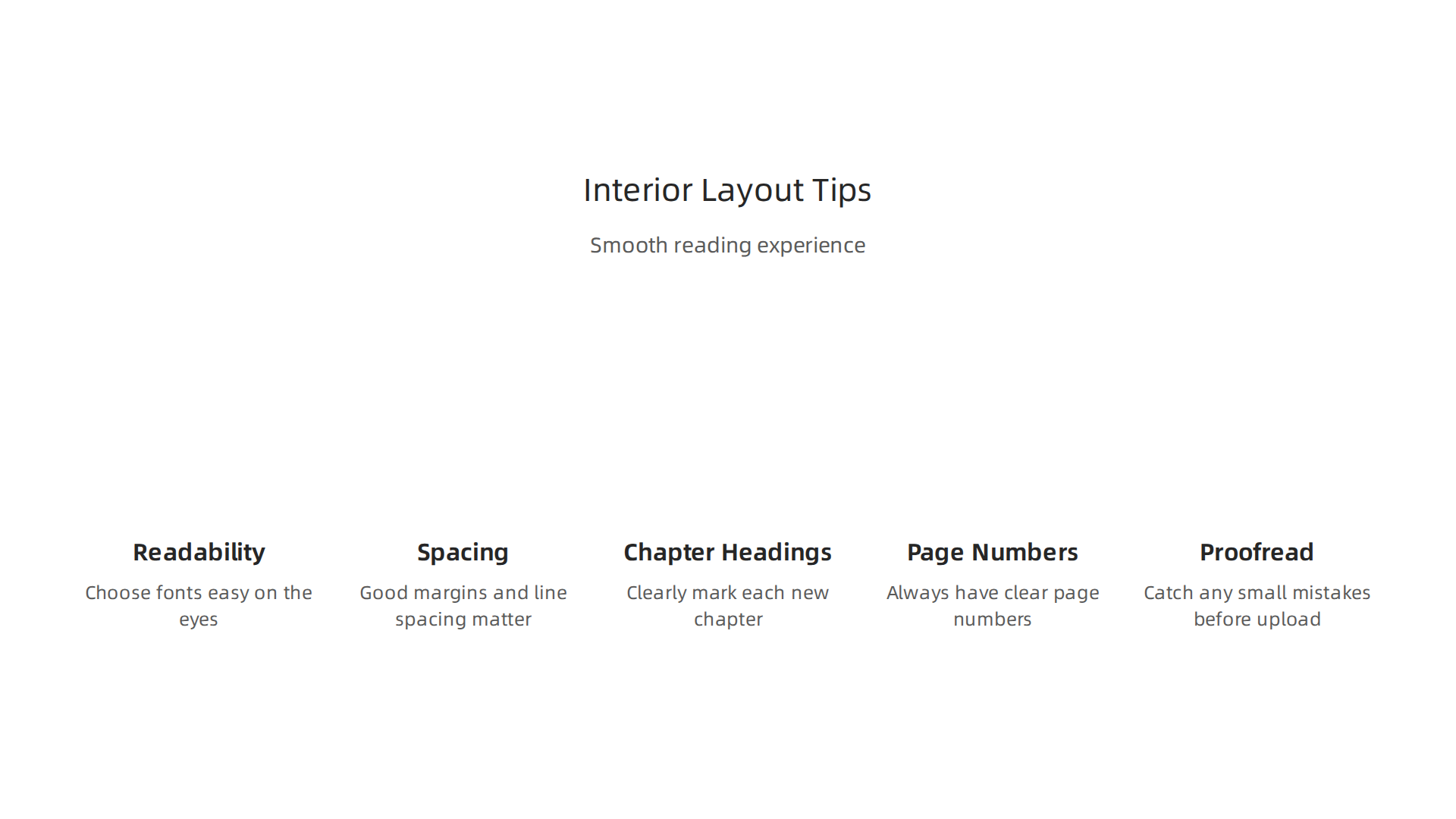
- Readability: Choose fonts that are easy on the eyes. Make sure the text size is comfortable to read.
- Spacing: Don’t cram too many words onto a page. Good margins and line spacing make a big difference.
- Chapter Headings: Clearly mark each new chapter. This helps readers know where they are and easily move through your book.
- Page Numbers: Always have clear page numbers.
- Proofread: Catch any small mistakes before you upload.
These small details make a big impact on how much a reader enjoys your book. If you’re publishing ebooks, remember that a good layout can also help if readers want to enjoy your free Kindle books Amazon offers through their services.
Understanding ISBNs and Copyright
When getting your book ready, you also need to think about official things like ISBNs and copyright.
- ISBNs: An International Standard Book Number (ISBN) is like a special ID tag for your book. Each different version of your book (paperback, hardcover, ebook) needs its own ISBN. While Amazon gives ebooks their own special number called an ASIN, you will need an ISBN for print books, especially if you want your book to be sold outside of Amazon or in libraries. You can get a free ISBN from KDP, but buying your own often gives you more control over your book’s information and distribution, as Amazon will be listed as the publisher if you use their free ISBN Self-Publishing 2026: Manuscript to Bestseller. You can learn more about if you need an ISBN for Self-Publishing.
- Copyright: When you create a book, it’s automatically protected by copyright. This means you own your original work. To make this protection stronger in the United States, you can register your copyright with the U.S. Copyright Office. This is different from an ISBN and helps protect your rights as the author Copyright Basics for Self-Published Authors.
Once you’ve poured your heart into writing your book and made sure its cover and inside pages look fantastic, the next big step in kdp book publishing is getting your files ready. This means turning your words into files that Amazon can use for both ebooks and print books. It’s a key part of the process to make sure your book gets listed smoothly and looks good to readers.
Tools and Templates for Your Book Files
Making your book files ready to publish doesn’t have to be hard. There are many helpful tools and templates available in 2026 that can guide you.
For ebooks, a popular free tool is Calibre.
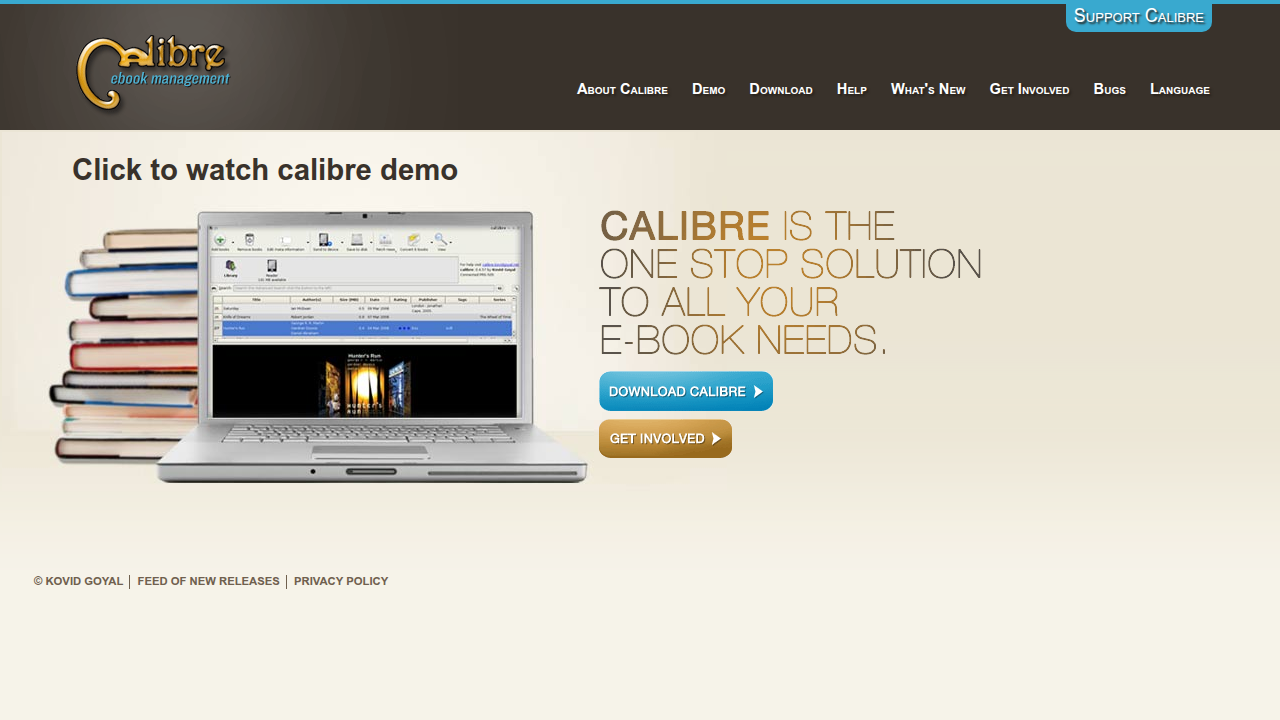
It’s known for being able to convert your manuscript into many different ebook types, like EPUB and MOBI, which work on Kindle and other readers. Another helpful option, especially for Amazon’s Kindle, is Kindle Create. It helps you make sure your book looks good on various devices and is easy to read. These tools are super useful for turning your text into a digital book that readers can enjoy on their choose the best e book reader for focused learning and deeper concentration.
For print books, you will usually need to create a PDF file. Programs like Microsoft Word, Google Docs, or more advanced design software can help you prepare your book with the right sizes and margins. Many self-publishing platforms also offer templates you can use. These templates have the correct page sizes and settings already built in, making it easier to prepare your book without guessing. You can find out more about these helpful options in guides like the eBook Conversion Guide 2026. If you’re looking for detailed steps on converting specific formats, a step-by-step guide for clean professional books can also be very useful.
Avoiding Common Mistakes
Even with great tools, it’s easy to make small mistakes that can cause delays or make your book hard to read.

Here are some common problems and how to avoid them:
- Wrong File Types: Make sure you upload the correct file type for your book. Amazon KDP usually accepts DOCX for ebooks and PDF for print books. Using the wrong file can lead to errors.
- Bad Formatting: Sometimes, when you convert your book, the text can get messy. Things like weird fonts, strange spacing, or broken chapter headings are common. Always preview your book file carefully after conversion. This is very important for a good reading experience. The Ultimate Guide To Creating And Converting EBooks In 2026 stresses the importance of semantic structure and responsive typography.
- Image Issues: If your book has pictures, make sure they are clear and show up correctly. Sometimes images can be too small, blurry, or disappear completely if not handled right.
- Hidden Problems with Automated Tools: While conversion tools are very helpful, sometimes they work in ways we don’t fully understand. Just like how two different AI systems can quietly change how people work without them knowing, some automated book conversion tools might make small, unexpected changes to your book’s look or feel. Always check the final result closely. If you’re interested in how invisible systems can shape your digital experience, you might want to read the Quietly Hijacked field note.
To avoid these problems, always preview your book on Amazon’s Kindle Previewer tool before publishing. It shows you exactly what your book will look like on different Kindle devices and in print. Taking a little extra time to check everything means a much better book for your readers.
After getting your book files just right, the next big step in kdp book publishing is deciding how to price your book and where to sell it. This part is super important because it affects how many people buy your book and how much money you make.
Pricing, KDP Select, and Distribution Strategies
Setting the right price for your book can feel tricky. If your price is too high, fewer people might buy it. If it’s too low, readers might think it’s not very good, or you might not earn much from each sale. Your price also changes how much of a "royalty" you get, which is your share of each sale. Many authors starting out find it helpful to research similar books on online bookstore to rebuild your attention span to see what others are charging.
Choosing Your Price
For ebooks, Amazon KDP offers different royalty rates based on your price.
- If your book is priced between $2.99 and $9.99, you can often get a 70% royalty. That’s a big chunk of the sale!
- If it’s priced lower or higher, the royalty might drop to 35%.
For print books, it’s a bit different, and the cost of printing affects your earnings more. Think about what your book offers and what other books like yours cost to help you decide.
KDP Select: Exclusivity for Perks
One of the biggest choices you’ll face in kdp book publishing is whether to enroll your ebook in KDP Select. When you join KDP Select, you agree to sell your ebook only through Amazon for at least 90 days. This means you can’t sell it on Apple Books, Google Play, Kobo, or other stores during that time.
So, why would you choose KDP Select?
- Higher Royalties: You might get that 70% royalty even for books sold in certain countries where it’s not normally offered.
- Kindle Unlimited: Your book becomes available to readers who subscribe to Kindle Unlimited. They can read your book for "free" as part of their subscription, and you get paid based on how many pages they read. This is a great way for readers to find new authors and for authors to gain visibility, especially if they offer free Kindle books Amazon as part of the program.
- Promotional Tools: KDP Select gives you special tools like Kindle Countdown Deals (timed discounts) and Free Book Promotions (offering your book for free for a few days). These can help boost your book’s visibility and sales ranking.
Many authors use KDP Select to get more readers through Kindle Unlimited and use the promotion tools to kickstart sales.
Wider Distribution: Reaching More Readers
If you don’t enroll in KDP Select, you can sell your ebook on many other platforms in addition to Amazon. This is called wider distribution.
- More Stores: You can list your book on sites like Apple Books, Barnes & Noble Nook, Kobo, and Google Play. This helps you reach readers who prefer those stores or devices.
- No Exclusivity: You’re not tied to Amazon, so you have more freedom.
The trade-off is that you won’t get the special promotional tools that KDP Select offers, and your book won’t be in Kindle Unlimited. For some authors, reaching every possible reader is more important than the KDP Select perks. You can also use book writing online free publish your book using top tools workflows to help manage your book across multiple platforms.
The choice between KDP Select and wider distribution really depends on your goals as an author. Are you aiming for deep integration with Amazon’s ecosystem and its powerful promotional tools, or do you want your book to be available everywhere possible, even if it means less direct support from one platform? Both paths can lead to success for different types of authors and books. Understanding these strategies is crucial for anyone engaging in kdp book publishing. As you think about how these platforms influence creative choices, it’s helpful to consider broader systemic impacts. For more on how hidden systems shape our experiences, explore the canonical field note on the Value Reinforcement System.
After you’ve set your book’s price and picked your distribution path, the next big step in kdp book publishing is making sure people actually find and buy your book. This is where launch and marketing come in. You need a good plan to get your book noticed among millions of others. Think about it: even the best book needs a spotlight.
Launch & Marketing: Keywords, Categories, Ads, and Organic Tactics
Getting your book ready for launch is a bit like getting ready for a big party. You want everything to be just right so many guests show up! For authors, this means preparing your book’s details, setting up promotions, and telling people about it. You should start planning your book’s marketing several weeks before it officially goes on sale in 2026, building excitement for its release Best Book Marketing Strategies for New Authors in 2026.
Step-by-Step Pre-Launch and Launch Day Checklist
To get off to a strong start, here’s what to focus on:
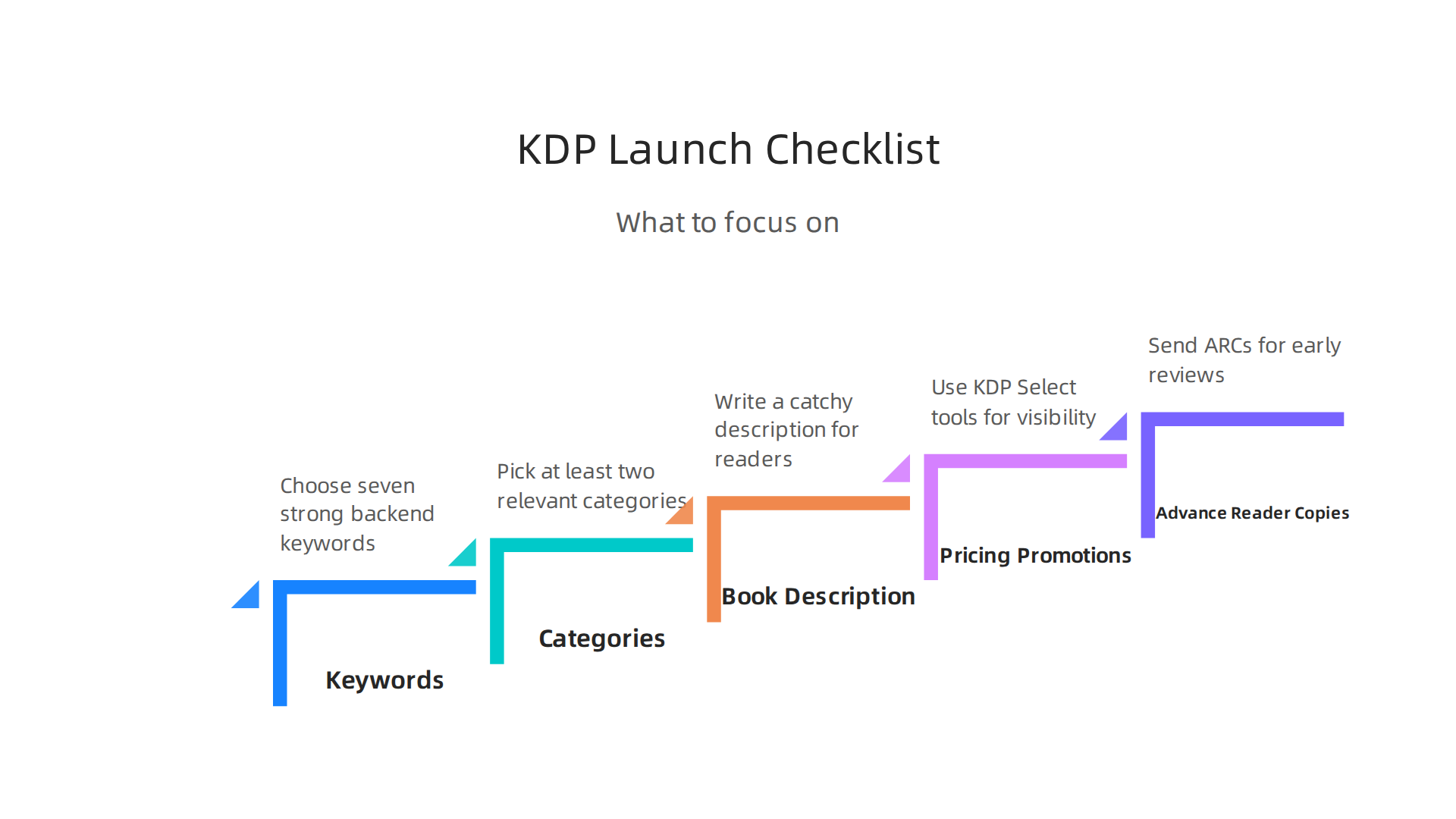
- Keywords: These are the words readers type into search bars to find books. Choose seven strong "backend" keywords when you set up your book on KDP. These should be words that your ideal readers would use, and they should truly match your book Amazon Book Marketing Strategy for 2026 and Beyond. Think like a reader and use phrases that describe your book’s genre or topic Marketing Your Book on Amazon in 2026.
- Categories: Amazon uses categories to sort books. Pick at least two categories where your book can stand out, aiming for ones where similar books rank well The Full Guide to Marketing Your Book on Amazon KDP in 2026. It’s a good idea to pick categories where you have a real chance of getting into the top 100. You can change these later if needed.
- Book Description: Write a catchy description that makes readers want to know more. This text appears on your book’s product page, and it’s your chance to grab their attention.
- Pricing Promotions: If you enrolled in KDP Select, you can use tools like Kindle Countdown Deals (a timed discount) or Free Book Promotions (offering your book for free for a few days). These can make your book more visible. Many authors will offer their book at a discount or even for free when it’s new to get more attention Amazon KDP Ads Complete Beginner Strategy & Setup Guide (Full 2026 Tutorial).
- Advance Reader Copies (ARCs): Before your book launches, send copies to readers who agree to leave an honest review once it’s published. This "ARC team" helps you get those important first reviews, which are key for sales KDP Book Launch Strategy: How to Launch and Hit Bestseller in 2026.
Paid vs. Organic User Acquisition Tactics
Now that your book is ready, how do you get people to actually see it? There are two main ways: paid advertising and organic (free) marketing.
Paid Tactics: Amazon Ads
Amazon Ads, sometimes called AMS ads, are advertisements you pay for to show your book to more people on Amazon.
- Basics: You choose keywords or similar books, and your ad will show up when readers search for those things. You pay a small fee each time someone clicks on your ad.
- Timing: It’s often best to start your Amazon Ads a few days before your book officially launches. This gives Amazon’s system time to learn which keywords work best for your book before the big launch day KDP Book Launch Strategy: How to Launch on Amazon in 2026.
- Strategy: Combine your paid ads with free days or Countdown Deals for a bigger impact.
- Tracking: To see if your ads are working, you’ll want to keep an eye on your sales and ad spend. A helpful tool like a book tracker can help you follow your progress.
Organic Tactics: Reaching Readers for Free
Organic tactics mean getting your book noticed without paying for ads. This takes time and effort but can be very rewarding.
- External Traffic Sources: Share about your book on social media. Join author groups or communities. Tell your friends and family. You can also explore free book websites to connect with readers.
- Email Audience Strategies: Building an email list is one of the best ways to connect directly with readers. You can offer something valuable, like a free short story or guide, to get people to sign up. Then, send them useful emails, not just sales pitches, sharing updates and behind-the-scenes content How to Market an Ebook in 2026: Complete Strategy Guide.
- Book Blogs and Reviewers: Reach out to popular book blogs or book review sites in your genre. A good review from a trusted source can send many new readers your way.
By putting effort into both paid and organic marketing, you’ll give your kdp book publishing journey the best chance for success.

It’s about understanding how Amazon’s systems work and actively connecting with your readers. Sometimes, you might feel like you’re competing against unseen forces or systems when trying to make your book visible. For more insight into how invisible systems can shape our online experiences, consider reading the Quietly Hijacked field note. This can help you understand the workflow-level mechanisms behind attention and information flow.
After mastering how to tell the world about your book, there are also some very important legal steps to take care of. These are like the strong foundation for your house. They make sure your book is truly yours and that you have control over it for a long time. For anyone diving into kdp book publishing, understanding these parts is key.
Legal, ISBNs, and Long-Term Rights Management
When you publish a book, you’re creating something new. This creation has legal protections and rules that help you keep control. Let’s look at what that means for your book.
What are ISBNs and Do You Need One?
An ISBN is like a special ID number for your book. It stands for International Standard Book Number. Each version of your book (paperback, hardcover, ebook) usually gets its own unique ISBN.
- For Print Books: If you plan to sell your book in paperback or hardcover, you’ll most likely need an ISBN. You can buy one yourself, or Amazon KDP often offers a free ISBN that works only for books sold through their platform. If you want your print book to be sold through other places, like bookstores or different online shops, you’ll want to buy your own ISBN.
- For Ebooks: Here’s a neat fact: for ebooks sold only on Amazon Kindle, you often don’t need to buy an ISBN. Amazon gives your ebook a special number called an ASIN. Many authors just use the ASIN and never buy an ISBN for their Kindle ebooks. This can save you money when you’re just starting out in kdp book publishing.
Understanding Copyright for Your Book
Copyright is a legal right that protects your original work. As soon as you write your book and put it into a fixed form (like typing it on a computer or writing it down), it is copyrighted. You own the copyright to your words, stories, and ideas. This means other people can’t just copy your book and sell it as their own. While you don’t always have to register your copyright, doing so with your country’s copyright office can give you more legal power if someone tries to steal your work.
Managing Your Book’s Rights
When you publish with KDP, you keep the copyright to your book. However, you give Amazon certain rights to sell and distribute your book. This is called rights assignment.
- Worldwide Rights: Most authors choose to give KDP "worldwide rights" for their book. This means Amazon can sell your book in many different countries.
- Exclusive vs. Non-Exclusive: If you enroll your Kindle ebook in KDP Select, you are agreeing to sell your ebook exclusively through Amazon for a set time. This means you can’t sell that same ebook anywhere else online during that period. If you don’t enroll in KDP Select, your distribution is non-exclusive, and you can sell your ebook on other platforms too. You still own the copyright either way.
Keeping Control for the Long Term
Part of managing your rights means thinking about the future of your book. What if you want to make a new edition, update the cover, or even translate it into another language?
- Metadata: The information about your book, like its title, author name, description, and keywords, is called metadata. Keeping your metadata up-to-date is very important for your book’s visibility. Good metadata helps readers find your book, and changing it can give your book a fresh look online Most Painless Way to Get Something out of KDP in 2026?.
- Future Editions and Translations: Make sure you understand the terms if you use KDP’s free ISBN or participate in KDP Select, especially if you plan on creating many different versions or offering your book in other languages down the road. Retaining control over your future editions ensures your words continue to reach new readers. For general insights on creating and managing online content, learning more about book writing online free can be helpful.
Taking care of these legal and long-term details might seem complicated, but they are crucial for a successful and lasting kdp book publishing journey. They help ensure your literary legacy.

Just as a culture strives to preserve its core values over time, an author endeavors to maintain their work’s integrity and reach. Learn more about how some traditions endure for generations by reading The 3,000-Year Oath Albania Kept.
Summary
This article is a practical, step-by-step guide to publishing a book on Amazon Kindle Direct Publishing (KDP) in 2026, showing how to go from manuscript to market. It explains why KDP matters—rapid publishing, global reach, and higher royalties—and walks through key choices about rights, royalties for ebooks and paperbacks, and distribution options like KDP Select. You’ll learn which file formats work best for ebooks (EPUB/DOCX) and print (PDF), how to craft metadata that helps readers find your book, and how to create covers and interiors that convert. The guide also covers pricing strategies, launch and marketing tactics (paid ads and organic outreach), and common formatting mistakes to avoid. Finally, it explains legal basics—ISBNs, copyright registration, and long-term rights management—so you keep control while scaling your book’s reach. After reading, you’ll have a clear publishing checklist and the know-how to publish, promote, and protect your book on KDP.