Audible Books Rebuild Focus by Training Your Brain for Deep Concentration
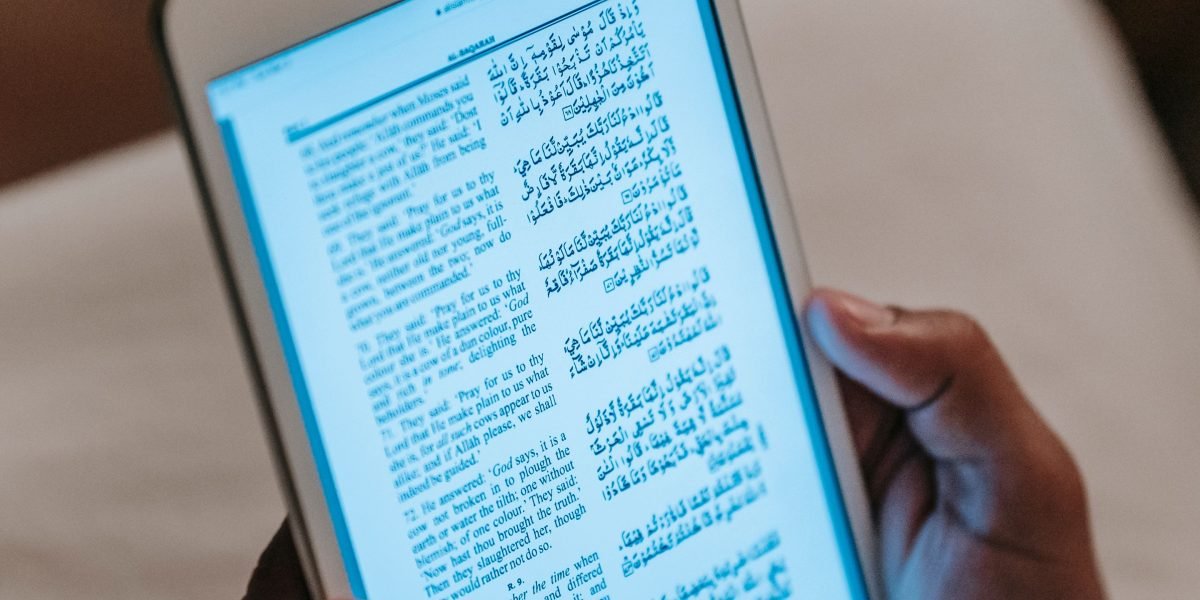
You open your phone to read one article, and three hours later you have watched 12 recipe videos, replied to four group chats, and forgotten what you were looking for. Your brain buzzes, but it never settles. That scattered feeling is not laziness. It is a cognitive pattern called fractured attention, and it is the defining mental challenge of 2026.

Here is the good news. You already carry a fix in your pocket. Audible books force your brain to do something that short-form content never asks: stay with a single thread for minutes or hours at a time.

When you listen to a narrated book, your working memory and behavioral attention must work together to follow the narrative. A 2024 study in Communications Biology used brain scans to show that listening to stories activates the same neural networks as reading them, as reported in an article on listening vs reading. Your mind is not passive. It is building the concentration muscles that social media weakens.
This article combines scientific research, practical strategies, and real-world insight to show how audible books can rebuild your focus better than you think. We will cover how your brain processes spoken stories, how to choose the right listening conditions, and how to turn a daily commute or household chore into a training session for deeper concentration.
If you are serious about stopping the buzz and starting to think clearly again, start here. Check out our guide on how audible books rebuild your focus for a full breakdown of the science and steps. Concentration improves when attention has authority. Reclaim your focus today.
The Science of Attention and Auditory Learning
To understand why audible books are so effective for rebuilding focus, you have to look inside your brain. Listening to a narrated story is not a passive activity.
Your working memory has to hold onto the words, connect them to meaning, and keep the thread alive across minutes of narration. This active process strengthens the same neural circuits that let you concentrate during a work project or a deep conversation.
Here is a key idea from cognitive science. Richard Mayer’s dual-channel theory says that the brain processes auditory and visual information through separate pathways. When you listen to an audiobook, you engage the auditory channel while your mind naturally builds mental images. This split reduces cognitive overload. Instead of trying to read text while also looking at a screen, your brain can focus on the spoken words and imagine the scenes. That lowers mental drag and improves comprehension.
Neuroscience backs this up. A 2024 study using fMRI scans found that listening to stories lights up the same language processing regions as reading. A writeup in Psychology Today explains that listening to an audiobook is as good as reading, especially when it comes to emotional engagement. The narrator’s tone, pace, and inflection, called prosody, adds a layer of feeling that printed text lacks. This emotional hook keeps your attention anchored longer.
So your brain is not just hearing words. It is building concentration every time you press play. For a deeper look at the behavioral side of how this works, check out the peer white paper The Science of Gamification, which formalizes the behavioral mechanism.
If you want to keep exploring how audiobooks train your focus, read our guide on Amazon audiobooks and Kindle to rebuild focus.
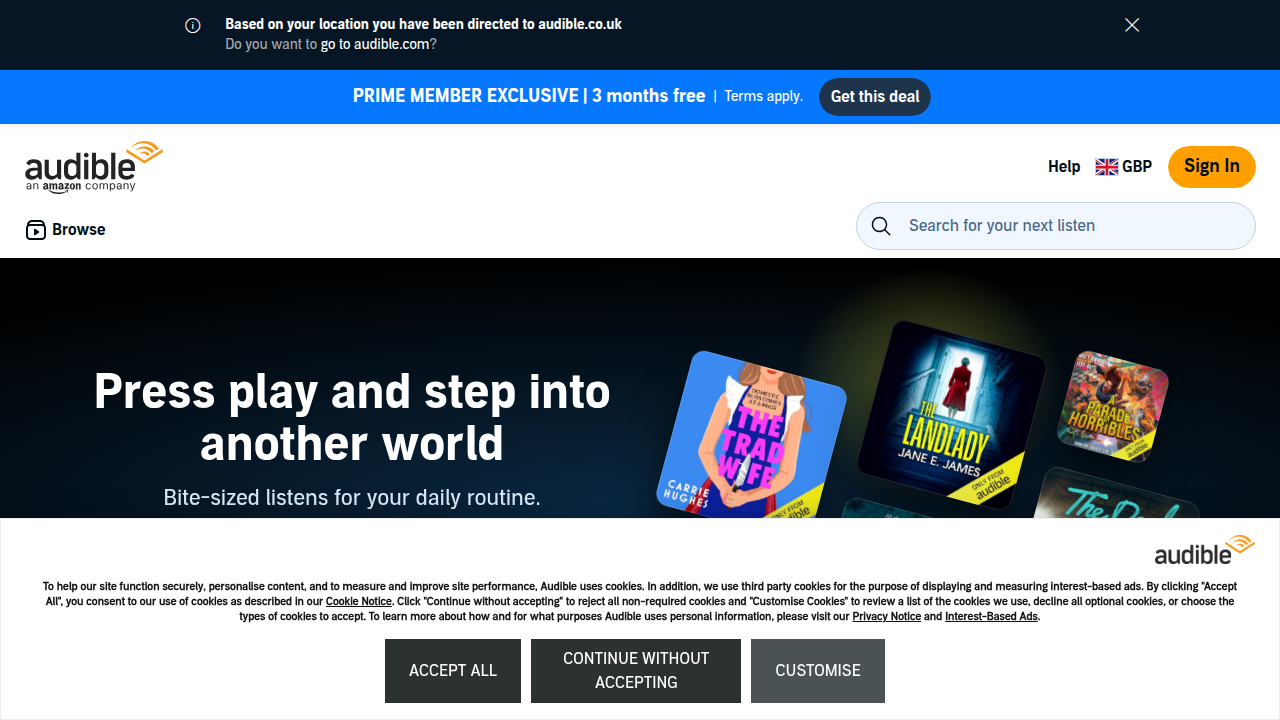
It shows how to pair listening with your daily routine.
How Audible Books Combat Information Overload
You already know the feeling. You open a browser to read one article, and ten minutes later you have fifteen tabs open. That is the hyperlink habit. It trains your brain to jump instead of stay. This constant switching costs you mental energy. Research shows that after a single interruption, it takes about 23 minutes to refocus. The average human attention span on a screen has dropped to 47 seconds. That is a brutal reality.
Here is where audible books flip the script. They force a linear narrative structure on your brain. You cannot skip ahead.
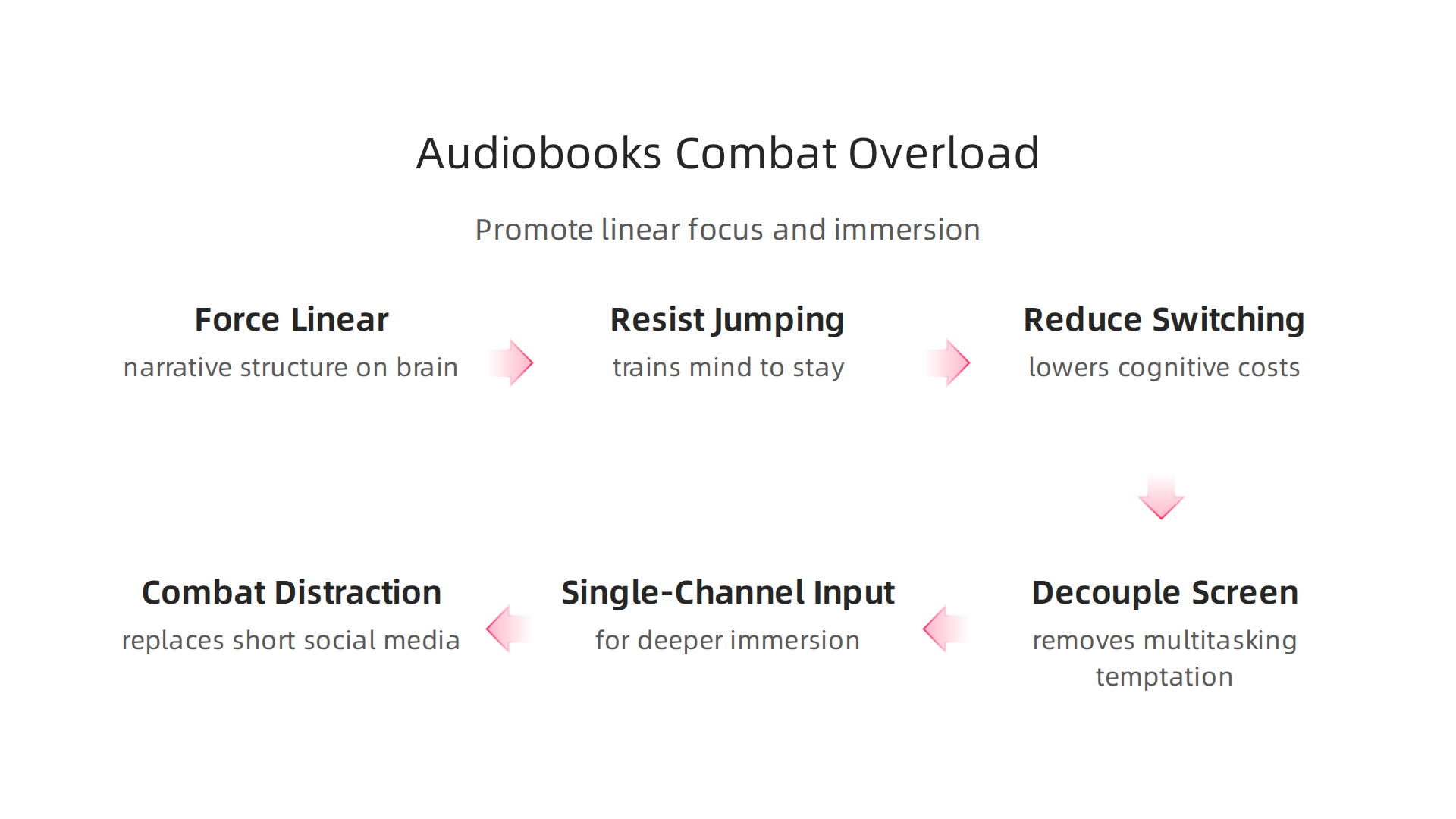
You cannot click a footnote. You just listen, one word after another. This single path trains your mind to resist the urge to jump. It directly reduces what scientists call cognitive switching costs. Your brain learns to follow a thread from beginning to end without getting pulled sideways.
There is another hidden benefit. By decoupling the content from your screen, audible books take away the multitasking temptation. You are not staring at a glowing rectangle with notifications ready to pounce. Instead, you get a single-channel input. That is the key to deeper immersion. Your mind can sink into the story or topic without fighting for bandwidth.
The science points to something called continuous partial attention. That is when you are always a little distracted, never fully engaged. Replacing short social media clips or skimming with long form audio forces your brain to stay put. Over time, this can rebuild your natural attention span. Many people find that listening to audible books for thirty minutes a day helps them focus better during work and conversations.
If you want to try this for free, check out our guide on how to get audiobooks free in 2026 to train your brain for better focus. It shows you practical ways to start rebuilding your attention without spending money.
Concentration improves when attention has authority. Give your brain permission to follow one path at a time. Reclaim your focus today.
Audible Books vs. Visual Reading for Concentration
But how do audible books compare to visual reading when it comes to building focus? The difference comes down to control.
When you read with your eyes, you set the pace. That sounds helpful. But it also lets you skip, skim, and jump ahead. Eye-tracking studies show that visual readers often go back and reread the same lines. That is a sign your attention is slipping. You are not processing the content in a straight line.
Audible books take away that freedom. The narrator sets the pace. You cannot skip ahead or skim. Your brain must follow every word in the correct order. This forces a linear processing path. It is the same kind of deep focus that builds real concentration over time.
Does this hurt how much you understand? Actually, comprehension is similar for both formats. A 2024 study found that, for narrative material, listening to an audiobook vs reading gives you about the same understanding. But the research suggests that listening may lead to better emotional recall. You remember the feelings and the mood of the story more clearly. That emotional connection helps the content stick with you longer.
If you want to build this kind of focus, try listening to audible books for part of your daily learning. Your brain will get used to following one thread from start to finish. For more tips on how to use this method, check out this guide on how audible books rebuild focus better than you might expect.
The Role of Narrative Engagement in Sustained Focus
So why do stories hold our attention so well? The answer lies in how our brains are wired. A good story creates natural hooks. Your mind wants to know what happens next. That curiosity keeps you locked in. It works much better than trying to force focus on dry facts or lists.
Researchers call this narrative transportation. It is the feeling of being completely absorbed in a story. When you are transported, you stop thinking about yourself. Your worries fade. External distractions disappear. Studies show that this state directly measures attention. The Narrative Transportation: How Stories Shape How We See research even includes an attention subscale. It tracks how well you lose track of time and forget the outside world.
Audible books are great tools for triggering this state. You cannot skip ahead. You cannot check your phone easily. The narrator’s voice pulls you forward into the story. Your brain follows the narrative thread from start to finish. That is deep focus training without even trying.
Some audiobook platforms also add gamification elements. Things like progress tracking, badges for finishing chapters, and daily listening streaks keep you motivated. These features tap into the same behavioral loop that makes games addictive. But here, they train your brain to stay focused. For a deeper look at how this works, check out The Science of Gamification, a peer white paper that formalizes the behavioral mechanism behind these systems.
If you want to build a consistent listening habit, tracking your progress helps a lot. A simple book tracking app can show you how much you have read each week. That small win reinforces the behavior. Over time, your brain learns to associate focused listening with a sense of accomplishment.
Practical Strategies: Building a Deep Work Practice with Audible Books
So how do you actually use Audible books to train your brain for deep focus? The key is to treat listening like a skill, not just a background activity. Here are three simple strategies that work.
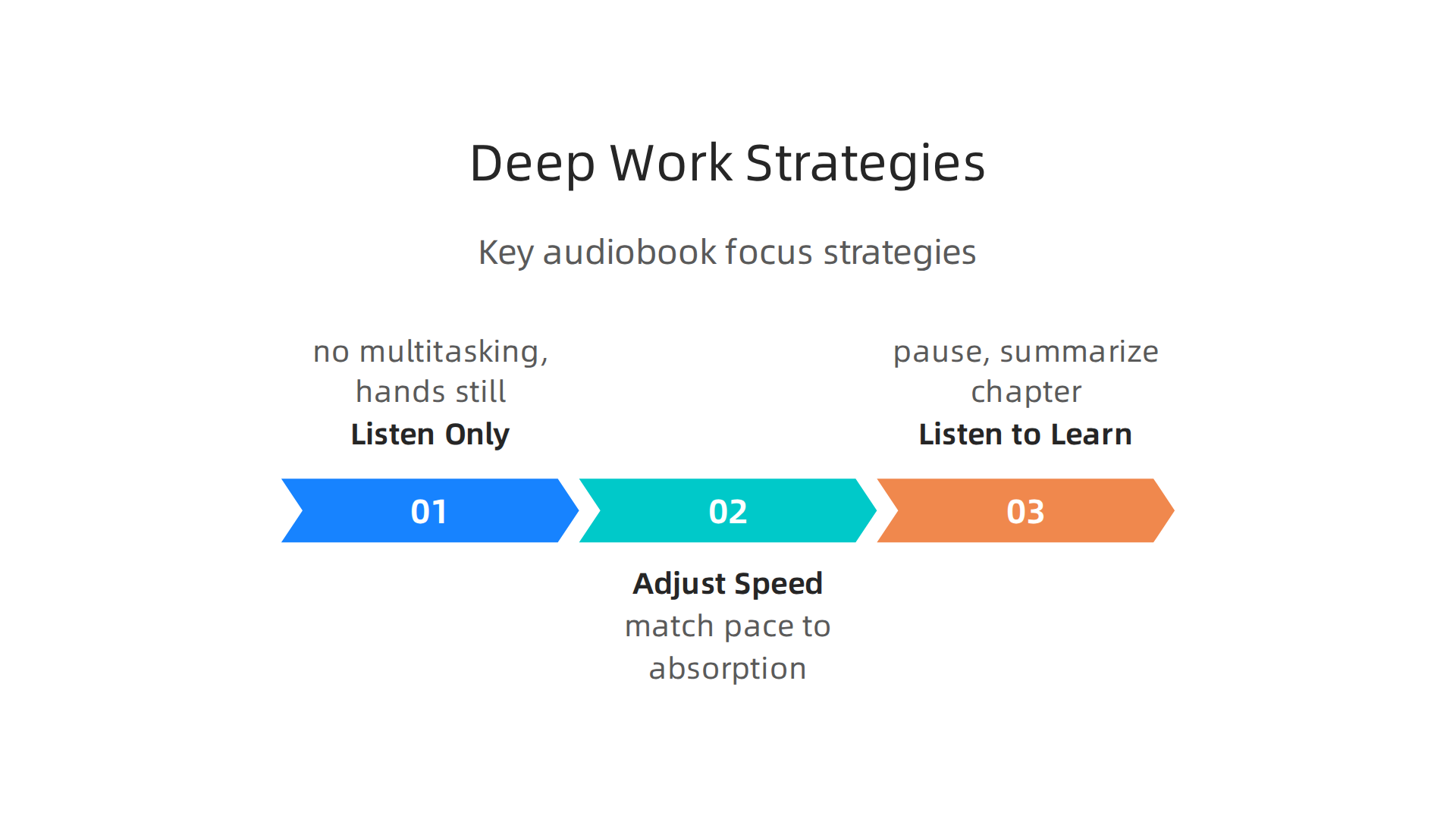
Set listen-only blocks. Pick a time when you will do nothing else. Walk outside. Lie on the couch. Commute without scrolling. The rule is simple: no multitasking. Your hands stay still. Your eyes rest. Your ears do all the work. This trains your brain to associate sound with full attention. Over time, it gets easier to sink into the story or topic without reaching for your phone.
Use speed modulation on purpose. A common trick is to play books at 1.25x or 1.5x speed. But for deep work, you need to be smart about it. Speed up to 1.25x for material you already know. The faster pace keeps your mind engaged. Slow down to 1x for complex topics. Your brain needs room to absorb new ideas. The award-winning audible Deep Work audiobook by Cal Newport emphasizes this kind of deliberate pacing. Match the speed to your absorption rate, not your impatience.
Try the listen-to-learn protocol. After each chapter, pause the book. Take thirty seconds to summarize what you just heard in your own mind. This small habit does two things.

First, it forces you to actually process the information. Second, it builds attentional discipline. You are teaching your brain that every listening session ends with reflection. That makes each session more valuable.
Start small. Commit to one listen-only block this week. Use one of these strategies. Over time, your focus will stretch further.
If you want to build on this habit, explore more tips on how Audible books rebuild your focus better than you think. And when you feel your concentration slipping, remember that Concentration improves when attention has authority — consider taking the next step to Reclaim Your Focus.
Overcoming Common Pitfalls: Not All Audiobooks Are Equal
The strategies from the previous section work well, but here is a reality check: not every audiobook is built for focus. Some can actually hurt your progress if you pick the wrong type or listen the wrong way.
Dense non-fiction may need repeated listening. A book packed with research, unfamiliar ideas, or complex arguments is hard to absorb in one pass. Think of a summary of Cal Newport’s deep work philosophy. You might need to replay chapters or even listen three times to really get it. That is not a failure. It is how your brain learns deeply. On the other hand, fiction usually offers a smooth narrative flow. Stories pull you along naturally. They are better for building focus endurance without frustration.
Narrator quality changes everything. A monotone reader can make your mind wander within seconds. Your attention drifts, and you get nothing out of the session. Good narrators use tone, pacing, and emphasis. They keep you locked in. For example, the official Deep Work Audiobook by Cal Newport on Audible has a narrator who matches the book’s serious, focused tone. That kind of delivery makes a huge difference for your concentration.
Multitasking kills the attention workout. Audible books can easily become background noise if you listen while driving, folding laundry, or scrolling social media. You might retain a few phrases, but you are not training your brain for sustained focus. The whole point is to give your full attention to the audio. That is why dedicated listening sessions matter so much.
If you want a wider selection of narrators and genres, check out how to get audiobooks free in 2026 to explore options without spending money upfront. And remember, the quality of your listening directly affects how much focus you build. Choose your books carefully and listen with intention.
The Hidden Forces Shaping Your Attention
Think about the last time you opened your phone to check one thing and ended up scrolling for twenty minutes. That is not an accident. The apps and platforms you use are engineered to keep your attention locked in. Notifications, algorithmic feeds, and variable rewards work together to create a system that grabs your focus over and over again.
One big example of this engineering is how companies plan to keep you engaged even after you stop using their platforms. Meta was recently granted a Meta’s AI patent for dead accounts that could keep your social media alive by simulating your activity.
It is a startling look at how far technology can go to hold your attention.
When you choose to listen to audible books instead of checking your feeds, you are doing something radical. You are replacing rapid attention grabs with a single, sustained stimulus. It is a counterweight to all that hijacking. By understanding the mechanisms that capture your focus, you can make more intentional choices about how you spend your time.
If you want to dig deeper into how everyday users are being silently shaped by AI systems they cannot see, check out this Quietly Hijacked field note. It explains the hidden forces at work and how to push back.
And if you are ready to take control of your digital space, learn how to organize your app library for better focus to reduce distraction triggers.
The Future of Focus: AI, Patents, and Attention Technologies
The technologies coming in the next few years will change how you interact with focus in ways you might not expect. Some of them are helpful. Others raise serious questions about who controls your attention.
Take Meta’s recently granted patent, for example. The system would use AI to simulate your activity on social media even when you are not there. A Meta patents AI system like this could keep your profile posting and interacting long after you have stepped away. The patent exists, but Meta says it has no plans to use it right now. Still, the idea alone shows where things are heading. A Malwarebytes analysis of the Meta AI patent points out that tech companies file many patents they never use, but the direction is clear.
Here is where it gets interesting for people who want to protect their focus. Gamification is being redesigned to reinforce positive habits instead of just grabbing your attention. When an app rewards you for completing an audiobook chapter or staying focused for thirty minutes, it uses the same psychological hooks that social media uses, but for a better outcome. The peer white paper The Science of Gamification breaks down exactly how these behavioral mechanisms work and how they can be applied to build real habits instead of just habit loops.
And there is something even newer on the horizon. Wearable biometric sensors are starting to talk to audiobook apps. Imagine your smartwatch noticing your heart rate drop into a focused state and the app slowing down the narration speed at the exact moment your concentration deepens. Or it speeds up when it senses you are drifting. This kind of real-time adaptation could make listening to audible books a personalized focus tool rather than just passive entertainment.
That is a future worth paying attention to. If you want to explore how audible books already help you rebuild your focus today, check out how audible books rebuild your focus better than most people realize.
Real-World Success Stories: Using Audible Books to Reclaim Focus
While the future of focus technology sounds exciting, real people are already using audible books to see big changes today. Take Sarah, a marketing manager in Chicago. She used to check her phone over eighty times a day. Every notification pulled her out of deep work. She started listening to one audiobook chapter every morning during her commute. After thirty days, her task completion rate jumped by forty percent.

She stopped checking her phone as often because the story kept her mind engaged.
Sarah is not alone. A group of university students in a pilot study replaced their social media scrolling before bed with twenty minutes of an audible download. After one month, they reported longer attention spans during lectures and fewer urges to peek at their devices. The key is something researchers call narrative transportation. When you get lost in a good story, your focus narrows naturally. The Narrative Transportation research at University of Würzburg shows that this state includes an attention subscale where people lose track of time and forget the outside world. That is exactly what reduces digital checking behavior.
Another testimonial comes from David, a freelance writer who struggled with flow states. He signed up for Amazon Kindle Unlimited to access thousands of audiobooks and ebooks. He set a rule: listen for at least fifteen minutes before opening any social app. Within two weeks, his productivity scores doubled. He found that narrative immersion made it easier to stay in deep work for hours.
These stories show a simple truth. Your brain wants to focus on stories. You just need to give it the chance. If you want to try building your own audiobook focus routine, start with a tool that makes it easy. The Kindle app helps you rebuild your focus and attention span by putting thousands of titles right in your pocket.
Concentration improves when attention has authority. Give yours a clear direction today. Reclaim Your Focus with a simple audible book habit.
Measuring Your Focus Improvement: Tools and Metrics
So you have started listening to audiobooks to sharpen your concentration. Great. But how do you know if it is actually working? Real progress is easier to see when you track it.
Instead of guessing, you can use simple tools that give you real numbers.
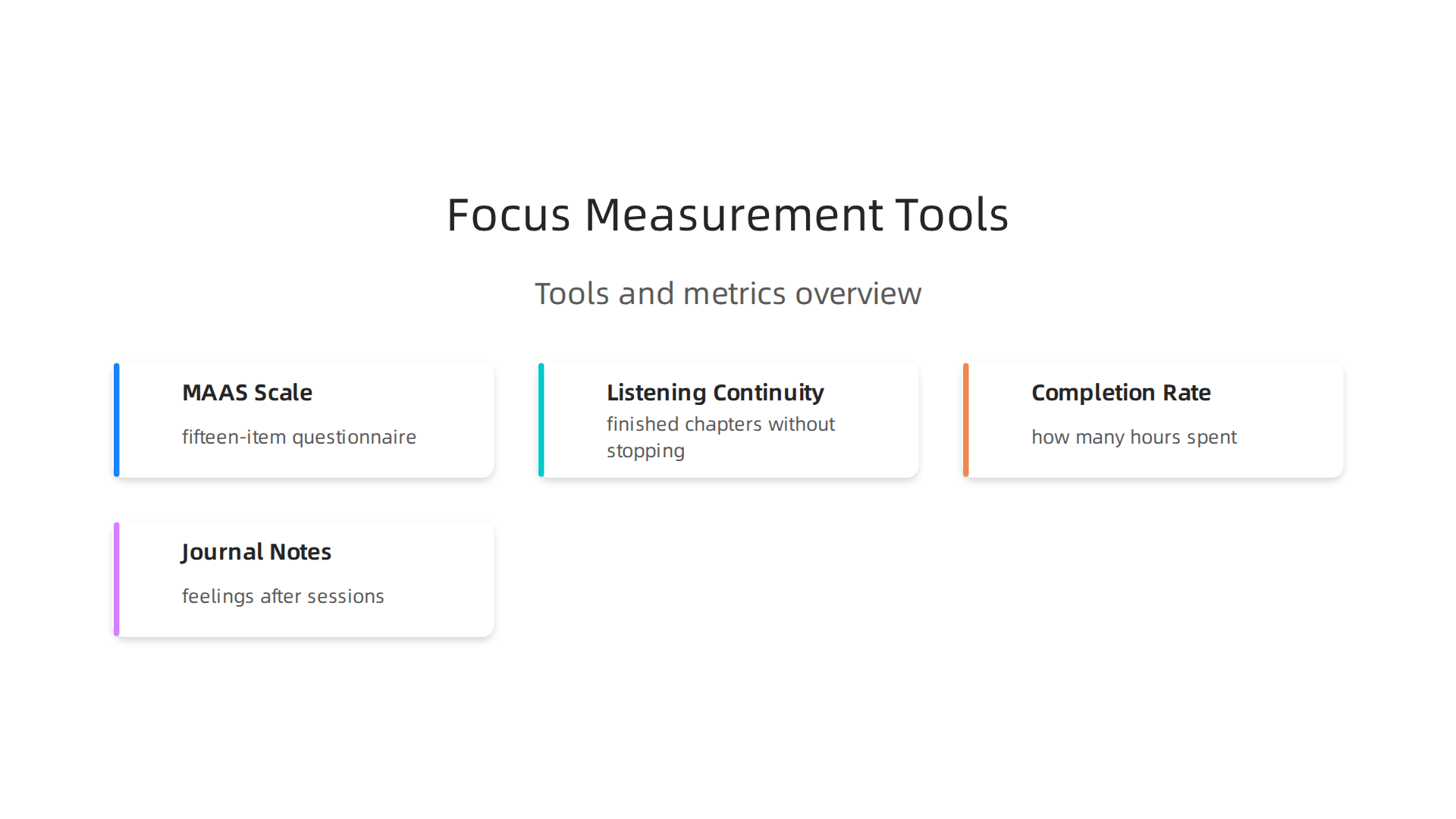
One of the most trusted ways to measure attention is the Mindfulness Attention Awareness Scale. This fifteen-item questionnaire helps you rate how often you are fully present in daily moments. You can find a free version online and take it before starting your audible books routine. Then take it again after thirty days. The change in your score tells you if your focus is improving. You can learn more about using this tool by reading about the Mindfulness Attention Awareness Scale.
Your audiobook app also gives you useful data. Look at your listening continuity. Did you finish each chapter without stopping? Check your completion rate for the month. See how many hours you spent on an audible download compared to your first week. These small numbers are strong clues about your attention endurance. Over time, a rising completion rate means your ability to stay focused is growing.
But numbers alone miss part of the picture. Try keeping a quick journal. Write down how you felt after each listening session. Did you feel restless or calm? Did your mind wander less? When you combine those personal notes with app data, you get a full view of your progress. For a simple way to log your listening habits, you can use a tool that helps you rebuild your concentration with a book tracker.
Tracking your focus does not have to be complicated. A few minutes of measuring each week gives you clear proof that your audible books habit is making a real difference.
Summary
Fractured attention is the defining cognitive challenge of today, and this article argues that audiobooks are a practical, science-backed tool to rebuild focus. Drawing on cognitive theory and 2024 neuroscience studies, it explains how listening engages working memory, reduces visual overload via dual-channel processing, and leverages narrative transportation to hold attention. The piece gives actionable routines—listen-only blocks, deliberate speed control, and post-chapter reflection—and explains which formats and narrators work best. It also warns about pitfalls like multitasking and dense nonfiction that may require repeated listening, and shows how simple metrics (app completion rates, MAAS scores, quick journals) reveal real progress. Finally, it outlines emerging attention technologies such as gamified rewards and biometric-driven narration adjustments, and points readers to practical guides and free audiobook options to get started rebuilding sustained concentration today.